On the Canadian prairies, distance has always shaped political feeling. Roads stretch for hours beneath enormous skies, passing wheat fields, oil infrastructure, and towns separated by long intervals of silence. In Alberta, geography often carries emotional meaning — a sense of self-reliance formed through resource wealth, frontier identity, and the persistent feeling that decisions made far away in Ottawa arrive like weather from another climate.
It is within this atmosphere that former central banker and political figure Mark Carney issued a stark warning about growing separatist rhetoric in Alberta, describing the prospect of the province leaving Canada as “a very dangerous bluff” that could ultimately produce the same kind of regret many associate with Brexit in the United Kingdom.
His remarks arrived as debates surrounding Alberta’s place within Canada once again surfaced through political frustration over energy policy, federal regulation, taxation, and cultural identity. Though full-scale separatist movements remain outside mainstream Canadian politics, the idea periodically gains attention during moments of heightened tension between Alberta and the federal government.
Carney’s comparison to Brexit carried symbolic weight precisely because it touched on a broader pattern visible across many democracies in recent years: the appeal of political separation during periods of economic anxiety and regional discontent, followed by the slower, more complicated realities that emerge afterward.
In Britain, the Brexit referendum unfolded through arguments about sovereignty, control, immigration, and economic independence. Years later, the consequences remain deeply debated, with supporters defending regained autonomy while critics point to trade complications, political instability, and economic friction. Carney suggested Alberta could face similarly difficult realities if frustration hardened into serious secessionist ambition.
The comparison resonates differently in Canada, where confederation itself has long depended upon balancing strong regional identities across immense geographic distances. Alberta occupies a particularly complex position within that balance. The province remains central to Canada’s energy economy, especially through oil and gas production, yet many Albertans argue that federal environmental policies and political priorities increasingly fail to reflect western economic realities.
These tensions have intensified during periods of low oil prices, pipeline disputes, and climate transition debates. Some residents view Ottawa’s policies as burdens imposed by eastern political interests, while others warn that separation rhetoric risks deepening division without offering practical solutions.
Carney’s remarks also reflected concern about how emotionally charged political narratives can oversimplify the realities of economic interdependence. Alberta’s economy remains deeply woven into Canadian institutions, trade systems, infrastructure networks, pensions, banking structures, and federal transfer arrangements. Untangling those relationships would likely involve years of negotiation and uncertainty.
Yet the emotional force behind separatist language cannot be understood purely through economics. In Alberta, the conversation often touches identity itself — questions about recognition, fairness, and whether regional priorities are heard within national decision-making. Political alienation, once established, rarely disappears through statistics alone.
Across Calgary and Edmonton, these debates unfold against the ordinary backdrop of daily life. Downtown towers reflect oil markets and global commodity cycles. Ranchland communities confront rising costs and changing industries. Young professionals discuss climate transition while older generations remember boom years that once seemed endless. The future of Alberta exists somewhere between those overlapping visions.
Canada itself has long experience navigating regional strain. Quebec sovereignty debates shaped national politics for decades, forcing repeated reflection about language, identity, and the meaning of federation. Though Alberta’s grievances emerge from different historical roots, they similarly reveal how modern nations often contain multiple emotional geographies beneath a single flag.
For Carney, invoking Brexit may have been less about predicting exact parallels and more about warning against political decisions driven by frustration without full consideration of long-term consequences. Referendums and separation movements can transform from symbolic protest into irreversible structural change with surprising speed once public anger gathers momentum.
Meanwhile, many Albertans remain focused not on independence itself but on leverage — using the language of separation to pressure Ottawa for greater autonomy, economic flexibility, or political attention. Whether that rhetoric remains symbolic or evolves into something more serious may depend on future economic conditions, federal-provincial relations, and the broader direction of Canadian politics.
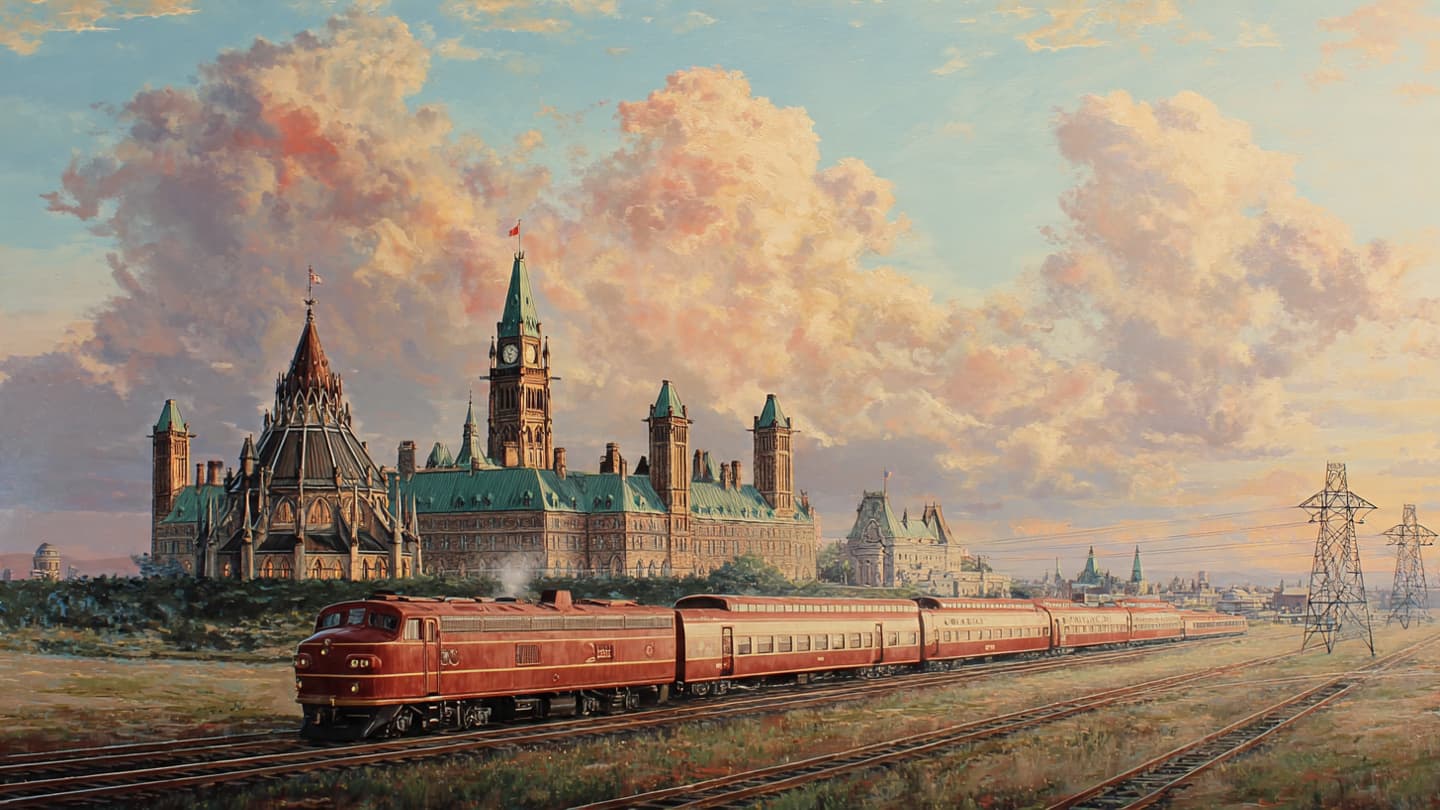
As evening settles across the prairie provinces, freight trains continue crossing vast distances beneath fading skies while pipelines and highways bind regions together in quiet physical continuity. Confederation, in many ways, is held not only through constitutions and parliaments but through those invisible systems of dependence built over generations.
And somewhere between frustration and belonging, between local identity and national structure, Canada once again confronts an old democratic question: how large countries hold together when different regions begin imagining different futures beneath the same horizon.
AI Image Disclaimer: The accompanying visuals were generated using AI tools and are intended as illustrative interpretations of the article’s themes and locations.
Sources:
Reuters CBC News The Globe and Mail BBC News Financial Times
Published by Banx Network. This article is part of the Banx decentralized media programme, powered by the BXE token on the XRP Ledger.