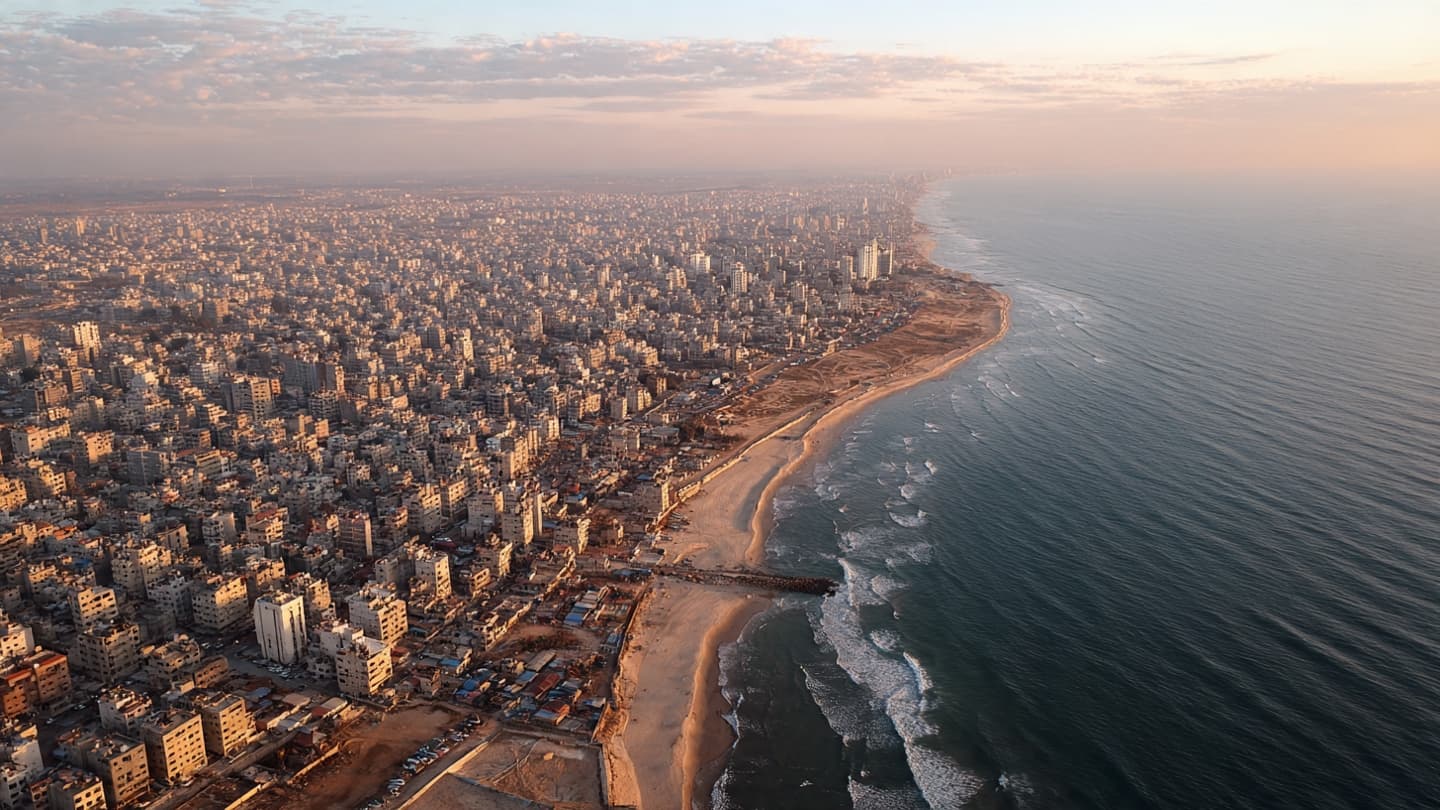
Morning arrives softly along Gaza's Mediterranean shoreline. Waves continue to reach the sand with familiar rhythm, even as neighborhoods bear the marks of years shaped by conflict. Between damaged buildings, temporary shelters, and crowded streets, everyday life continues in measured steps. In places where uncertainty has become a constant companion, even the smallest discussion about the future carries unusual weight.
Israel's security cabinet has approved the legal framework allowing a limited multinational International Stabilization Force to enter parts of Gaza under a broader ceasefire and post-conflict plan backed by the United States. According to Israeli officials, the force would operate in coordination with the Israeli military and only in designated areas outside Israel's direct military control. No deployment date has yet been announced.
The proposed force is expected to begin with approximately 200 personnel contributed by countries that agree to participate, with each deployment requiring Israeli approval. Its mission is intended to support stabilization efforts, assist humanitarian operations, and contribute to security during a transitional period as civilian administrative structures are gradually established.
The initiative forms part of a wider framework that envisions a Palestinian technocratic administration, expanded humanitarian assistance, reconstruction efforts, and the eventual withdrawal of Israeli forces from parts of Gaza, alongside the disarmament of Hamas. While these objectives outline a possible path forward, several elements of the broader plan remain unresolved, and implementation has progressed only gradually.
For many residents of Gaza, discussions about international stabilization are inseparable from more immediate concerns. Access to food, medical care, clean water, electricity, and secure shelter continues to shape daily life. Families rebuilding routines after years of conflict often measure progress not by diplomatic announcements alone but by whether schools reopen, hospitals function, and neighborhoods regain a sense of ordinary rhythm.
The proposal has also generated differing reactions among political leaders and observers. Supporters argue that a multinational presence could help improve security, facilitate humanitarian assistance, and support future governance during a fragile transition. Critics, however, question how such a force would operate amid unresolved political disagreements and whether lasting stability can be achieved without a broader negotiated settlement involving all major stakeholders.
History offers many examples of international stabilization missions, each shaped by its own circumstances and challenges. Their effectiveness has often depended not only on military coordination but also on political consensus, local participation, and sustained international support. Gaza's circumstances are uniquely complex, suggesting that any multinational mission would face significant operational and diplomatic responsibilities from its first day.
Across the region, governments and humanitarian organizations continue watching developments with cautious attention. Every proposal carries hopes of reducing suffering while also raising practical questions about implementation, oversight, and long-term governance. In places emerging from prolonged conflict, rebuilding institutions often proves as demanding as rebuilding infrastructure.
For now, Israel's cabinet approval represents an initial legal step rather than the beginning of deployment. Much remains to be negotiated before an international stabilization force becomes operational. Along Gaza's coastline, where the sea continues its patient rhythm despite years of upheaval, the future remains unwritten—resting not only on agreements reached in meeting rooms, but also on whether lasting security, humanitarian recovery, and political understanding can gradually take root.
AI Image Disclaimer
These illustrations were generated using AI to provide conceptual visual context and are not authentic documentary photographs.
Sources
Reuters Associated Press United Nations The Times of Israel Reuters Graphics
Published by Banx Network. This article is part of the Banx decentralized media programme, powered by the BXE token on the XRP Ledger.