
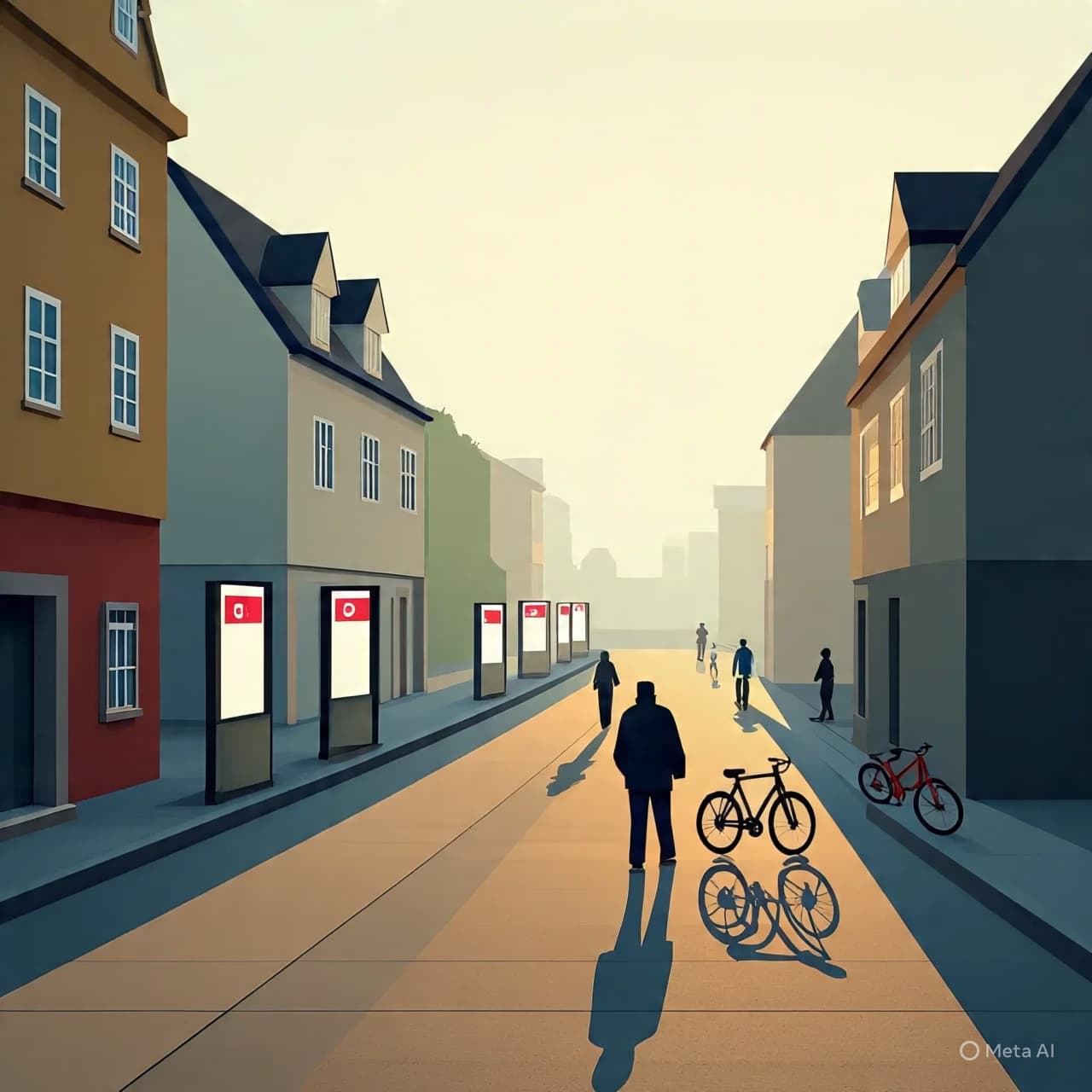
The light in Denmark arrives gently, especially in the early hours—soft over harbor waters, catching on rows of bicycles, settling into streets where movement feels measured rather than rushed. In this quiet unfolding, the act of voting becomes less a spectacle and more a continuation of civic rhythm, a familiar gesture repeated across time.
Yet this election carries a different undercurrent, one that stretches far beyond Denmark’s immediate horizon. The ballots are cast within a context shaped not only by domestic concerns, but by the distant echo of an earlier idea—voiced by Donald Trump—regarding the potential acquisition of Greenland. What once seemed an improbable suggestion has lingered, reframing how territory, sovereignty, and global interest intersect in the northern reaches of the world.
Greenland itself exists in a space both physical and symbolic—vast, sparsely populated, and increasingly central to conversations about climate, resources, and strategic positioning. Its ice, long perceived as immutable, has begun to shift, revealing not only environmental change but new possibilities for access and influence. For Denmark, the relationship with Greenland is both administrative and historical, shaped by autonomy arrangements and ongoing dialogue about the future.
As voters move through polling stations, these broader considerations form a quiet backdrop to more immediate concerns: economic policy, social welfare, governance. Yet the presence of Greenland in the international imagination—sparked in part by Trump’s remarks—adds a layer of reflection that is difficult to fully separate from the domestic conversation.
Political leaders in Denmark have responded to this dynamic with a measured tone, emphasizing sovereignty while acknowledging the growing attention directed toward the Arctic. The idea that an external power might express interest in acquiring territory, even rhetorically, has prompted a subtle recalibration of how such relationships are discussed in public and diplomatic spaces.
Meanwhile, in Greenland, the conversation carries its own distinct resonance. Local leadership and communities continue to navigate questions of autonomy, economic development, and environmental stewardship. The island’s future is not defined solely by external interest, but by internal priorities that unfold within its unique cultural and geographic context.
The election, then, becomes a moment where these threads briefly converge. It is not defined by Greenland alone, nor by Trump’s past statements, but these elements shape the atmosphere in which decisions are made. They remind voters that even in a relatively small nation, political choices can be influenced by forces that originate far beyond national borders.
Across Denmark, the process remains calm, orderly, almost understated. Ballots are counted, results begin to take shape, and the familiar mechanisms of democracy proceed with quiet efficiency. Yet within this calm, there is an awareness—subtle but present—of a world in which geography and geopolitics are becoming more closely intertwined.
As the day draws to a close, the facts settle into place. Danes have voted in a national election, one conducted under the shadow of renewed international attention on Greenland, sparked in part by Donald Trump’s earlier ambitions. The outcome will determine the direction of governance, but it will also sit within a broader context that continues to evolve.
For now, the light fades over Copenhagen and beyond, and the rhythm of the country resumes. But somewhere to the north, across vast stretches of ice and sea, the questions that hovered over this election remain—quiet, persistent, and still unfolding.
AI Image Disclaimer Visuals are AI-generated and serve as conceptual representations.
Sources Reuters BBC News The Guardian Politico Europe DR News
Published by Banx Network. This article is part of the Banx decentralized media programme, powered by the BXE token on the XRP Ledger.
.jpg&w=3840&q=75 "Blake Lively Awarded $400,000 in Legal Fees After Justin Baldoni Lawsuit Dismissed")

