When we think of melting ice, we often imagine the sun beating down on a glacier, a visceral image of atmospheric warmth. Yet, beneath the surface of the polar seas, a quieter, more potent force is at work. It is the ocean itself, with its vast reservoirs of heat, that is increasingly becoming the primary agent in the dismantling of the world’s ice sheets.
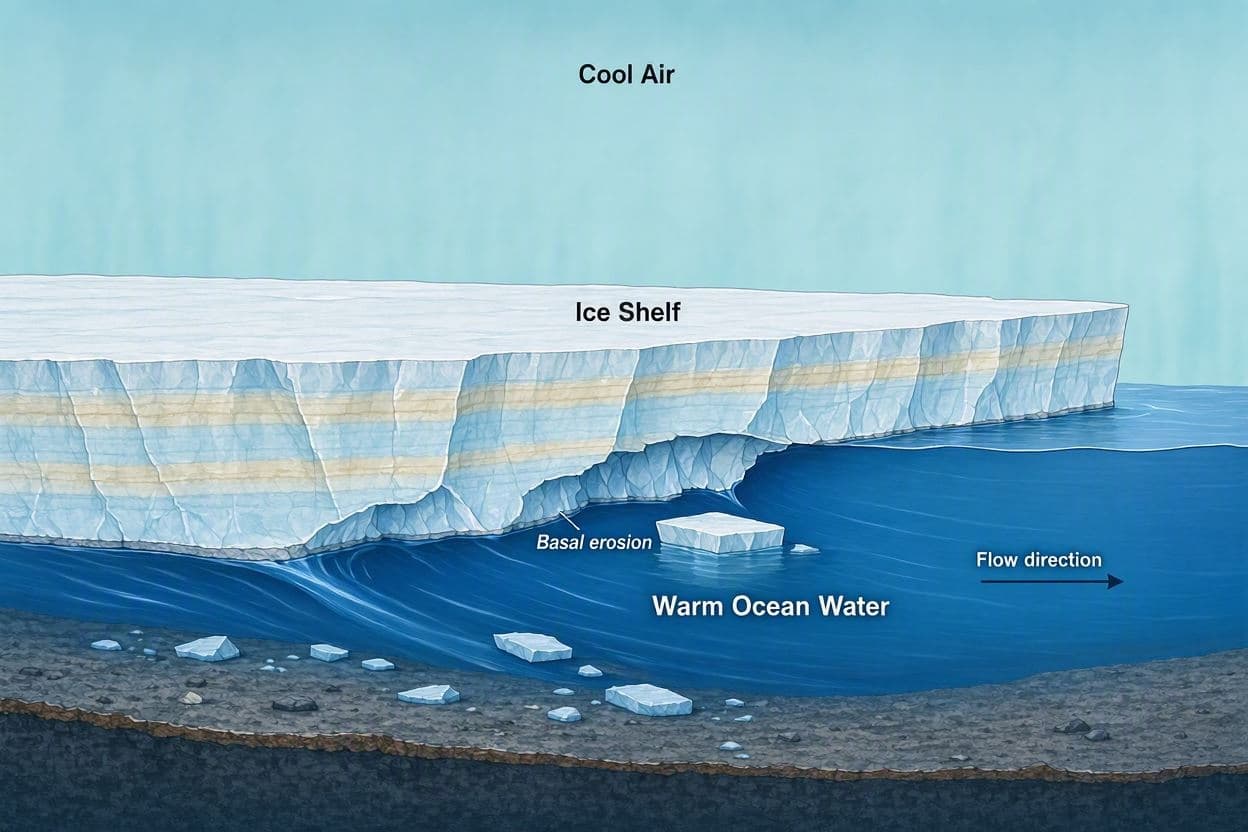
Recent climate research has shifted focus from air temperature to ocean thermal forcing as the dominant driver of ice loss in Antarctica and Greenland. While rising air temperatures contribute to surface melting, particularly in the Arctic, the destabilization of massive ice shelves is largely driven by warm circumpolar deep water flowing beneath them. This subsurface warmth erodes the ice from below, weakening its structural integrity and accelerating its flow into the sea.
In Antarctica, where the majority of the world’s ice is stored, the atmosphere remains cold enough to prevent significant surface melt in many regions. However, the ocean currents surrounding the continent are warming due to global climate change. As these warmer waters reach the grounding lines—the points where ice sheets meet the bedrock—they cause rapid basal melting. This process undermines the ice shelves that act as buttresses, holding back the inland ice.
The implications for sea-level rise are profound. Ice lost to the ocean contributes directly to rising seas, threatening coastal communities worldwide. Unlike surface melt, which can sometimes refreeze or be offset by snowfall, basal melting represents a permanent loss of mass from the ice sheet. The rate of this loss has accelerated in recent decades, outpacing earlier projections and raising alarms among climate scientists.
Understanding this mechanism requires sophisticated modeling and direct observation. Scientists use autonomous underwater vehicles and satellite altimetry to measure changes in ice thickness and ocean temperature. These tools reveal a complex interplay between wind patterns, ocean circulation, and ice dynamics. For instance, changes in wind can push warm water closer to the ice shelves, triggering episodes of rapid retreat.
The distinction between atmospheric and oceanic drivers is crucial for policy and adaptation strategies. Mitigation efforts must address not only carbon emissions that warm the air but also those that heat the oceans. The ocean absorbs over 90 percent of the excess heat trapped by greenhouse gases, making it a critical component of the climate system that cannot be ignored.
As research continues, the focus is shifting toward predicting tipping points. Certain glaciers, such as Thwaites in West Antarctica, are particularly vulnerable to ocean-driven melt. If these glaciers collapse, they could trigger a cascade of ice loss from the interior of the continent. Understanding the role of the ocean is key to forecasting these scenarios and preparing for their consequences.
The message is clear: saving the ice sheets requires looking beneath the waves. As the ocean continues to warm, the race to understand and mitigate its impact on polar ice becomes ever more urgent for the stability of our global climate.
AI Image Disclaimer: The images associated with this article are AI-generated visualizations created to illustrate the themes of ocean warming and ice sheet dynamics.
Sources: Nature Climate Change, NASA Earth Observatory, NOAA, The Guardian
Published by Banx Network. This article is part of the Banx decentralized media programme, powered by the BXE token on the XRP Ledger.