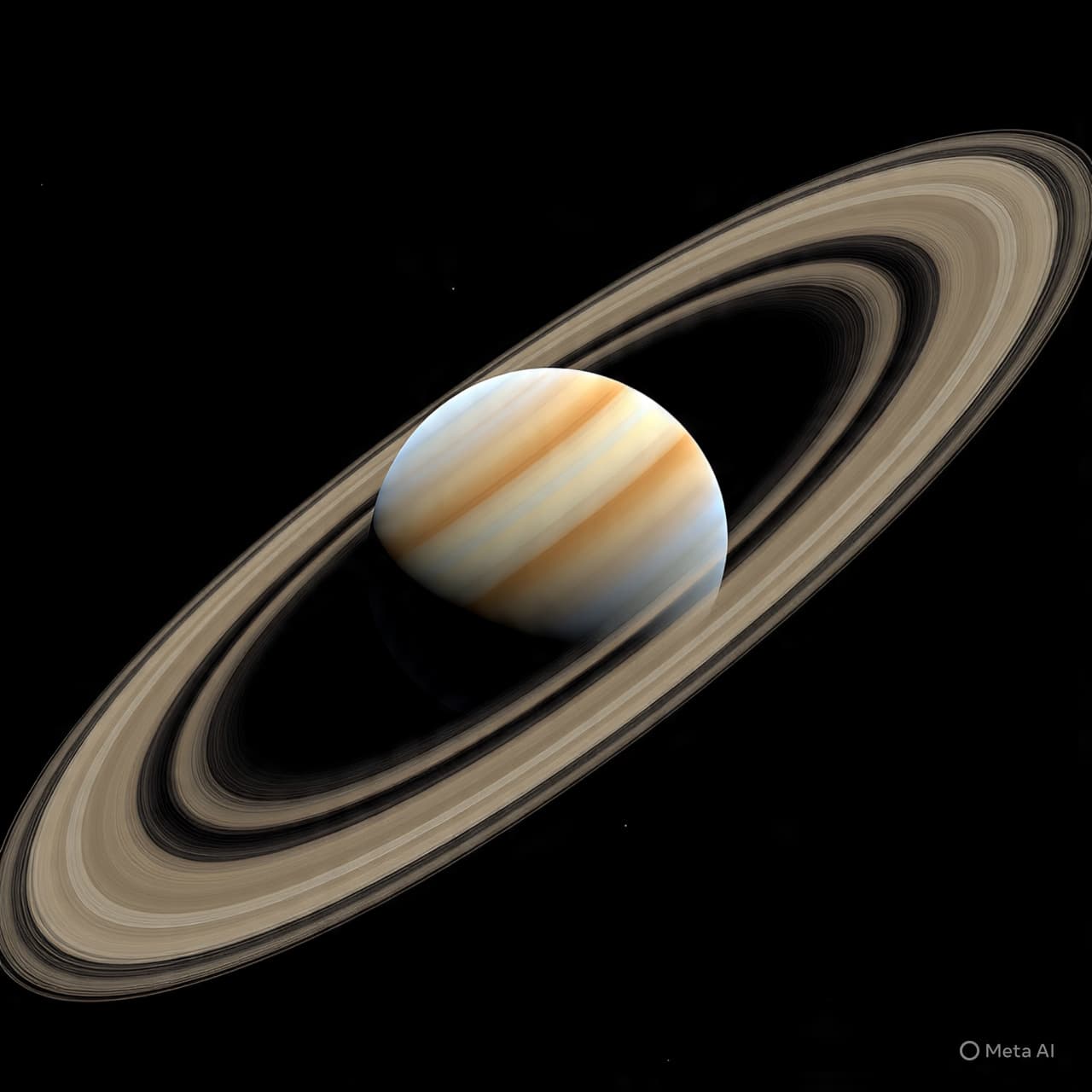
Far beyond the blue hush of Earth’s atmosphere, where sunlight thins into a distant shimmer, turns in stately silence. Its rings, luminous and improbably delicate, have long seemed like ornaments suspended in vacuum — a celestial flourish against the dark. But recent research suggests that those rings, and perhaps even the planet’s largest moon, may be the remnants of something more violent: the disappearance of a lost moon.
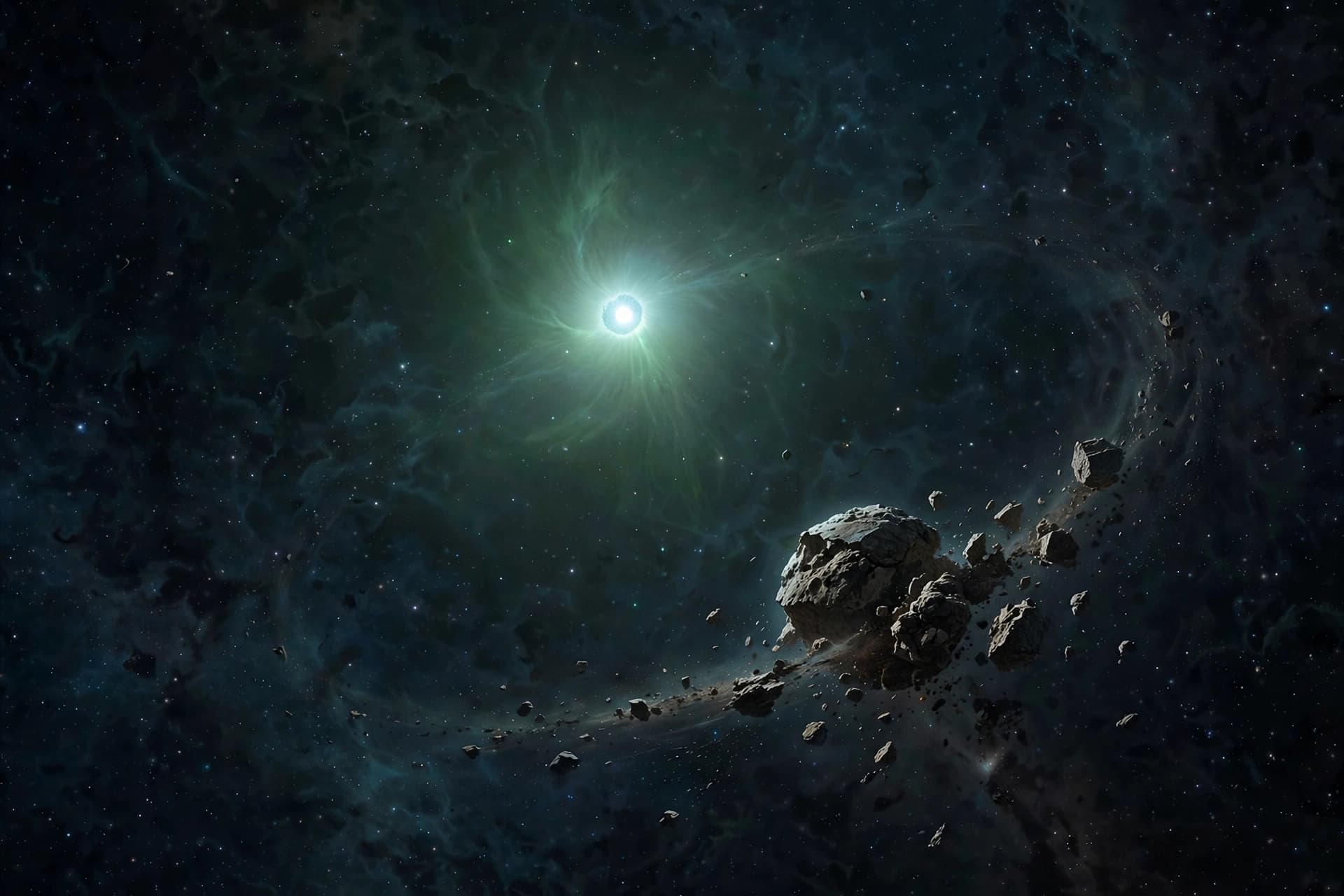
Scientists studying the orbital dynamics of and the structure of Saturn’s rings have proposed that a colossal moon merger could lie behind the system’s current configuration. According to this hypothesis, an ancient moon once orbited Saturn before gravitational forces drew it inward. As tidal interactions intensified, that moon may have been torn apart or collided with another satellite, scattering debris into orbit. Over time, that debris could have coalesced into the bright rings now visible from Earth, while Titan emerged as a battered survivor of the upheaval.
Titan itself is no minor fragment. Larger than the planet Mercury, it possesses a thick nitrogen-rich atmosphere and surface lakes of liquid methane and ethane. Observations from missions such as have revealed a world both alien and strangely Earth-like in its complexity. Yet Titan’s slightly unusual orbital tilt and distance from Saturn have puzzled astronomers for decades. The new modeling work suggests that these characteristics could be explained by the gravitational aftershocks of a moon-shattering event.
Saturn’s rings, too, carry clues. Though they appear ancient, some studies indicate they may be relatively young in cosmic terms — perhaps only a few hundred million years old. Their mass and composition hint at an origin in icy satellite material rather than primordial leftovers from the planet’s formation. If a former moon drifted too close to Saturn’s Roche limit — the threshold at which tidal forces overcome structural cohesion — it might have fragmented spectacularly, seeding the rings in the process.
The idea reframes Saturn’s serene beauty as the outcome of turbulence. Planetary systems are not static sculptures but evolving arrangements shaped by collision, migration, and gravitational negotiation. Moons can spiral inward or outward over eons, nudged by tidal exchanges of energy. In this case, researchers suggest that Titan may have migrated outward while another moon met its end, reshaping the balance of the system.
Such theories rely on complex simulations and the reinterpretation of data gathered over years. The Cassini mission, which orbited Saturn from 2004 to 2017, provided detailed measurements of the planet’s gravity field and ring mass. Those measurements continue to fuel new hypotheses, long after the spacecraft’s deliberate plunge into Saturn’s atmosphere marked the mission’s end.
There is, as yet, no definitive proof of the lost moon. Planetary science often advances through converging lines of evidence rather than singular discoveries. Competing models persist, and further analysis will refine or challenge the merger scenario. But the proposal offers an elegant explanation for two enduring mysteries: the origin of Saturn’s luminous rings and Titan’s distinctive orbit.
In the quiet mathematics of orbital mechanics, catastrophe and creation often share the same equation. A moon’s destruction can become a planet’s adornment; a collision can yield a survivor. From Earth, Saturn remains a symbol of balance and symmetry, its rings encircling it like a halo. Yet hidden within that symmetry may be the memory of an ancient upheaval — a reminder that even the most graceful forms in the cosmos are shaped by forces both patient and profound.
Published by Banx Network. This article is part of the Banx decentralized media programme, powered by the BXE token on the XRP Ledger.