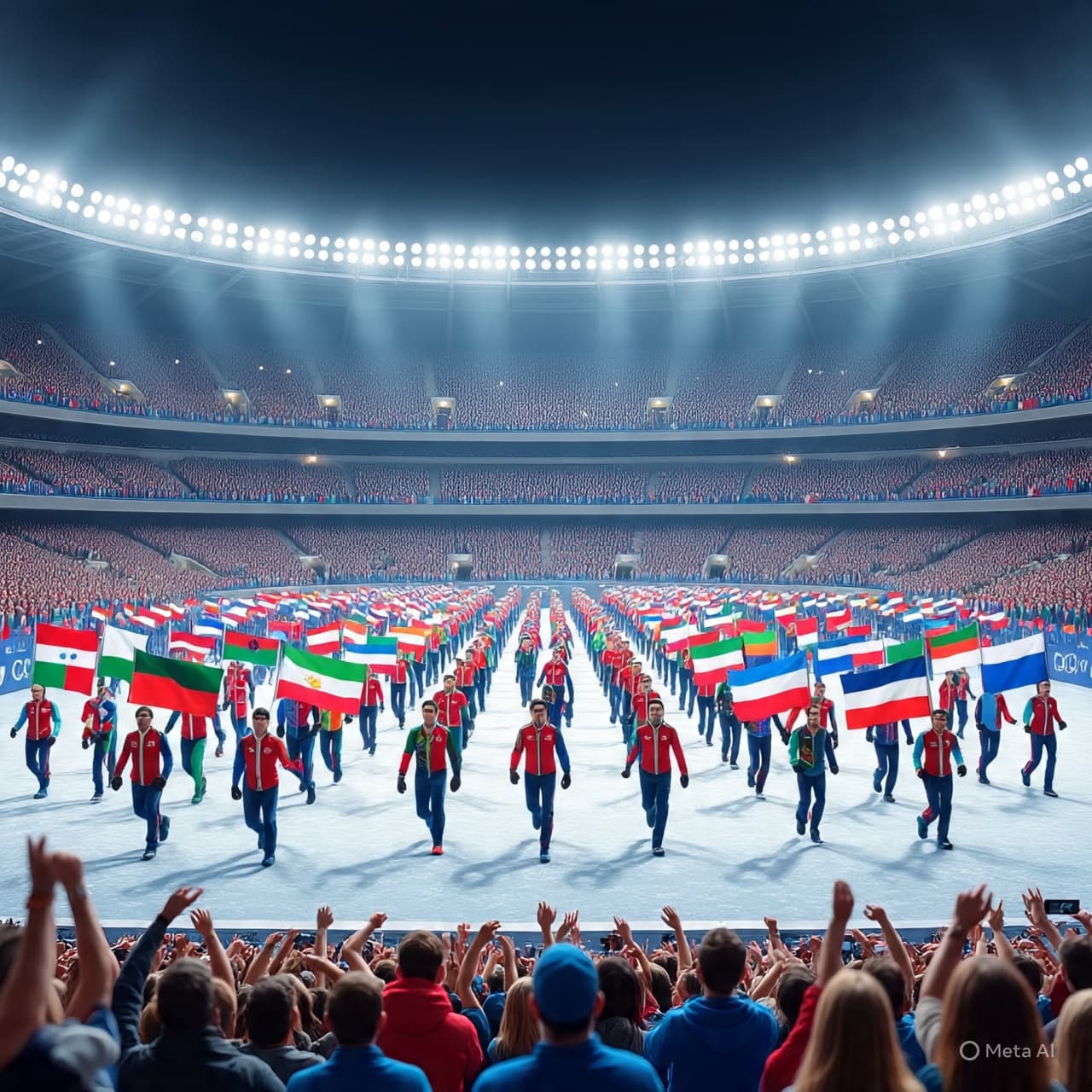
Opening ceremonies have a language of their own. Flags rise in careful choreography, athletes step forward beneath stadium lights, and the world pauses — if only briefly — to watch nations gather not in conflict, but in ceremony. In that luminous procession, even the smallest gestures can carry unexpected weight.
At a recent Winter Olympics opening ceremony, a moment unfolded that quietly drew global attention. A Russian woman, serving in an official role during the parade of athletes, carried the team placard for Ukraine as its delegation entered the stadium. In another season, such a detail might have passed unnoticed. In the current climate, it resonated more deeply.
Since the escalation of war between Russia and Ukraine, sporting events have existed under a different kind of spotlight. International competitions — including the Winter Olympic Games — have sought to maintain traditions of neutrality and unity, even as geopolitical tensions remain close to the surface. Against that backdrop, the image of a Russian national holding Ukraine’s placard was interpreted by some as symbolic, by others as procedural.
Organizers clarified that placard bearers are typically volunteers or event staff assigned without political intent. The role is logistical, part of the structured sequence that allows each delegation to enter in order. Yet symbols are rarely confined to logistics. In times of conflict, they often gather meanings beyond their design.
The Ukrainian team proceeded through the stadium as planned, athletes waving to the crowd beneath their national colors. Observers noted the composure of the delegation, mindful of the larger realities unfolding beyond the arena. For many Ukrainian athletes, participation in international sport has carried an additional emotional dimension in recent years, representing both continuity and resilience.
The Russian woman’s participation as a placard bearer was not accompanied by public commentary from her during the ceremony. Olympic organizers emphasized that the selection of volunteers follows operational criteria, and that the Games remain committed to principles of inclusion and neutrality as defined by the International Olympic framework.
International reactions were measured. Some commentators viewed the image as a reminder that individuals and institutions can operate separately from state-level disputes. Others pointed to the complexities inherent in staging global events during periods of war. The Olympics, long described as a forum for peaceful competition, inevitably reflect the era in which they occur.
In recent cycles, governing bodies have navigated sensitive questions regarding athlete eligibility, flags, and anthems. Decisions about representation and participation have required careful balancing between sporting regulations and geopolitical realities. Within that context, even ceremonial roles have attracted scrutiny.
Still, the opening ceremony continued in its customary rhythm. Nations entered, music swelled, and the Olympic flame prepared to burn once more. For viewers around the world, the fleeting image of a Russian volunteer carrying Ukraine’s placard became part of a broader narrative — one that blends symbolism, protocol, and the enduring aspiration for sport to transcend division.
Organizers have not indicated any change in procedures following the ceremony. Officials reiterated that volunteers are assigned roles without political consideration. The Games proceed according to schedule, with competitions underway and delegations participating as registered.
In the bright theater of the opening night, a simple act of carrying a sign reminded many that even in divided times, global gatherings continue — layered, complex, and closely watched.
AI IMAGE DISCLAIMER Illustrations were produced with AI and serve as conceptual depictions.
SOURCE CHECK
Credible coverage found in:
Reuters BBC The Guardian Associated Press The New York Times
Published by Banx Network. This article is part of the Banx decentralized media programme, powered by the BXE token on the XRP Ledger.