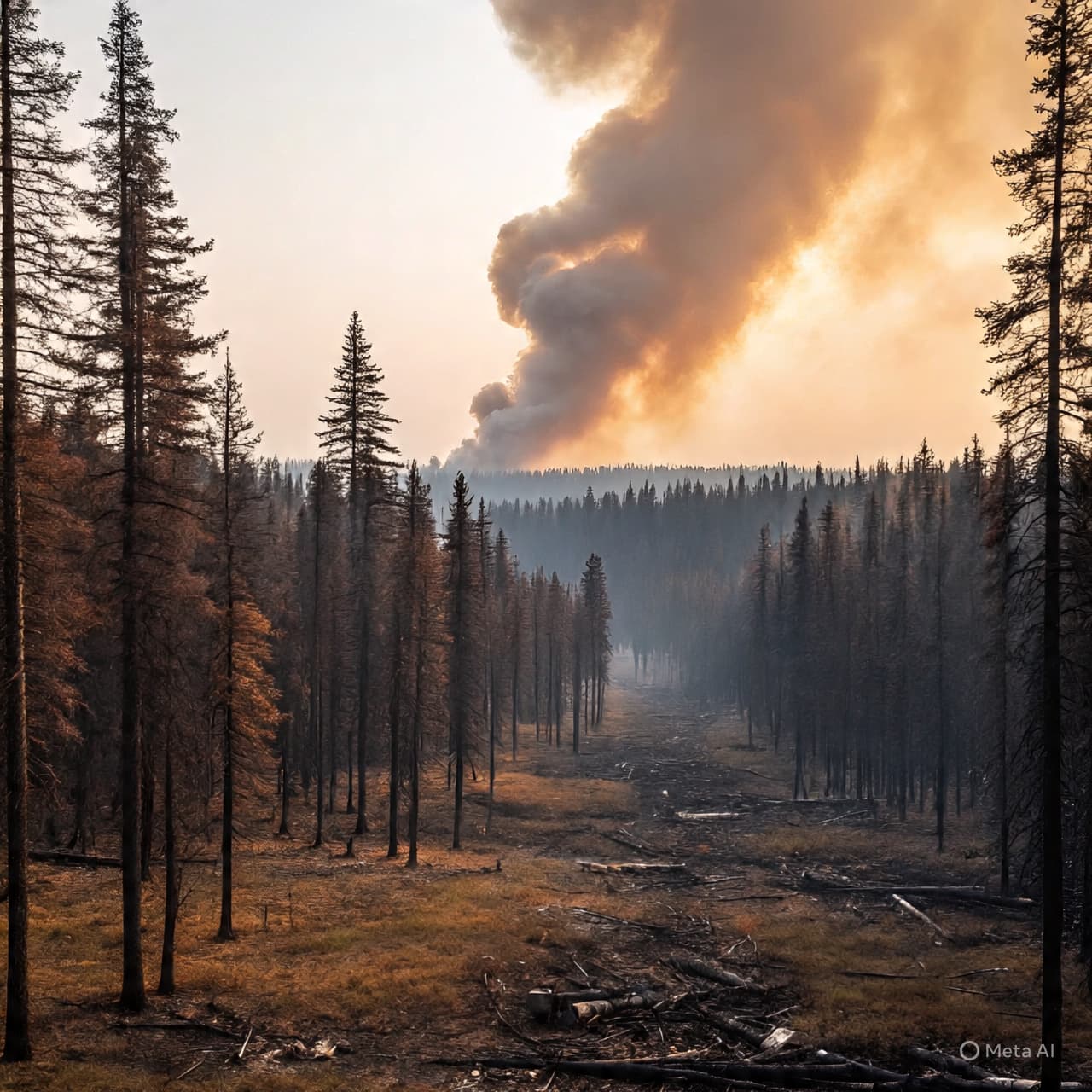
In the far northern latitudes, where forests stretch in dark green bands across Canada and Siberia, fire has always been part of the story. Lightning strikes, dry summers, and time itself have long shaped the boreal landscape. Yet in recent years, the flames seem to linger longer, burn hotter, and reach deeper into soils that once remained undisturbed. The smoke rises quietly into vast skies, dispersing across continents. And within that smoke lies a question that climate scientists are now asking with renewed urgency: are we counting all that it carries?
Boreal forests store enormous amounts of carbon—not only in trees but in the peat-rich soils beneath them. These soils have accumulated organic matter over centuries, even millennia, preserved in cold conditions that slow decomposition. When wildfires ignite and penetrate deeply into this ground layer, they can release carbon that has been locked away far longer than the lifespan of a single forest generation.
Recent studies suggest that current climate models may underestimate these emissions. Traditional modeling frameworks often focus on above-ground biomass—trees and vegetation that visibly burn. But boreal wildfires can smolder underground, consuming peat and organic soils in ways that are more difficult to detect and measure. Satellite imagery captures the scale of flames and smoke plumes, yet it may not fully reveal how much carbon is released from the soil itself.
The distinction matters. Carbon emitted from surface vegetation can, in theory, be reabsorbed as forests regrow. Soil carbon, however, represents long-term storage. When it is released, it adds to atmospheric concentrations in a way that may not be quickly offset. In this sense, boreal fires do not merely reset a forest cycle; they may alter the broader carbon balance.
Climate models rely on assumptions—carefully constructed, scientifically grounded, yet still dependent on available data. If wildfire emissions are higher than estimated, projections of future warming could be subtly but significantly affected. The boreal region, spanning parts of Canada, Alaska, and northern Eurasia, represents one of the planet’s largest terrestrial carbon reservoirs. Small percentage changes in emission estimates there can translate into meaningful shifts globally.
There is also a feedback loop to consider. Rising temperatures increase the likelihood of intense wildfires. In turn, larger fires release more carbon, which contributes to further warming. The cycle does not unfold dramatically in a single season, but gradually, through compounding effects. Researchers are now working to refine fire-emission datasets, incorporating improved satellite monitoring and ground-based measurements to better quantify soil carbon loss.
At the same time, scientists emphasize nuance. Climate models are continuously updated, and uncertainty ranges are built into projections. The suggestion that emissions may be underestimated does not invalidate existing frameworks; rather, it highlights areas where understanding is still evolving. The complexity of boreal ecosystems—interwoven layers of trees, mosses, permafrost, and peat—resists simple accounting.
Communities across high-latitude regions have already witnessed unprecedented fire seasons in recent years. Beyond carbon metrics, these events carry immediate consequences for air quality, biodiversity, and livelihoods. The global climate conversation, however, increasingly recognizes that what burns in the north does not remain there. Atmospheric currents distribute the effects widely, linking remote forests to distant cities.
In closing, researchers continue to assess how boreal wildfire emissions are represented in leading climate models. Ongoing field studies and satellite analyses aim to narrow the gap between observation and projection. While uncertainties remain, the emerging evidence suggests that the carbon story of northern fires may be larger than previously assumed. As models are refined, policymakers and scientists alike will look to this data to inform future climate strategies. For now, the boreal forests stand as both witness and participant in a changing climate—quiet expanses whose flames may carry more weight than once believed.
AI Image Disclaimer Illustrations were produced with AI and serve as conceptual depictions.
Sources Nature Science The Guardian BBC Reuters
Published by Banx Network. This article is part of the Banx decentralized media programme, powered by the BXE token on the XRP Ledger.