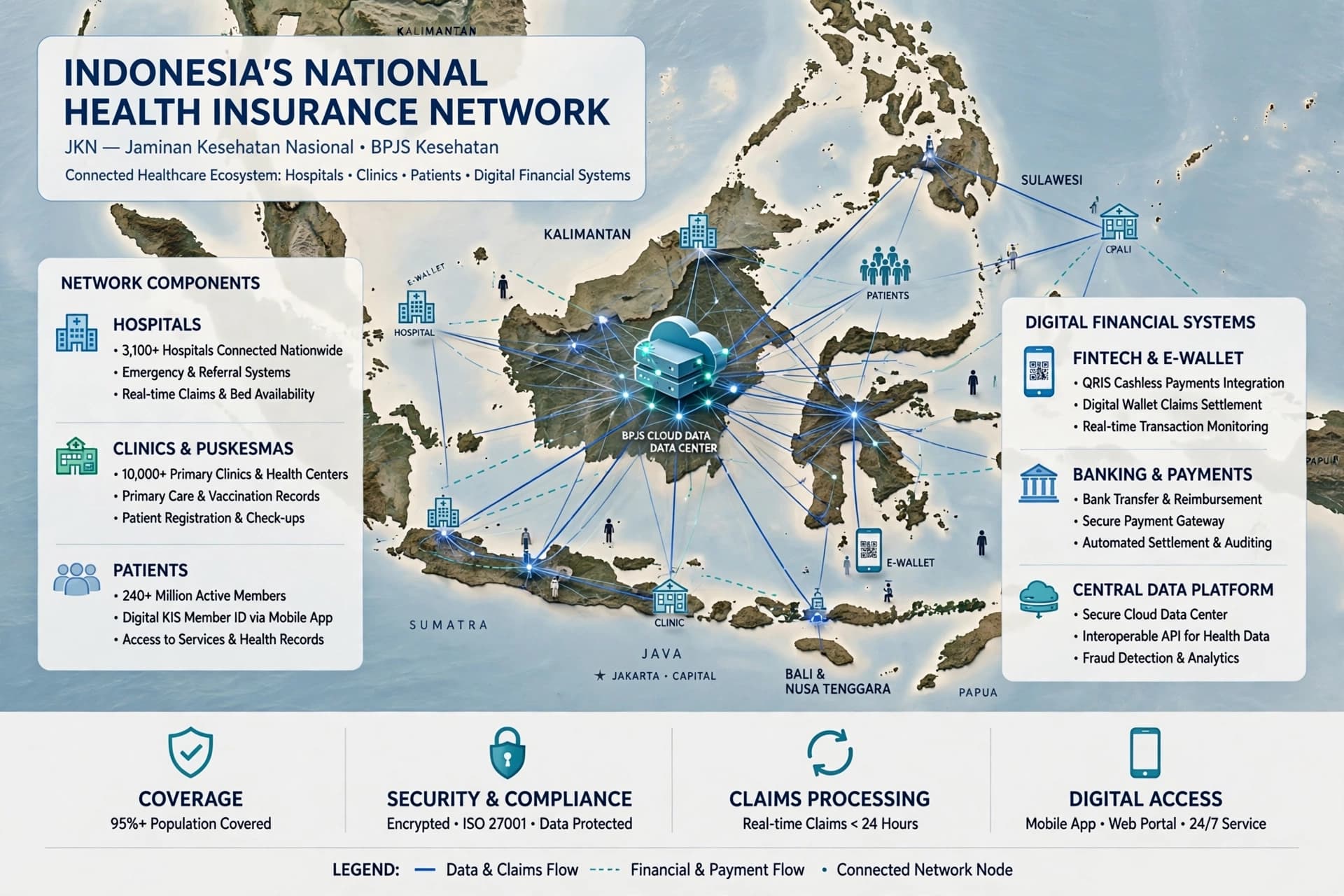
A national health system is built from thousands of ordinary moments: a patient entering a clinic, a prescription being filled, a hospital bill being processed. Behind those moments lies another system, quieter but equally important—the flow of money that keeps care available.
Indonesia’s government plans to inject Rp20 trillion, or about $1.11 billion, into BPJS Kesehatan to help the state health insurer cover its expected 2026 deficit. The funds are scheduled to be provided in October and November from the existing state budget.
BPJS Kesehatan covers about 285 million people, making it one of the world’s largest single-payer health insurance systems by membership. Its size means that relatively small changes in medical spending, contributions or reimbursement patterns can translate into large financial movements.
The immediate pressure can be seen in the agency’s 2026 figures. According to a government statement cited by Reuters, BPJS Kesehatan had collected Rp118 trillion in revenue while paying Rp132 trillion in medical claims during the year to date.
That difference does not describe the entire financial structure of the national insurance program, but it illustrates the gap that authorities are addressing through the additional funding. The government’s injection is intended to provide financial support while the program continues serving a population spread across Indonesia’s provinces and islands.
The scale of BPJS Kesehatan also makes its finances closely connected with everyday healthcare. Its members include people seeking treatment at hospitals, visiting primary-care facilities and obtaining medicines through the national insurance network.
The planned injection is not being presented as a new insurance benefit or a change in patient eligibility. Rather, it is a fiscal measure aimed at supporting the insurer’s ability to meet its obligations during the 2026 financial year.
The timing is also notable. The funds are expected to be transferred during October and November, using resources already contained within the 2026 state budget rather than relying on a newly created financing mechanism. Finance Minister Suahasil Nazara was quoted by Reuters as saying the government would use existing budget funds.
For a health insurance system of this size, financial sustainability depends on more than a single injection. Contributions, medical utilization, reimbursement rates, hospital costs, medicine prices and the broader design of healthcare financing all influence the balance between money entering the system and money leaving it.
The government’s decision therefore places the immediate focus on stability while leaving the longer-term financial dynamics of BPJS Kesehatan to continue evolving. The size of the membership means that the question is ultimately larger than an accounting figure: it concerns the financial foundation beneath one of Indonesia’s most widely used public services.
For patients, those financial calculations remain mostly invisible. What matters at the point of care is whether coverage functions when treatment is needed. Behind that simple expectation, however, BPJS Kesehatan continues to operate a vast financial and administrative network, now receiving another substantial injection as Indonesia works to keep that system moving.
Published by Banx Network. This article is part of the Banx decentralized media programme, powered by the BXE token on the XRP Ledger.