There are moments in exploration when the most important discoveries are not distant worlds or brilliant stars, but practical solutions to simple questions. For future explorers on the Moon, one such question carries enormous weight: how do you bring enough fuel to travel farther into space without launching every drop from Earth?
For decades, engineers and scientists have imagined a different approach—one where astronauts produce what they need directly from the landscapes they explore. If the Moon holds water in its coldest shadows, perhaps it could also become a place where rocket fuel is made rather than merely consumed.
With that idea in mind, researchers at NASA are testing a new cryogenic system designed to help produce and store rocket propellant using resources found on the Moon itself. The technology represents a step toward a future where lunar missions may rely less on Earth and more on the materials already waiting in space.
The concept is part of a broader effort known as in-situ resource utilization, often abbreviated as ISRU. Instead of transporting large quantities of supplies from Earth, missions would extract useful substances—such as water, oxygen, and hydrogen—from local environments.
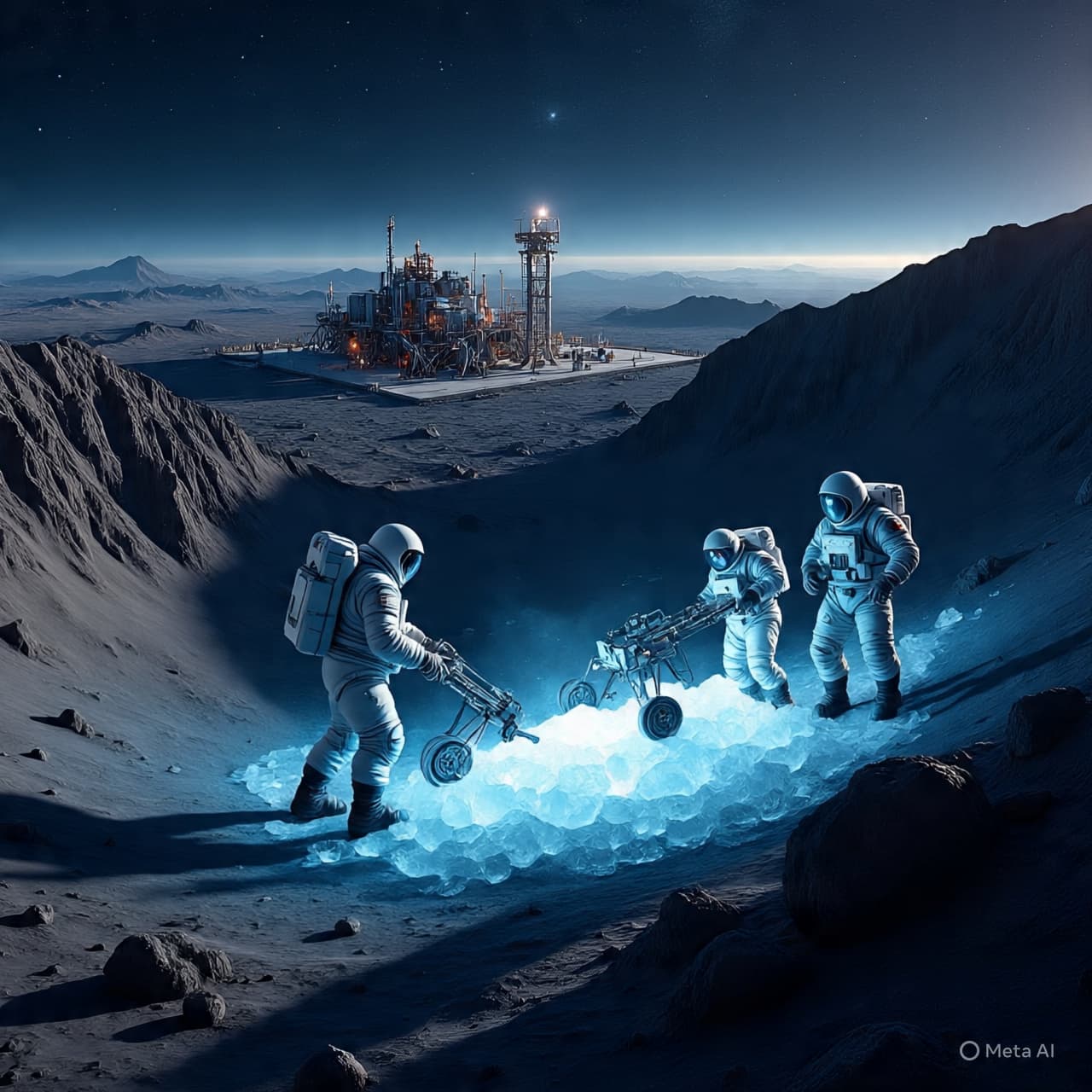
On the Moon, the most promising resource lies hidden within permanently shadowed craters near the poles. These regions never receive direct sunlight, allowing water ice to remain frozen for billions of years. Spacecraft observations over the past two decades have provided growing evidence that such deposits exist in significant quantities.
If harvested successfully, that ice could be transformed into rocket propellant.
Water molecules consist of hydrogen and oxygen, the same elements used in many modern rocket fuels. Through a process called electrolysis, electricity can split water into these two gases. When stored as extremely cold liquids—liquid hydrogen and liquid oxygen—they form one of the most efficient propellant combinations used in spaceflight.
The challenge lies not only in producing these gases, but also in storing them safely in the harsh lunar environment. Cryogenic fuels must remain at extremely low temperatures. Even small amounts of heat can cause them to boil away, leading to loss of valuable propellant.
NASA’s cryogenic testing system is designed to address this challenge. Engineers are experimenting with technologies capable of producing, liquefying, and storing hydrogen and oxygen under conditions similar to those expected on the Moon.
These experiments help scientists understand how long such fuels could remain stable, how systems might operate in extreme cold, and how energy requirements would affect lunar infrastructure.
If successful, the approach could fundamentally reshape how space missions are planned.
Instead of launching every kilogram of fuel from Earth’s gravity well—a costly and technically demanding task—future spacecraft might refuel on the Moon before heading deeper into the solar system. In this way, the Moon could become a kind of cosmic fueling station, supporting journeys to destinations such as Mars or asteroids.
The idea also aligns with broader goals within the Artemis program, which aims to establish a sustained human presence on and around the Moon. Producing fuel locally could make long-term missions more practical by reducing the amount of material that must be transported from Earth.
Yet the path from laboratory testing to lunar operations remains complex. Engineers must design systems capable of functioning in extreme temperature swings, lunar dust, and low gravity. Power generation, likely through solar arrays or nuclear systems, will also play a crucial role in supporting fuel production.
Still, each new experiment helps refine the technologies that might one day support human activity beyond Earth.
The cryogenic tests currently underway represent one small but meaningful step in that process. By studying how rocket fuel can be created and preserved using extraterrestrial resources, researchers are laying groundwork for a future in which exploration becomes more self-sufficient.
For centuries, explorers crossing oceans carried everything they needed aboard their ships. In time, they learned to rely on the resources of distant shores. Space exploration may follow a similar path.
As NASA continues testing these cryogenic systems, the vision of producing rocket fuel on the Moon moves gradually from concept toward possibility—an idea that could help humanity travel farther into the solar system than ever before.
AI Image Disclaimer Images in this article are AI-generated illustrations, meant for concept only.
Sources NASA SpaceNews Space.com Phys.org ScienceDaily
Published by Banx Network. This article is part of the Banx decentralized media programme, powered by the BXE token on the XRP Ledger.