For much of human history, gravity has stood as a quiet, dependable force — the reason keys fall to the floor and oceans cling to shorelines. Yet deep beneath the frozen expanse of Antarctica, gravity itself has a story to tell, one unwinding over tens of millions of years. In a remarkable blend of geology, climate science, and geophysics, researchers have uncovered that the mysterious “gravity hole” beneath the southern continent — a region where gravity is measurably weaker than elsewhere on Earth — has been quietly growing stronger over geological time. This insight challenges our everyday sense of gravity’s constancy and invites us to ponder how Earth’s deep interior and surface processes might be intertwined.
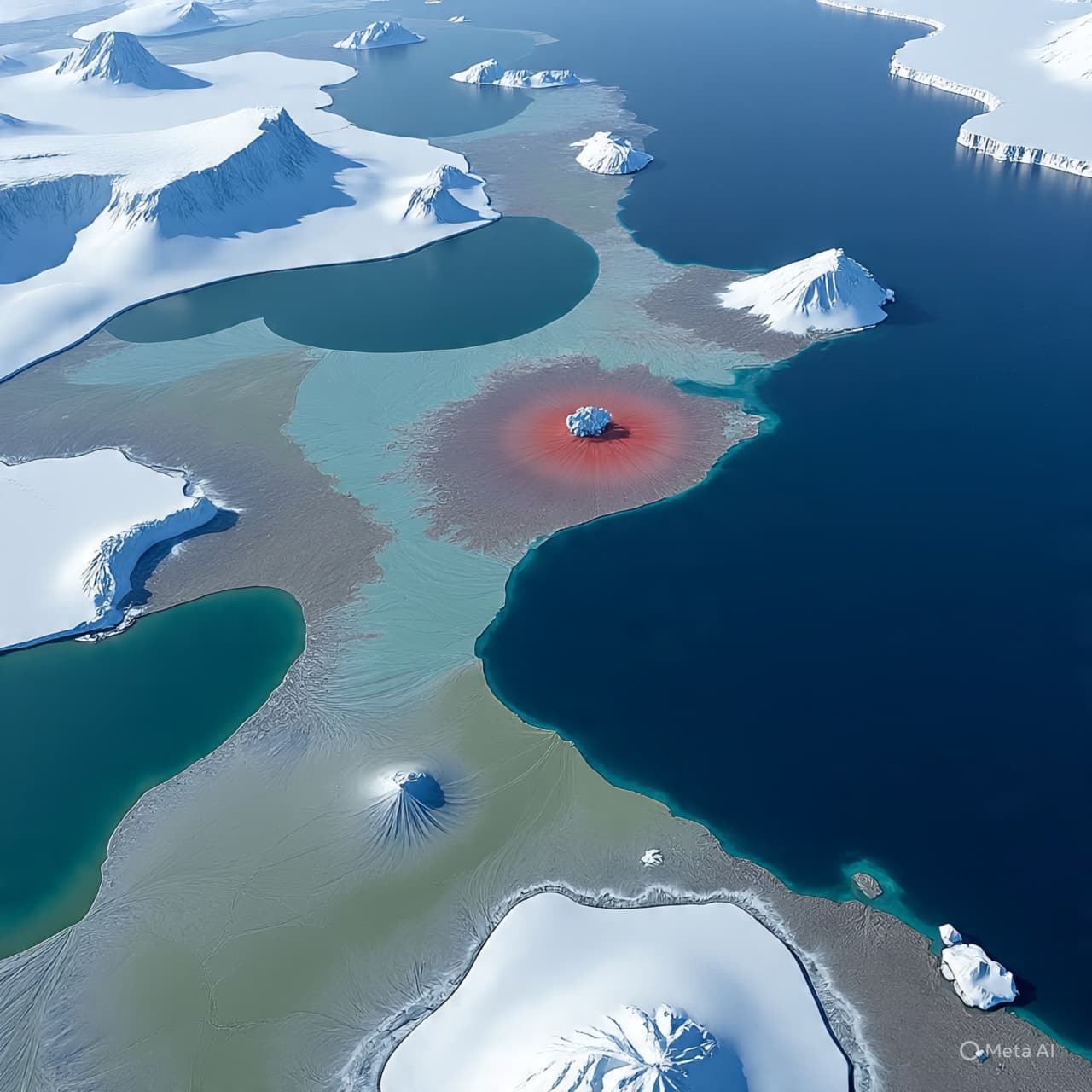
To understand this phenomenon, scientists look beyond familiar notions of “gravity feels the same everywhere.” In reality, the gravitational pull we feel at a given spot depends on how Earth’s mass is distributed far below the surface. Beneath Antarctica — particularly around the Ross Sea, Victoria Land, and Marie Byrd Land — gravity is slightly less intense than global averages when measured against a theoretical smooth Earth shape. Geophysicists call this the Antarctic Geoid Low or “gravity hole”: a subtle dip in Earth’s gravity field that doesn’t affect humans walking across the ice but is detectable with precision satellite gravimetry and geodynamic modeling.
Recent research has taken these measurements further by simulating how this gravity anomaly has evolved over the past approximately 70 million years. Using global earthquake data and physics‑based models, scientists effectively created a three‑dimensional reconstruction of Earth’s mantle — akin to a CT scan of our planet. These models reveal that the gravity hole was once much weaker and deepened significantly between about 50 million and 30 million years ago, a period that remarkably overlaps with a pivotal climatic transition: Antarctica’s shift into long‑lasting icy conditions and large‑scale glaciation.
This evolutionary timeline raises intriguing questions. Was the strengthening of the gravity hole simply a byproduct of deep mantle dynamics, or did it play a role in shaping Antarctica’s climate and ice sheet development? While researchers caution that there’s no definitive proof of a direct cause‑and‑effect relationship, the coincidence invites deeper inquiry into how Earth’s internal rhythms might influence surface environments and even large‑scale features like ice sheets and sea levels.
Because gravity helps shape ocean surfaces — pulling water toward regions of stronger gravitational pull — the gravity hole also affects sea‑surface height around Antarctica. Water tends to sit slightly lower where gravity is weaker, meaning this deep‑Earth feature subtly contributes to ocean geometry and may influence how scientists model sea level and climatic feedbacks in polar regions.
As scientists continue to explore these slow, powerful forces, Antarctica’s growing gravity hole serves as a reminder of the rich interplay between Earth’s core and surface. In a world where we measure seismic waves, satellite gravity data, and ancient rock flows to understand our past, this gravitational anomaly invites reflection on the unexpected ways our planet’s inner workings resonate through time and shape what we see on the surface today.
AI Image Disclaimer “Visuals are created with AI tools and are not real photographs.”
📌 Sources
• Study reconstructs Antarctica’s gravity hole evolution and links its strengthening to deep mantle dynamics over millions of years.
• Analysis shows gravity variations shape sea‑surface height around Antarctica and overlaps with major climatic transitions.
Published by Banx Network. This article is part of the Banx decentralized media programme, powered by the BXE token on the XRP Ledger.