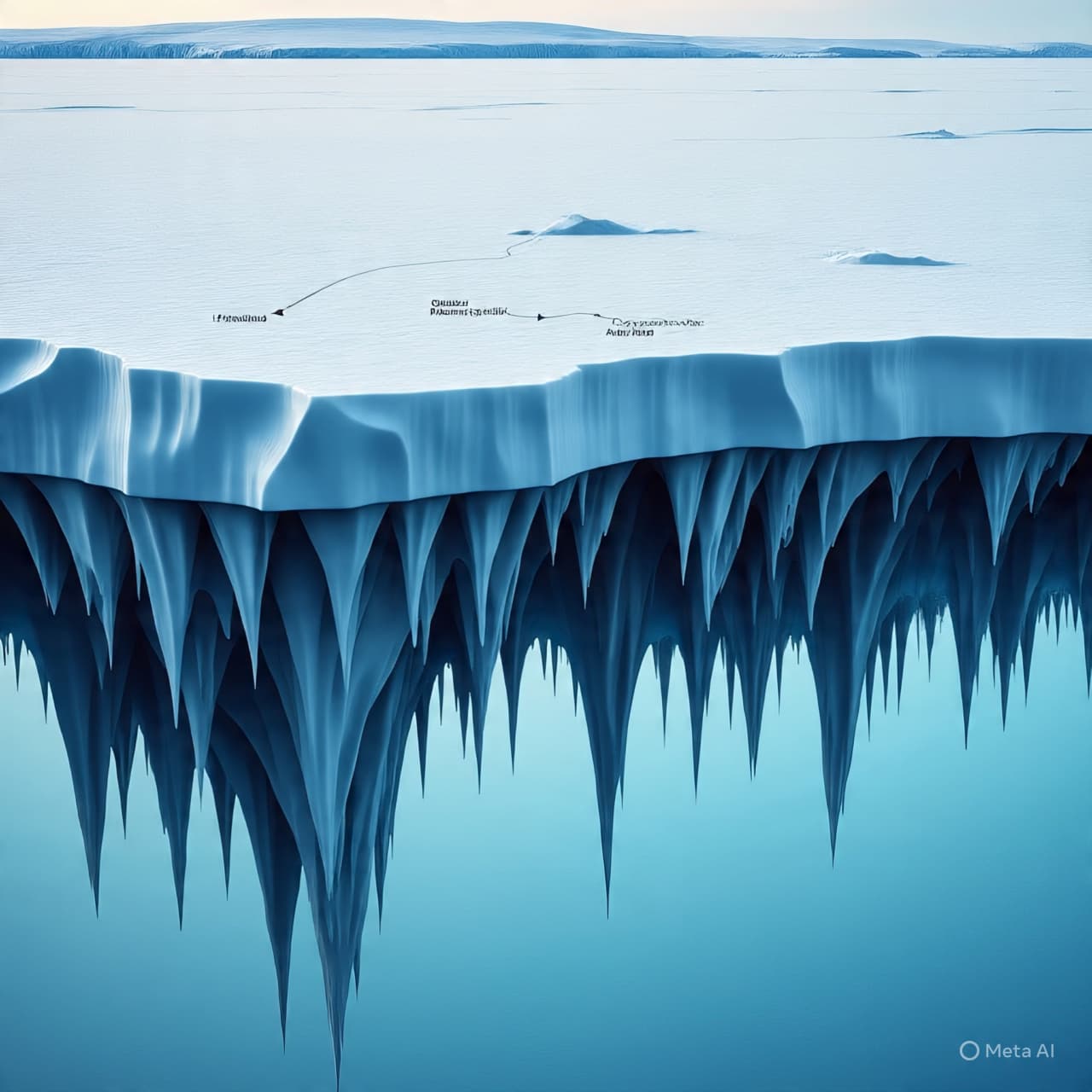
In the wide sweep of Earth’s icy realms, Greenland has long stood as a symbol of frozen stillness—a white canvas barely touched by change. Yet beneath that seemingly serene surface, researchers have been puzzling over strange signals emanating from deep inside the ice for years. Only now, through a novel lens on the ice sheet’s internal dynamics, are scientists beginning to understand one of its most curious mysteries—suggesting that the ice may be more active, complex, and sensitive than previously thought.
The enigma centers on what scientists call “plume-like structures”—vast swirling features deep within the Greenland ice sheet that defy the conventional view of ice as a static, rigid mass. Instead of lying inert, parts of the sheet appear to be gently churning and moving, as though stirred from within. Until recently, the origin of these structures was poorly understood, leaving glaciologists to puzzle over what might be driving motion in what should be solid ice.
A new study published in The Cryosphere suggests that the answer lies in a process once thought impossible at these depths: thermal convection. This mechanism, familiar to geologists studying Earth’s mantle and to cooks watching water boil on a stove, occurs when differences in temperature cause material to circulate—warmer sections rising, cooler ones sinking. In the Greenland ice sheet’s interior, scientists now think similar temperature differences may create slow, vertical motions of ice, giving rise to the plumes and ridges observed beneath the surface.
Researchers describe this phenomenon as akin to “a boiling pot of pasta,” a phrase meant to convey how solid ice, under the right conditions, can behave in surprising ways. The plumes—long visible in radar scans of the ice’s interior—may thus be the telltale signs of slow, internal motion rather than random quirks in the crystal layers.
Understanding these subtle dynamics is more than an academic exercise. The Greenland ice sheet plays an outsized role in global climate and sea-level rise—holding enough frozen water to raise seas by many feet if it were to melt entirely. How the ice responds to warming, how it flows and fractures, and how heat moves inside its depths all influence predictions of future change. The realization that parts of the ice can undergo convection suggests that models of ice sheet behavior may need refining to account for processes previously overlooked.
However, scientists caution that convective motion does not necessarily mean the ice will melt more rapidly. Instead, it highlights the complexity of the ice sheet’s internal physics and underscores the importance of incorporating these insights into long-term models. As glaciers thin at their margins and seasonal melting intensifies, having a clearer picture of what lies beneath becomes increasingly crucial for predicting not just how quickly the ice might recede, but also how its internal structure might evolve under a warming climate.
For decades, the Greenland ice sheet has offered up clues about Earth’s climatic past and present. Now, by probing its hidden motions, scientists are opening a new chapter in understanding how this colossal body of ice lives and breathes—quietly, deeply, and in motion more than we ever suspected.
AI IMAGE DISCLAIMER Visuals are created with AI tools and are not real photographs.
SOURCES BASED ON SOURCES ROLE Scientific American The Cryosphere (peer-review science journal) Phys.org science reporting BBC News Reuters
Published by Banx Network. This article is part of the Banx decentralized media programme, powered by the BXE token on the XRP Ledger.