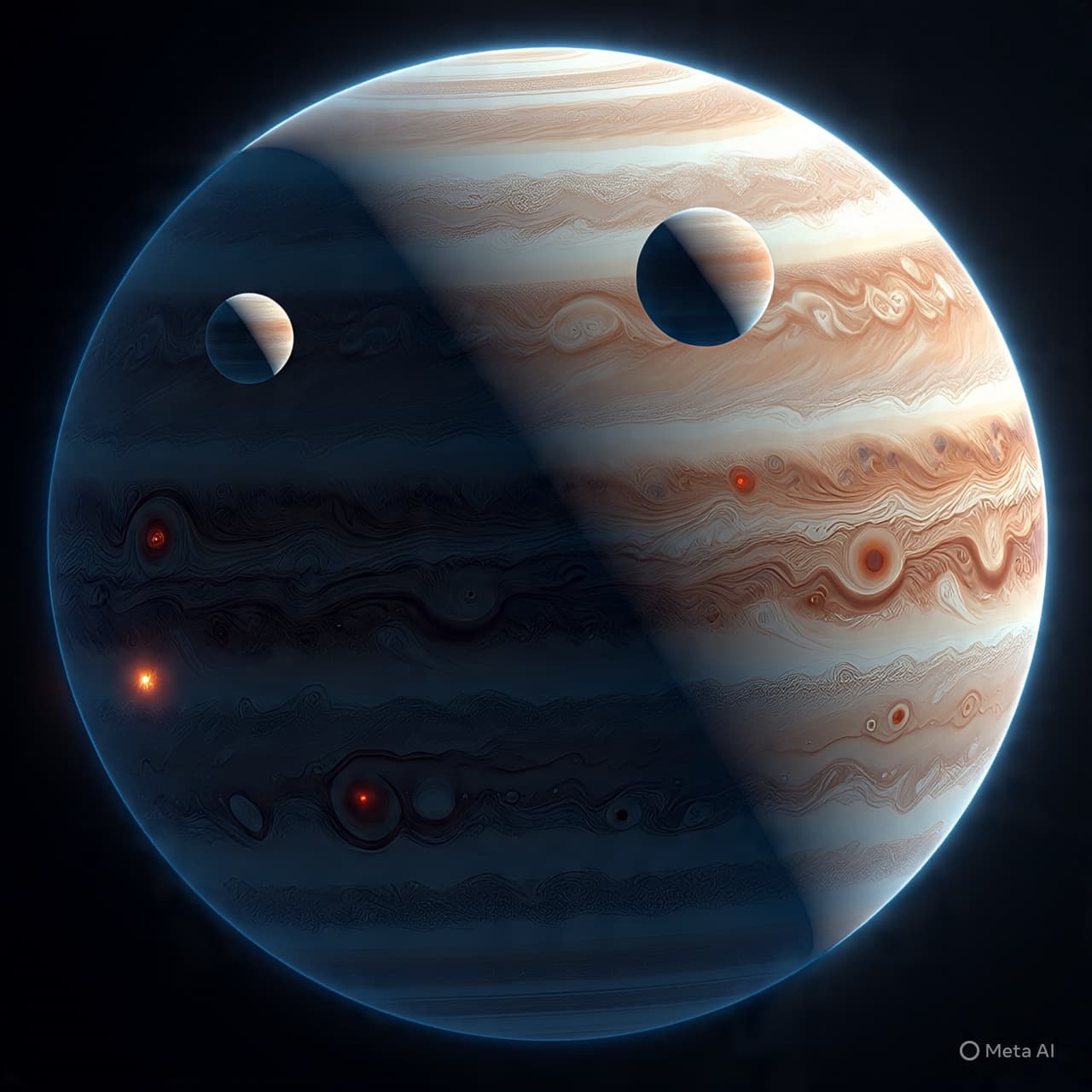
In the deep quiet beyond the asteroid belt, Jupiter turns slowly in the dark, attended by a retinue of moons that seem, at first glance, frozen and distant. For centuries they were points of light, discovered by early telescopes and mapped with patient care. Yet beneath their icy crusts and scarred surfaces, scientists have begun to imagine something warmer — a chemistry set assembled long ago, waiting in the cold.
Recent research suggests that some of Jupiter’s major moons may have formed with many of the fundamental ingredients necessary for life. The idea does not claim the presence of living organisms. Instead, it gently shifts the timeline of possibility. Rather than acquiring life’s building blocks solely through later impacts or external delivery, moons such as , , and may have incorporated key chemical compounds during their earliest formation.
Studies discussed in explore how the protoplanetary disk surrounding Jupiter billions of years ago could have contained water ice, carbon-based molecules, nitrogen compounds, and other volatiles. As the moons coalesced from this swirling material, they may have trapped these substances within their interiors. In effect, the recipe for life — at least in chemical terms — may have been baked into them from the beginning.
Europa, long a focus of astrobiological interest, is believed to harbor a vast ocean beneath its icy shell. Observations from spacecraft missions and telescopes suggest that this subsurface ocean is in contact with a rocky seafloor, where chemical reactions could occur. If organic molecules and essential elements were present from formation, they may have mixed with liquid water for billions of years — an environment that, on Earth, proved fertile.
Ganymede, the largest moon in the solar system, presents its own intrigue. It possesses a magnetic field and likely contains multiple layers of subsurface oceans separated by ice. Callisto, though more heavily cratered and less geologically active, may also conceal a deep ocean. The possibility that these worlds began with life’s raw materials broadens the scope of inquiry. It suggests that habitability is not merely a matter of present conditions, but of ancient inheritance.
The research does not assert that life exists there now. It points instead to chemical plausibility. The ingredients — water, carbon compounds, energy sources — are the same trio that underpins life on Earth. Whether they combined in the necessary ways remains an open question. Temperature, pressure, radiation exposure, and internal heat all influence the outcome.
Missions planned by space agencies aim to examine these moons more closely. The mission Europa Clipper, for example, is designed to conduct detailed flybys of Europa, studying its ice shell and subsurface ocean. Meanwhile, the has launched the Jupiter Icy Moons Explorer (JUICE), set to investigate Ganymede, Callisto, and Europa in the coming years. These missions will not drill into oceans, but they will analyze surface chemistry, magnetic fields, and gravitational signatures that hint at internal composition.
There is a quiet elegance to the idea that life’s ingredients might be widespread. It reframes our solar system not as a singular oasis, but as a collection of experiments — some frozen, some hidden, some perhaps ongoing. Jupiter’s gravity once shaped the early solar system, influencing asteroid paths and planetary formation. Its moons, born in that dynamic environment, may have inherited more than ice and rock.
Yet scientists remain measured. The presence of ingredients does not guarantee a finished product. Earth’s history shows that life’s emergence required not only chemistry but time, stability, and perhaps a measure of chance. Still, the notion that multiple worlds began with similar starting materials deepens the sense that biology is not isolated to a single cosmic accident.
For now, telescopes and spacecraft continue to gather data. Laboratory models refine simulations of moon formation. Each piece adds nuance to an evolving picture. Jupiter’s moons remain distant and cold, but the story they tell is warmer than once imagined — a story of primordial chemistry, preserved beneath ice.
As new missions approach their targets in the years ahead, scientists hope to learn whether these early ingredients endured unchanged or transformed over time. The research does not promise imminent discovery of life. It simply suggests that, from their earliest days, some of Jupiter’s moons may have held the same elemental possibilities that once stirred on Earth.
AI Image Disclaimer Images in this article are AI-generated illustrations, meant for concept only.
Sources
The Conversation BBC News Scientific American Nature Astronomy Space.com
Published by Banx Network. This article is part of the Banx decentralized media programme, powered by the BXE token on the XRP Ledger.