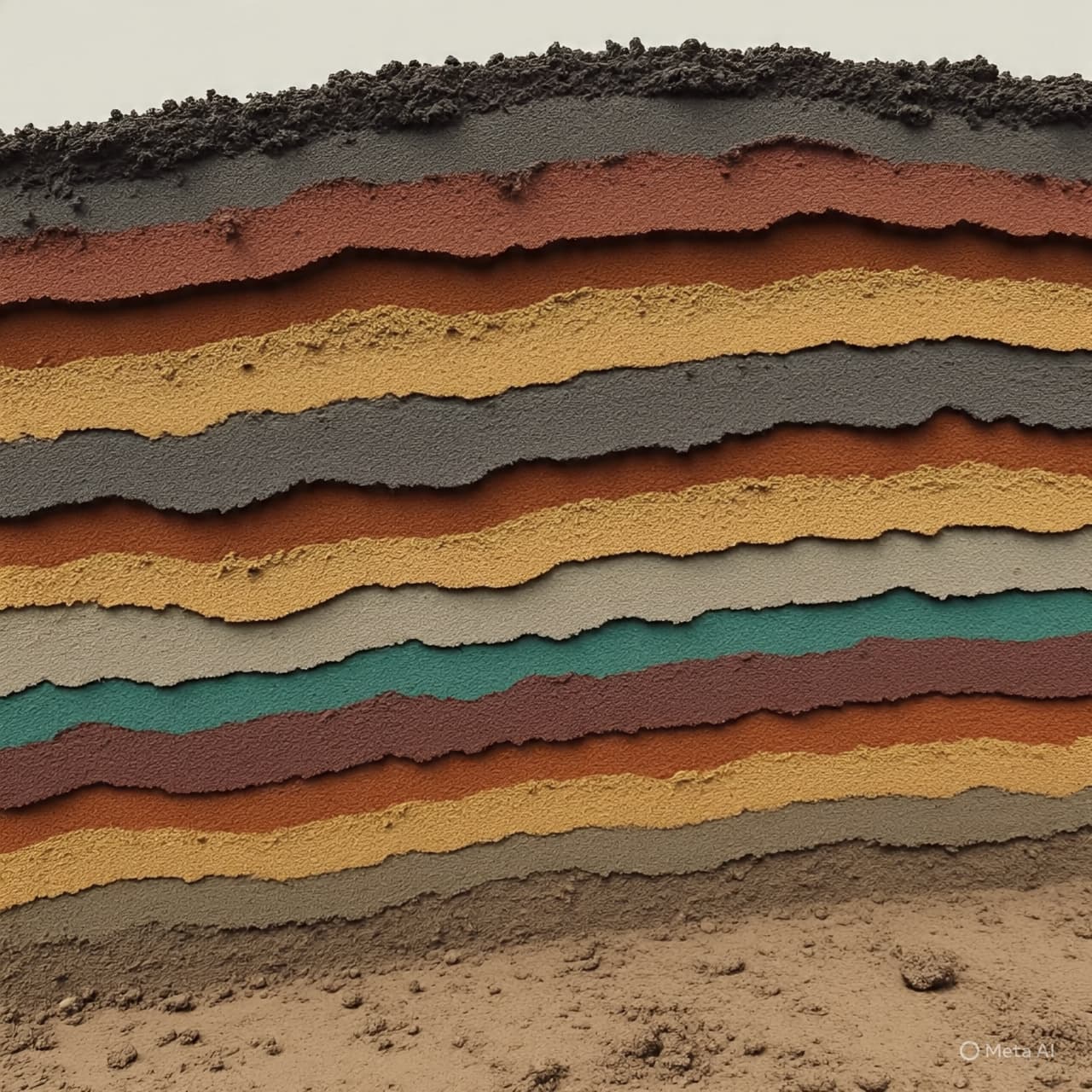
There is a stillness to soil when viewed from above—a surface that appears steady, receptive, shaped by seasons and intention. Fields stretch outward in ordered lines, their textures marked by cultivation, their purpose visible in growth yet to come. Beneath this surface, however, lies a structure less apparent, a delicate arrangement of particles, pores, and pathways that hold together in quiet balance.
This hidden architecture is not static. It breathes, in a sense, allowing air and water to move through its spaces, supporting roots as they extend and organisms as they live unseen. The soil’s strength lies not in compactness, but in its complexity—a network of voids and connections that sustain life at scales too small to observe directly.
Recent research, using fiber-optic sensing technologies, has begun to illuminate how this structure changes under the influence of modern farming practices. By embedding sensitive cables into the ground, scientists can detect minute shifts in pressure and movement, mapping how soil responds when it is disturbed, compressed, or repeatedly worked.
What emerges from these observations is not a sudden collapse, but a gradual transformation. As heavy machinery passes over fields, as plowing and tilling reshape the surface, the soil’s internal structure begins to compress. Pores that once allowed water to flow and roots to expand become reduced or closed. The pathways that connected different regions weaken, and the soil becomes denser, less able to sustain the processes that once moved through it.
The changes are subtle at first, difficult to detect without precise measurement. From above, the field may appear unchanged, its surface prepared and ready. But below, the balance shifts. Water may no longer penetrate as easily, leading to runoff rather than absorption. Roots may encounter resistance, limiting their growth. Microbial activity, dependent on the movement of air and nutrients, may decline.
Fiber-optic sensors allow these changes to be seen in a new way. By capturing continuous data across time and depth, they reveal patterns that were previously inferred but not directly measured. The soil becomes not just a medium, but a system whose responses can be traced, whose alterations can be mapped in detail.
There is a quiet clarity in this approach. It does not rely on surface observation alone, but reaches into the ground to follow the consequences of repeated action. What it shows is not necessarily unexpected, but it renders the process visible in a way that invites reconsideration.
At the same time, the findings do not point to a single cause or a single solution. Farming practices vary widely, as do soils themselves. Some methods may preserve structure better than others, and the long-term effects depend on a combination of factors, including climate, crop type, and management techniques.
What becomes evident is the sensitivity of the system. Soil, though often treated as stable, responds continuously to pressure and disturbance. Its structure is something that can be maintained or diminished over time, shaped by how it is used.
There is a certain restraint in how this knowledge emerges. It does not call for immediate change, nor does it assign simple conclusions. Instead, it adds depth to the understanding of a familiar landscape, revealing the processes that occur beneath what is seen.
Scientists using fiber-optic sensors have shown that farming practices can degrade soil structure by compacting it and reducing its internal pore networks. The findings provide detailed insight into how soil responds to repeated disturbance and mechanical pressure.
AI Image Disclaimer
Illustrations were generated using AI and are intended to visually represent the scientific concepts described.
Source Check Nature Science BBC The Guardian Scientific American
Published by Banx Network. This article is part of the Banx decentralized media programme, powered by the BXE token on the XRP Ledger.