There are places on Earth so still they seem untouched by time. Antarctica is one of them — a continent of white horizons and patient silence, where wind moves like a distant breath across endless snow. Yet beneath this frozen quiet, something extraordinary is happening. Deep in the ice, particles from the farthest reaches of the universe are arriving, and scientists are listening.
These particles are known as neutrinos — nearly massless, electrically neutral travelers born in some of the most violent events in the cosmos: exploding stars, black hole collisions, and distant galaxies blazing with energy. Unlike light or charged particles, neutrinos pass through matter almost untouched. They can travel billions of light-years without being deflected, carrying pristine information about their origins.
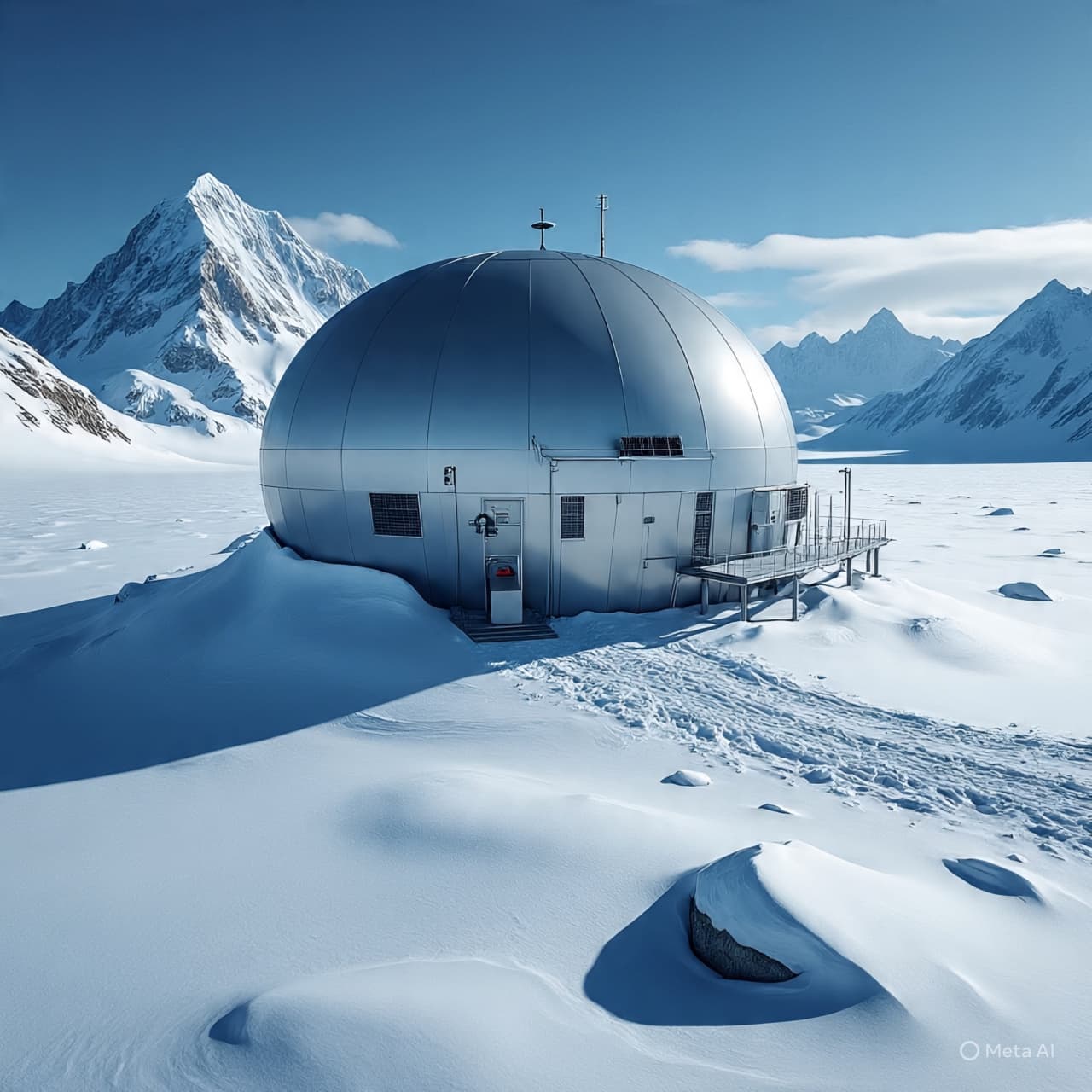
To detect something so elusive requires both ingenuity and environment. Buried deep within Antarctic ice is the IceCube Neutrino Observatory, a vast detector embedded more than a mile beneath the surface. The ice itself serves as a transparent medium, allowing scientists to observe faint flashes of blue light produced when a neutrino happens — rarely — to interact with an atom in the frozen depths.
The setting is not incidental. Antarctic ice is ancient, remarkably clear, and free from much of the background radiation that complicates measurements elsewhere. In that clarity, researchers can distinguish the subtle signatures of neutrino interactions from noise. It is a quiet conversation between cosmic particle and frozen crystal.
What makes neutrinos so valuable is their honesty. Light from distant galaxies can be distorted or absorbed. Charged particles are bent by magnetic fields. But neutrinos travel straight, almost indifferent to obstacles. When they arrive at Earth, they bring with them direct evidence of processes occurring in the far universe — processes otherwise hidden from view.
Through years of observation, scientists have used IceCube data to trace high-energy neutrinos back to powerful cosmic sources, including active galactic nuclei where supermassive black holes consume surrounding matter. Each detection sharpens our understanding of how energy is generated and distributed across the cosmos.
Beyond mapping distant phenomena, neutrinos also hold clues to fundamental physics. Their properties — including their tiny masses and ability to oscillate between types — challenge aspects of the Standard Model, the framework that describes elementary particles and forces. Studying neutrinos may reveal why matter dominates over antimatter in the universe, a question tied directly to why galaxies, stars, and life itself exist.
The research is meticulous. Sensors embedded in the ice capture brief flashes of Cherenkov radiation — the light emitted when a particle moves faster than light travels through ice. From these flashes, scientists reconstruct the neutrino’s direction and energy. It is an act of inference and precision, transforming faint glimmers into cosmic narratives.
There is something quietly poetic about the arrangement: a detector built in one of Earth’s most remote landscapes to study events occurring millions or billions of years ago. The ice preserves ancient air bubbles from Earth’s past, while the neutrinos passing through it carry messages from even older realms.
Importantly, the work is ongoing. Upgrades to IceCube and complementary observatories around the world aim to increase detection sensitivity and refine measurements. Each additional neutrino captured expands the dataset, bringing researchers closer to answering enduring questions about cosmic acceleration, particle behavior, and the architecture of the universe.
In straightforward terms, scientists working with detectors embedded deep in Antarctic ice continue to analyze neutrinos from distant cosmic events. Their findings contribute to understanding high-energy astrophysical sources and fundamental particle physics, with further research underway.
AI Image Disclaimer Illustrations were produced with AI and serve as conceptual depictions.
Sources
Reuters BBC News The Guardian Nature Science Magazine
Published by Banx Network. This article is part of the Banx decentralized media programme, powered by the BXE token on the XRP Ledger.