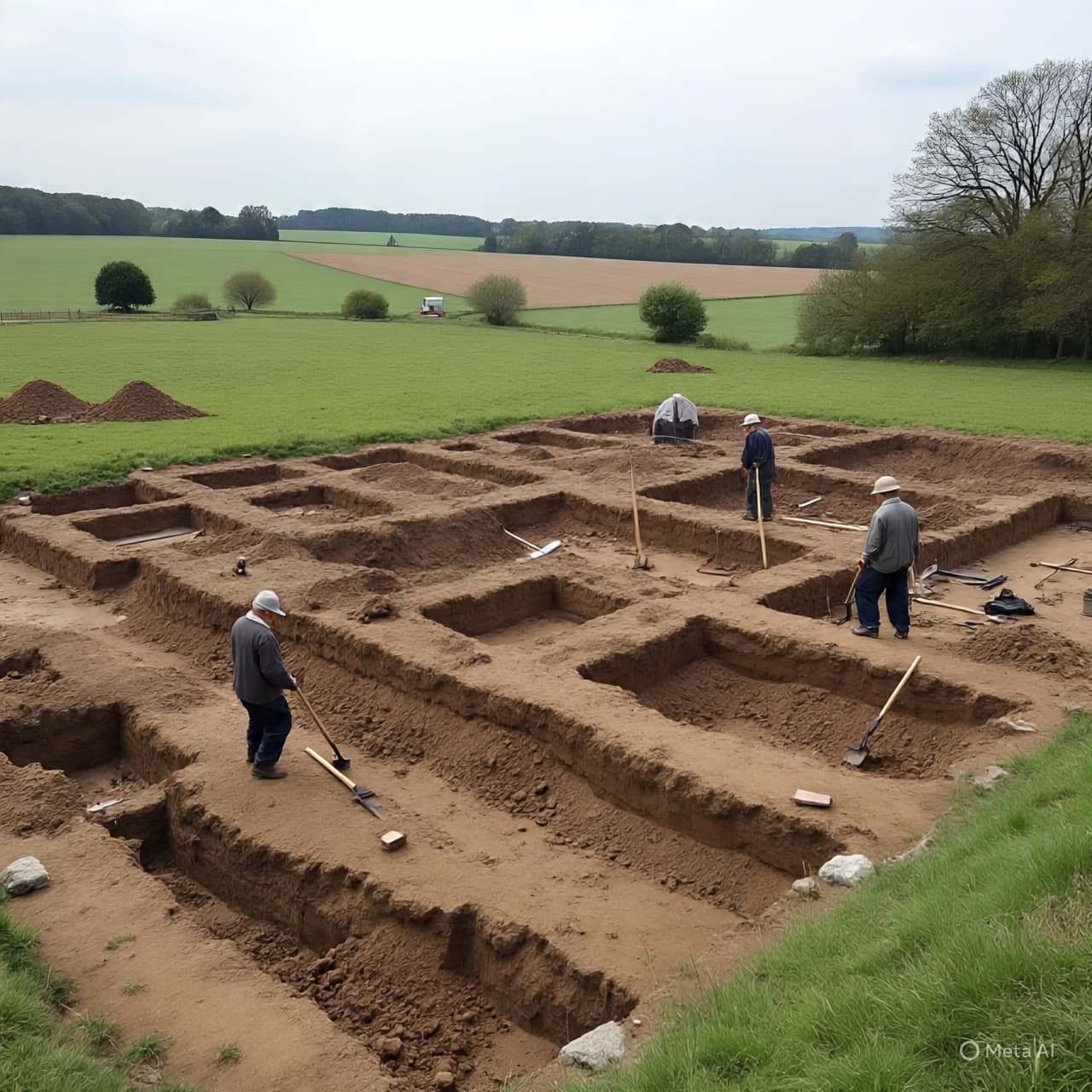
In a quiet field in Germany, where mist gathers low in the early morning and the soil carries the weight of millennia, archaeologists have uncovered a story that folds time upon itself. Beneath a burial site dating back to the 4th millennium BC — when Europe’s first farmers shaped earth and ritual with stone tools — lies something far younger, yet no less mysterious: a corridor system from the late Middle Ages.
The discovery, made during systematic excavations of a Stone Age funerary complex, reveals a layered landscape where centuries have settled one atop another. What began as an inquiry into prehistoric burial customs has opened into a passageway from an entirely different epoch — a narrow, constructed corridor dating roughly to the 14th or 15th century AD.
The Neolithic burial site itself speaks of an ancient world. Megalithic tombs and carefully arranged grave goods mark a community deeply invested in ceremony and memory. Such sites, found across parts of northern Europe, reflect early agricultural societies that built enduring monuments to honor their dead. The German site had already yielded pottery fragments, stone tools, and structural features characteristic of the period.
Then, during deeper analysis, archaeologists identified cut stone and passage alignments inconsistent with the Stone Age layer. Further excavation revealed a built corridor — deliberate, engineered, and unmistakably medieval in origin. The construction techniques, including masonry details and soil stratigraphy, indicate it was created thousands of years after the original burial complex.
Researchers suggest the corridor may have served as a subterranean storage space, escape route, or part of a defensive or monastic structure. In parts of Central Europe, late medieval communities constructed underground passages for protection during conflict or as cellars for food preservation. The newly uncovered system appears modest in scale but carefully designed, its entrance concealed beneath centuries of accumulated earth.
What makes the find remarkable is not simply the coexistence of eras, but their intersection. The medieval builders either knowingly dug into a prehistoric sacred site or stumbled upon it during construction. Whether the ancient tombs were visible above ground at the time remains uncertain. Some Neolithic burial mounds persisted as landscape features for millennia, sometimes repurposed or mythologized by later generations.
Archaeologists are now conducting soil analyses and architectural studies to determine the corridor’s full extent and purpose. Radiocarbon dating and material examination will help refine the timeline. The team is also mapping the structure using ground-penetrating radar to assess whether additional chambers lie undiscovered.
Discoveries like this remind us that landscapes are rarely static. Fields that appear pastoral and unassuming often conceal layers of human intention — ritual, survival, reinvention. A burial ground becomes a foundation; sacred earth becomes shelter.
In the cool darkness of the corridor, where medieval hands once shaped stone, the air now carries a different presence: the measured steps of researchers tracing lines between centuries. Above ground, wind moves through grass that has grown and regrown countless times since the first graves were dug.
The passage does not erase the older world beneath it, nor does the ancient tomb diminish the medieval craft. Instead, they coexist — two chapters written in the same soil.
In Germany’s layered earth, time is less a straight line than a tunnel — one where distant eras meet quietly in the dark.
AI Image Disclaimer Illustrations were created using AI tools and are not real photographs.
Published by Banx Network. This article is part of the Banx decentralized media programme, powered by the BXE token on the XRP Ledger.