There are places on Earth where light arrives only as a memory.
In the deep folds of limestone and shadow, where ceilings drip and walls narrow into passages barely wide enough for a human to pass, the world becomes quieter, more deliberate. Sound travels differently there. Time feels slower. And in that stillness, something new has begun to move—not with urgency, but with intention.
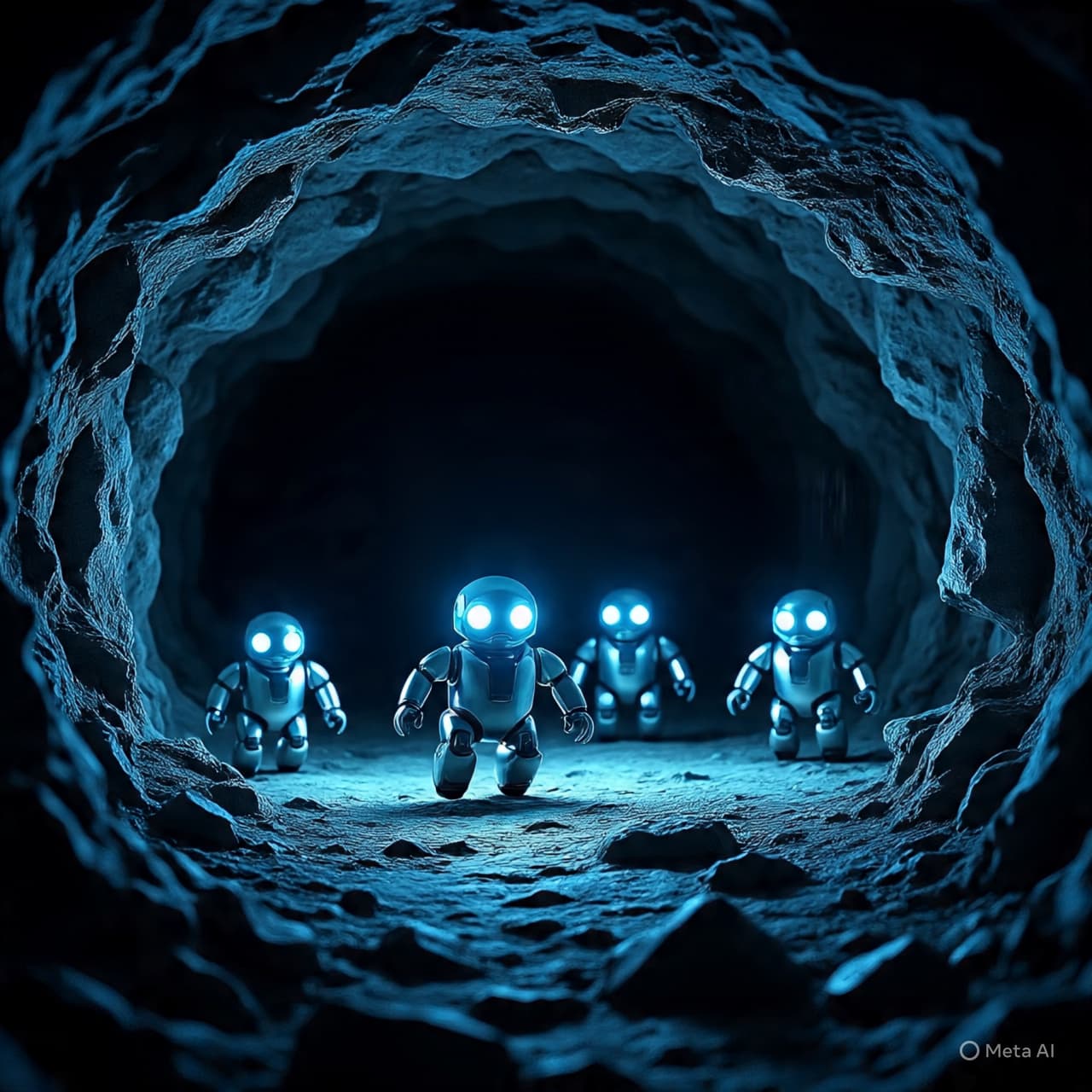
They are small, almost inconspicuous at first glance. Machines weighing little more than a kilogram, scattered like careful thoughts across the cave floor. Alone, each one is limited. Together, they begin to behave differently, as if a larger awareness emerges from their quiet coordination.
This is the premise behind a recent campaign led by the Institute of Space and Astronautical Science of JAXA, where a swarm of small robots was tested deep inside natural caves in Australia.
The setting is not incidental. These caves, with their darkness and irregular geometry, echo something far beyond Earth. On the Moon and Mars, scientists have identified deep pits—sinkholes that may open into vast underground lava tubes. These hidden spaces are thought to offer shelter from radiation, temperature extremes, and the silent hazards of the surface.
But they are also unreachable by conventional means.
Large robotic explorers, so effective on open terrain, hesitate at such thresholds. A single misstep could mean permanent loss. The unknown becomes too costly. And so, the idea shifts: not one machine, but many. Not dominance over terrain, but adaptation to it.
In November 2025, that idea was tested in the caves of Queensland. Around ten small robots were released into the underground environment, moving independently yet aware of one another, spreading through narrow corridors, turning into spaces that would stop a larger system entirely.
They did not simply wander. They mapped.
Using cooperative behavior and real-time positioning technologies, the swarm explored and reconstructed the cave’s structure as it moved. Each robot contributed fragments of understanding—location, distance, terrain—building a collective sense of place that no single unit could achieve alone.
At the same time, an invisible experiment unfolded alongside them. Signals passed between the robots—radio waves bending and reflecting through stone corridors, tracing paths as complex as the terrain itself. By studying how these communications behaved in confined, irregular spaces, researchers gathered insights that may one day allow machines to stay connected in the hidden chambers of other worlds.
There is a quiet resilience in this approach. If one robot fails, the others continue. If a path is blocked, the swarm adjusts. Risk is no longer concentrated in a single fragile system but distributed across many small, persistent ones.
It is a different philosophy of exploration—less about singular achievement, more about collective presence.
The roots of this idea reach back to earlier Japanese missions, where small hopping robots explored the surface of asteroids, and compact rovers accompanied lunar landers. Those experiments hinted at a future where scale is not defined by size, but by number, by coordination, by the ability to adapt rather than endure.
And yet, what unfolds in these caves is still only a beginning.
The robots move slowly. They pause. They communicate. They return. Their paths overlap and diverge, forming a kind of choreography shaped by constraints rather than freedom. It is exploration not as conquest, but as listening—an attempt to understand spaces that resist being known.
Somewhere in that darkness, the boundary between Earth and elsewhere becomes less distinct.
Because these caves are, in a sense, rehearsals.
The data gathered from the campaign will support the development of cooperative robotic systems designed to explore hazardous environments on the Moon and Mars, particularly subsurface lava tubes that may host future human infrastructure.
For now, the experiment remains grounded, its movements confined to stone and shadow. But its direction is outward.
And if one day machines descend into the hidden chambers of another world—mapping, communicating, moving together in silence—it may begin to feel familiar, as though they have already been there, once, beneath our own feet.
AI Image Disclaimer
Visuals are AI-generated and serve as conceptual representations.
Source Check: ISAS/JAXA, CSIRO, Astrobiology Magazine
Published by Banx Network. This article is part of the Banx decentralized media programme, powered by the BXE token on the XRP Ledger.