Opening
There are places where time does not pass in the way we expect. It settles instead, layer upon layer, quietly preserving what once moved freely across the earth. In such places, history is not written—it is held, waiting for the moment when it might be seen again.
Beneath the surface, in spaces shaped by water and stone, the past can remain intact, untouched by the rhythms above. And when it is finally revealed, it does not arrive as a single story, but as a gathering of many.
---
Body
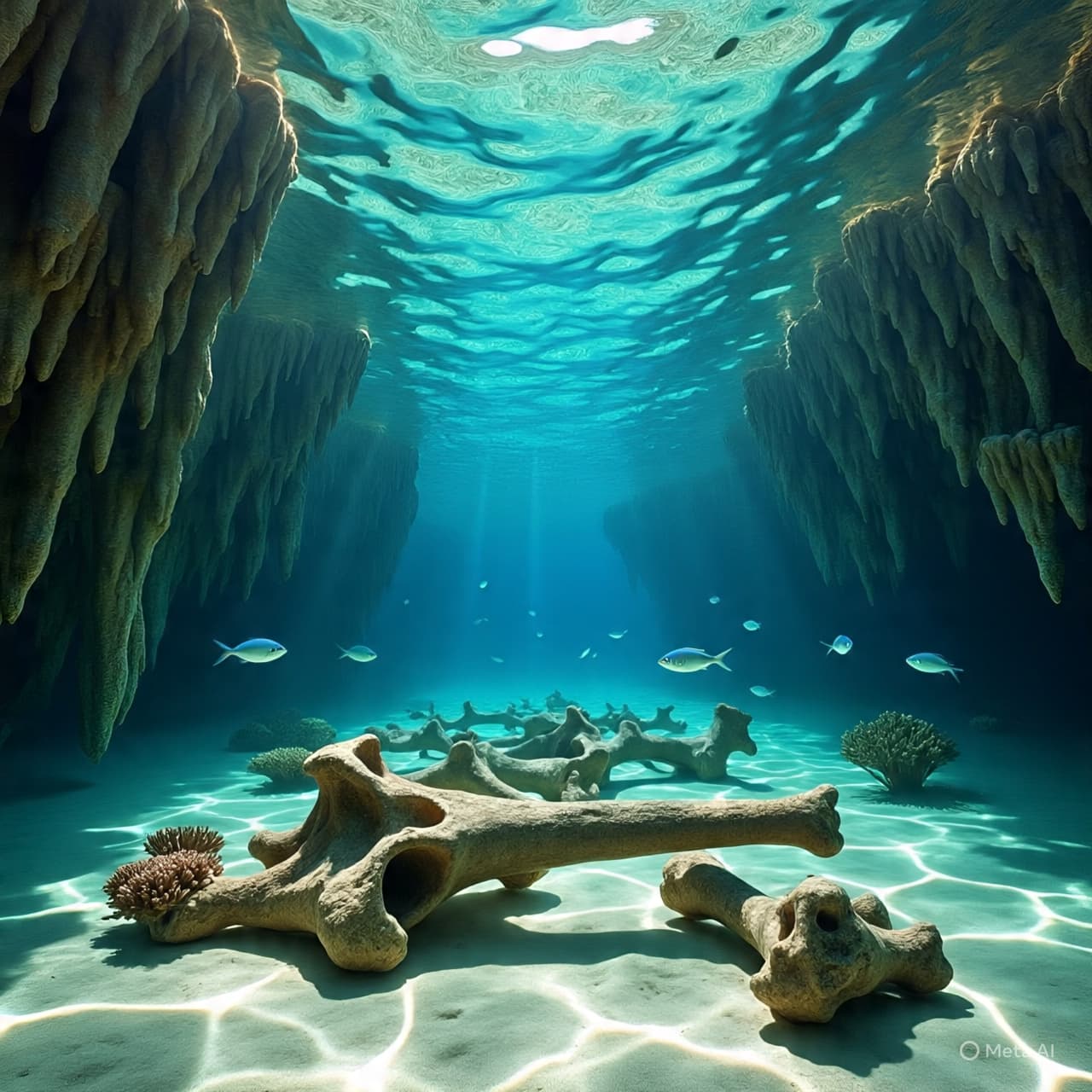
In central Texas, scientists have uncovered a remarkable collection of remains from Ice Age animals within a submerged cave system, offering a rare glimpse into a distant chapter of Earth’s history. The discovery, preserved in a water-filled environment, has revealed fossils that have endured for thousands of years.
Among the findings are remains of large mammals that once roamed the region during the Ice Age, a period marked by cooler climates and dramatically different landscapes. These animals, now long extinct, form part of a broader ecological picture—one that reflects a world shaped by shifting temperatures, changing habitats, and evolving life forms.
What makes the cave particularly significant is its state of preservation. Submerged environments can protect organic material from many of the processes that typically lead to decay. In this case, the cave has acted almost like a natural archive, shielding bones and other remnants from disturbance.
Researchers suggest that the site may also contain geological layers that record environmental conditions over time. Sediments, minerals, and fossilized remains together create a timeline—one that can help scientists better understand how ecosystems responded to changes during the Ice Age.
Exploring such caves is not without challenge. The conditions are often difficult, requiring specialized equipment and careful navigation. Yet these efforts can yield insights that are difficult to obtain elsewhere, particularly when it comes to understanding periods of deep history.
The discovery also highlights how much of Earth’s past remains hidden, not only in remote or distant places, but sometimes beneath landscapes that are otherwise familiar. It is a reminder that history is not always lost—it is often simply waiting to be uncovered.
In studying these remains, scientists are able to reconstruct aspects of ancient ecosystems, from the types of species that existed to the environments they inhabited. Such knowledge contributes to a broader understanding of how life on Earth has adapted to change over long timescales.
---
Closing
The cave in central Texas is expected to remain a focus of ongoing research, as scientists continue to examine its contents and the stories they may hold. Further analysis may reveal additional details about the animals and environments of the Ice Age.
For now, the discovery stands as a quiet window into the past—one that connects the present to a time when the world moved to a different rhythm, yet still leaves much to be understood.
AI Image Disclaimer
Visuals are created with AI tools and are not real photographs.
Source Check
Here are credible sources available for this topic:
1. Reuters 2. BBC News 3. CNN 4. National Geographic 5. ScienceDaily
Published by Banx Network. This article is part of the Banx decentralized media programme, powered by the BXE token on the XRP Ledger.