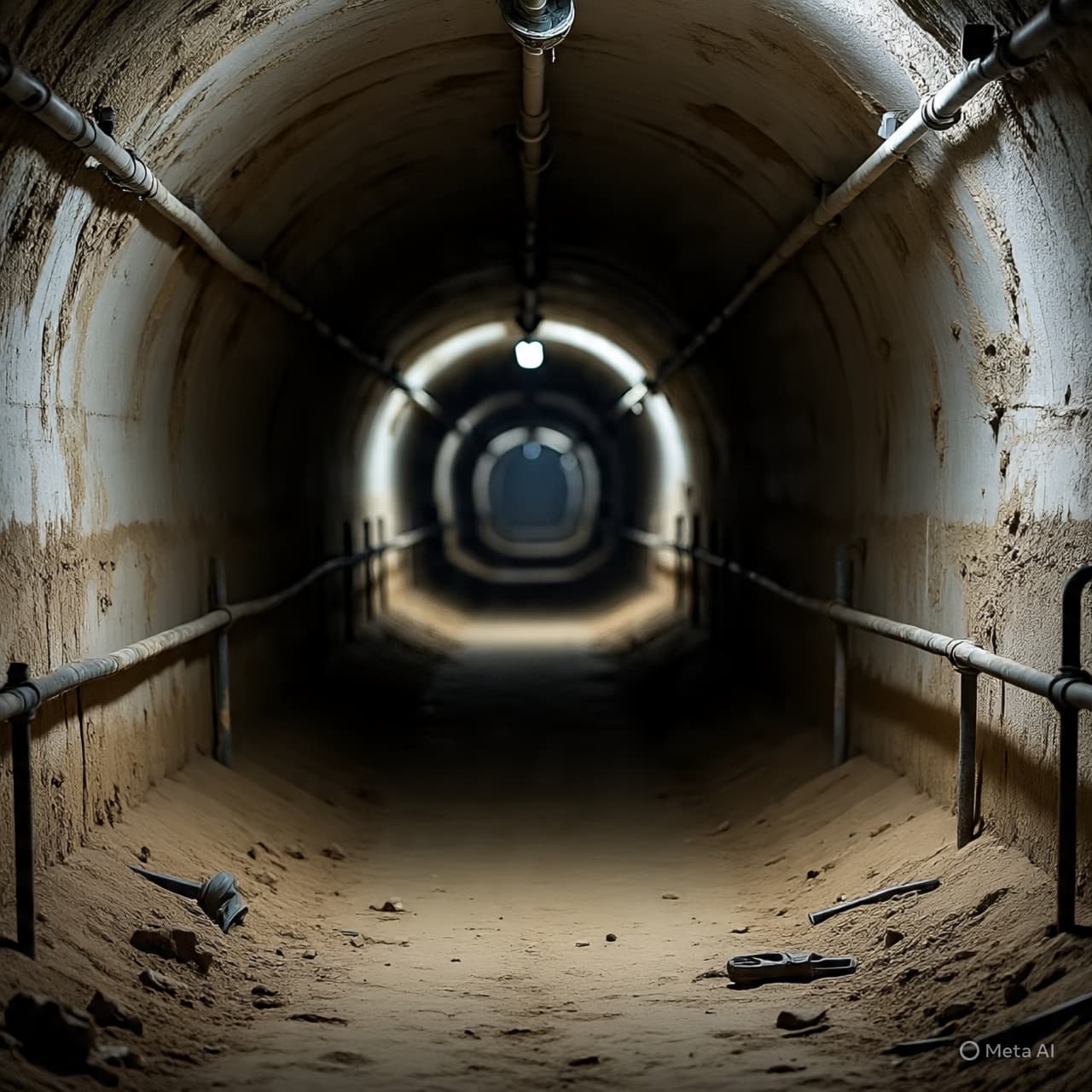
There is a strange hush beneath Rafah — not the silence of peace, but the echo of something long concealed, as if the earth itself had clasped its lips. Deep under the ghost-streets and ruined buildings, a labyrinth of tunnels stretches like the roots of a giant tree, weaving through sands, under crumbled homes and silent mosques, carrying within its bowels stories and secrets.
For more than 18 months, the soldiers who ventured into that darkness — lit only by the glow of their helmets — moved with hopes heavy but hearts steadfast. Their mission: to reclaim what was lost, to bring back the remains of a soldier taken nearly eleven years ago, whose name had become tragic shorthand for a wound that refused to heal.
They probed concrete panels, peeled back layers of sand and debris, searched forty, fifty, eighty concealed rooms, each an aching reminder of tunnels too many, secrets too deep. At times, the corridors opened into cavern-like spaces; at others they forked into narrow alleys where air itself seemed to suffocate. The engineers spoke of doors behind doors, of blast-hardened chambers, of concrete walls built to survive bombings and erase memories.
In those tunnels, the past refused to yield. They found blood, equipment, traces of conflict — but never the body they sought. Many times, they were within meters of where he lay. Yet the final door remained shut. The subterranean shadows held their secret tight.
Then, under the fragile pause of a ceasefire, a different hand reached in: operatives from the other side — long the enemy — carried out what the military could not. The body was retrieved, carried up from the earth’s underbelly, transferred through neutral mediators, and at last brought across borders buried in hope and sorrow.
Now, his remains rest where he belongs, his name quietly laid to rest. But the tunnels remain — a vast, broken underworld beneath the ruins, a silent testament to how deeply conflict can carve itself into land and memory.
And in that silence, one hears the bitter echo: sometimes the distance between loss and closure is measured not by kilometers or months — but by a single hidden wall, a hidden door, a moment when light fails to reach what lies beneath.
In Rafah, the earth gave up what it held, but it left behind its scars.
AI Image Disclaimer Graphics are AI-generated and intended for representation, not authentic photographs.
Sources Times of Israel; Associated Press; Ynetnews; i24NEWS; Government of Israel / Prime Minister’s Office.
Published by Banx Network. This article is part of the Banx decentralized media programme, powered by the BXE token on the XRP Ledger.