There are places where the past does not disappear, but settles—covered, softened, and held just out of sight. Beneath the shifting surface of coastal waters, where light reaches in fragments and sound moves differently, time can remain layered, waiting for a moment of return.
Off the coast of France, such a moment has taken shape. Beneath the waterline, researchers have identified long stone structures—stretching up to 120 meters—arranged in patterns that suggest intention rather than accident. They lie quiet now, their edges worn by currents, their presence revealed not by sudden discovery, but through careful observation and patient mapping.
Dating back approximately 7,000 years, these formations emerge from a period when coastlines were not as they are today. Sea levels were lower, land extended further outward, and areas now submerged once existed as accessible ground. It is within this shifting geography that the structures find their context—not as anomalies beneath the sea, but as remnants of a landscape that has since been claimed by water.
The alignment of the stones carries a particular weight. They do not scatter randomly, nor do they follow the irregular patterns typical of natural deposition. Instead, they form linear arrangements, suggesting placement, repetition, and a degree of planning. Within the field of archaeology, such patterns often signal human involvement, even when the purpose remains uncertain.
Interpretations, for now, remain open. The structures may have served as fish traps, guiding marine life into contained areas as tides shifted. They may have marked boundaries, or supported activities tied to the rhythms of coastal living. Each possibility reflects a relationship between people and environment, one shaped by proximity to water that was, at the time, nearer and more immediate.
There is also a broader movement within research that frames such findings within the context of submerged landscapes. As sea levels rose following the last Ice Age, coastlines changed gradually but decisively, covering areas where early communities once lived and worked. What remains beneath the water is not isolated, but part of a wider pattern—evidence that human activity extended into regions now hidden from direct view.
The stones themselves offer limited detail beyond their arrangement and age. They do not speak directly of the people who placed them, nor of the exact moment of their construction. Yet their presence suggests continuity—a trace of action carried forward through time, altered but not erased.
To encounter such structures is to stand at a distance from their origin, observing without full access to intention. The water above them becomes part of the story, not only concealing but preserving, holding the shapes in a state that is both changed and enduring.
Researchers report that long stone structures discovered off the French coast, dating back around 7,000 years, are likely human-made. Their arrangement suggests deliberate construction, possibly for fishing or coastal activity, and reflects ancient landscapes now submerged due to rising sea levels.
AI Image Disclaimer
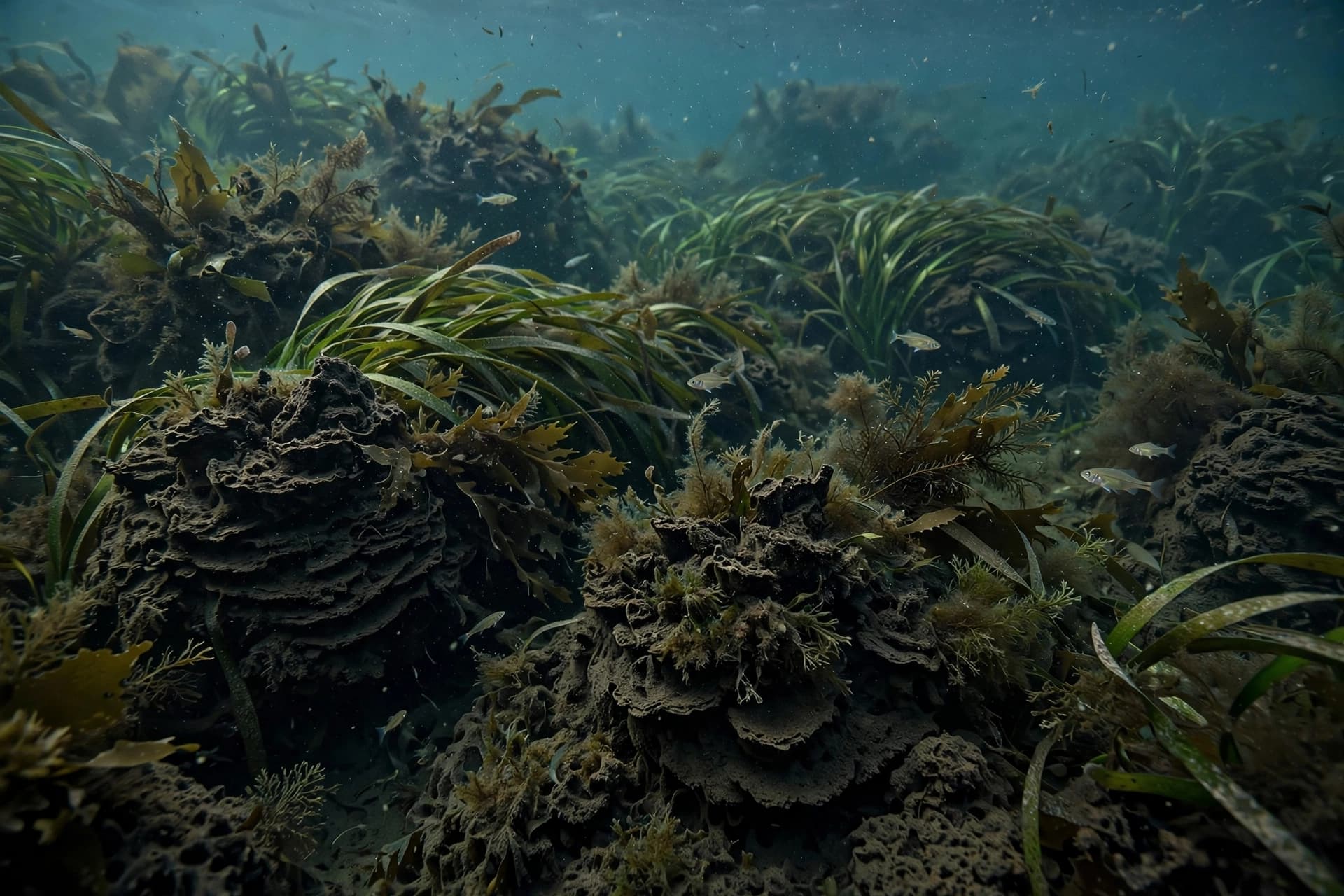
These visuals are AI-generated interpretations and not real underwater photographs.
Sources
Nature Science National Geographic Smithsonian Magazine BBC Science
Published by Banx Network. This article is part of the Banx decentralized media programme, powered by the BXE token on the XRP Ledger.