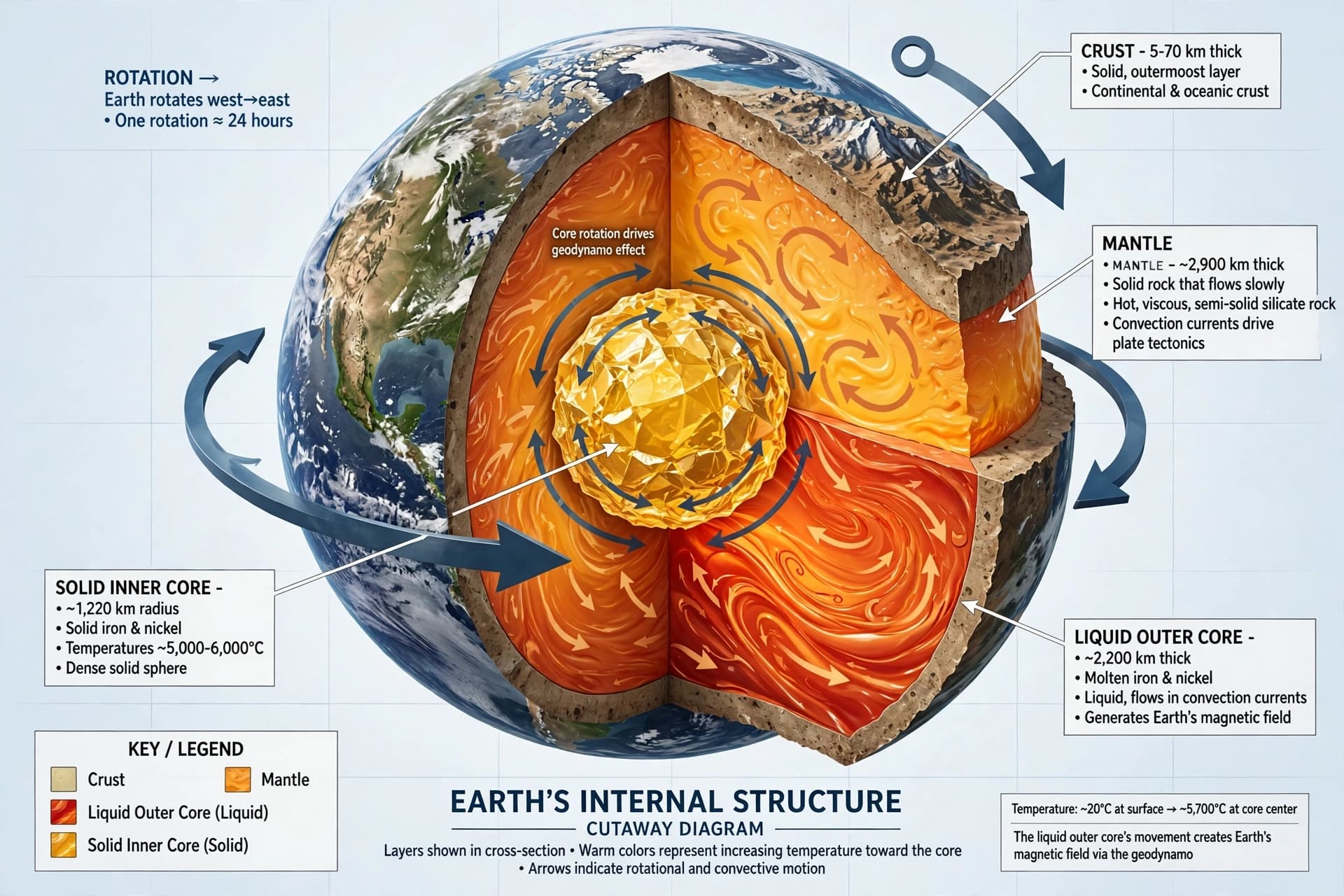
Beneath our feet, far below the crust we walk upon and the mantle that shifts slowly over millennia, a silent drama unfolds in the planet’s deepest heart. The Earth’s inner core, a solid sphere of iron and nickel, spins within the liquid outer core like a top inside a larger spinning sphere. For years, scientists have observed that this inner dance is not perfectly synchronized with the surface, and recent findings suggest that this gravitational tug-of-war is subtly altering the length of our days.
Research from institutions such as the University of Southern California and Cornell University has provided compelling evidence that the rotation of the Earth’s inner core began to slow down around 2010. This deceleration means that the inner core is now rotating more slowly than the planet’s surface, a reversal of trends observed in previous decades. The phenomenon is part of a long-term cycle, estimated to last about seventy years, where the core alternates between speeding up and slowing down relative to the mantle and crust.
The implications of this shift are measured in fractions of a second, yet they are significant for our understanding of planetary dynamics. As the inner core slows, it affects the Earth’s overall rotation, causing the length of a day to increase by tiny increments. While these changes are imperceptible to human senses, they are detectable through precise atomic clocks and seismic data, offering a window into the complex interactions between the planet’s layers.
The driving force behind this change is believed to be the churning of the liquid iron in the outer core, which generates the Earth’s magnetic field. This fluid motion creates electromagnetic and gravitational forces that interact with the solid inner core, pushing and pulling it in a delicate balance. It is a reminder that the Earth is not a static rock but a dynamic system with moving parts that influence each other in profound ways.
Seismologists have played a crucial role in uncovering this trend by analyzing waves from earthquakes that travel through the planet’s interior. By comparing the timing of these waves over several decades, researchers can track changes in the inner core’s rotation. This method has allowed scientists to confirm that the slowdown is real and not merely an artifact of measurement error or other geological noise.
The cycle of the inner core’s rotation is expected to continue, with predictions suggesting that it will begin to speed up again in the 2040s. This oscillation highlights the rhythmic nature of Earth’s internal processes, which operate on timescales far beyond human experience. Understanding these cycles helps scientists build more accurate models of the planet’s behavior, from its magnetic field to its rotational stability.
For the general public, the changing length of the day may seem abstract, but it underscores the interconnectedness of natural systems. It serves as a gentle reminder that even the most stable aspects of our environment, such as the twenty-four-hour day, are subject to the deep, hidden forces of the planet. This knowledge fosters a deeper appreciation for the complexity of the world we inhabit.
As research continues, the study of the Earth’s inner core offers valuable insights into the planet’s past and future. By listening to the subtle whispers of seismic waves, scientists are piecing together a story of gravitational balance and change, revealing the quiet power that shapes our daily lives from deep within the Earth.
AI Image Disclaimer: The images included in this article are AI-generated artistic representations of the Earth’s internal structure and do not depict actual scientific data or cross-sections.
Sources: USC News Cornell Chronicle CNN Space.com Nature Geoscience
Published by Banx Network. This article is part of the Banx decentralized media programme, powered by the BXE token on the XRP Ledger.