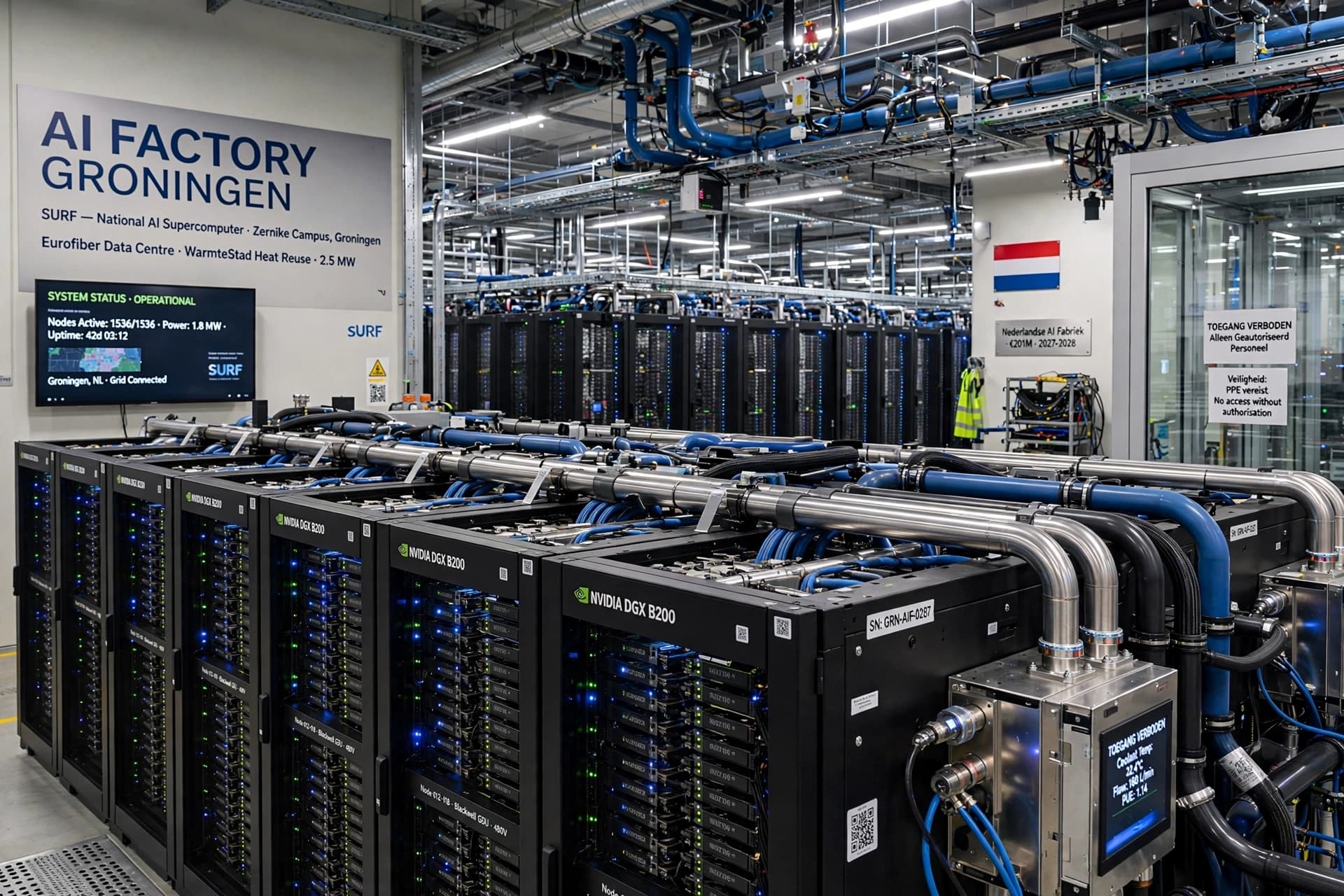
The Netherlands is preparing to install a new artificial-intelligence supercomputer in Groningen as part of a €201 million investment in advanced computing infrastructure. The project is intended to strengthen the country's capacity for AI research and other computationally demanding work.
A modern supercomputer is more than a collection of powerful machines. It is an infrastructure platform capable of processing enormous quantities of information and performing calculations that would take conventional computers considerably longer to complete.
For researchers, that capacity can be used in fields ranging from climate modeling and physics to medicine, materials science, engineering, and artificial intelligence. Large computing systems can allow researchers to test complex models, process large datasets, and simulate conditions that are difficult to reproduce physically.
The investment also reflects the growing importance of computing power in AI development. Training and operating advanced AI systems can require substantial processing capacity, making access to high-performance computing increasingly important for universities, research institutions, and technology companies.
Groningen offers a significant location for such infrastructure because of its universities, research community, and existing technological ecosystem. Bringing additional computing resources to the region could strengthen connections between academic research and technological development.
The project also raises practical questions about energy use and infrastructure. Supercomputers require large amounts of electricity and sophisticated cooling systems. Their environmental footprint therefore depends partly on how efficiently they operate and what sources provide the energy they consume.
For the Netherlands, investment in computing capacity is occurring alongside a broader effort to strengthen digital infrastructure. Data centers, high-speed networks, scientific computing facilities, and AI systems increasingly form part of the physical foundation of a digital economy.
The benefits of such infrastructure are rarely immediate. A supercomputer does not produce a single product in the way a factory does. Its value can emerge gradually through scientific discoveries, improved models, new technologies, and collaborations that develop over years.
In Groningen, the arrival of the new system represents another step into that less visible layer of the modern economy. Beneath the quiet rhythm of northern Dutch life, enormous volumes of calculations will eventually move through machines, transforming data into models, models into research, and research into possibilities that may travel much farther than the computers themselves.
SEO SLUG
netherlands-groningen-ai-supercomputer-201-million
HASHTAGS
#Netherlands #Groningen #AI #ArtificialIntelligence #Supercomputer #Technology #Science #Research
IMAGE DISCLAIMER
This AI-generated image is a conceptual editorial visualization and does not depict the actual supercomputer, facility, researchers, or construction site.
SOURCES
NL Times SURF University of Groningen Netherlands Organisation for Scientific Research
Published by Banx Network. This article is part of the Banx decentralized media programme, powered by the BXE token on the XRP Ledger.