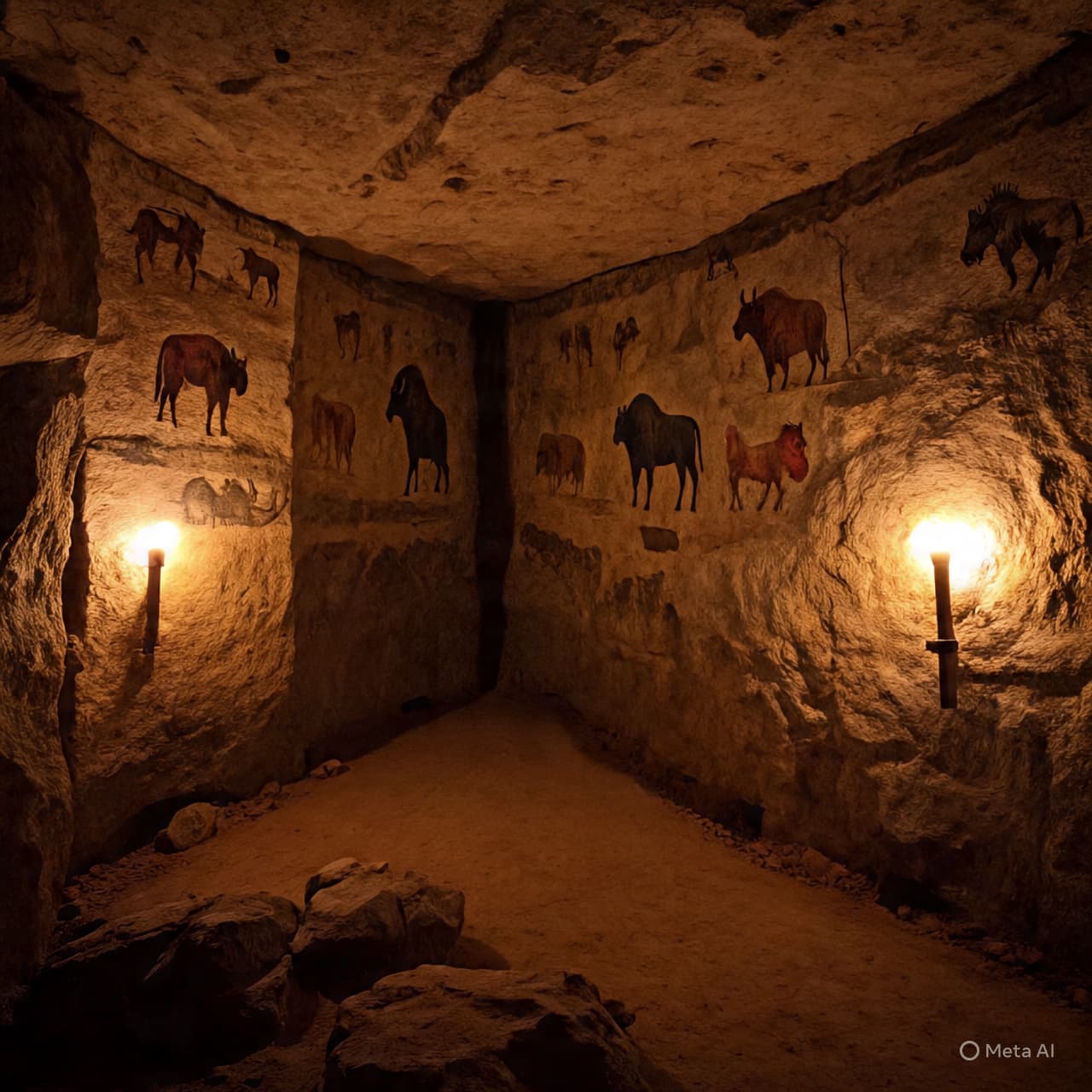
Deep beneath the quiet hills of southern France, where sunlight rarely reaches and silence lingers against stone walls, human memory waits in pigment and shadow. These caves are not museums in the modern sense. They are older than history books, older than cities, older even than agriculture. Yet on their walls remain traces of human presence — lines, shapes, animals, and symbols painted by hands that lived tens of thousands of years ago.
For generations, archaeologists have stood before these images with a mixture of wonder and caution. The paintings of bison, horses, and mysterious marks speak clearly of creativity, but the question of when they were made has often been more elusive. Time, after all, leaves few easy signatures inside caves.
Now, a new scientific effort has begun to illuminate that timeline with greater clarity. Researchers have successfully obtained direct radiocarbon dates from Paleolithic artworks in France, offering a more precise glimpse into the lives of the people who created them.
The study focused on several decorated caves in southern France, a region long known for its extraordinary Ice Age art. Sites such as , , and have preserved some of the most iconic prehistoric imagery in Europe. Their chambers contain drawings and paintings believed to date back more than 14,000 years, during the closing chapters of the last Ice Age.
Determining the age of such artworks has always been a delicate challenge. Many cave paintings were created using mineral pigments like ochre, which contain no organic material suitable for radiocarbon dating. In those cases, scientists often had to estimate the age indirectly by dating nearby charcoal remains, sediment layers, or artifacts found on cave floors.
But the new research applied a more direct approach.
Some Paleolithic artists used charcoal as part of their pigments or sketches. That charcoal once came from wood burned in ancient fires, meaning it still contains trace amounts of carbon-14 — a radioactive isotope that slowly decays over thousands of years. By carefully sampling microscopic fragments from the artwork itself, scientists can measure how much carbon-14 remains and calculate when the original wood was burned.
Using improved sampling techniques and advanced laboratory analysis, the research team obtained several new radiocarbon dates directly from the art.
The results suggest that many of the paintings belong to the Magdalenian period, a cultural era that flourished in Western Europe roughly between 17,000 and 12,000 years ago. During this time, Ice Age hunters followed migrating herds across cold landscapes while also producing some of the most sophisticated cave art known from prehistory.
In caves like Niaux and Pech Merle, the imagery reflects a close relationship between humans and animals. Bison appear with powerful shoulders and curved horns, horses are rendered with careful attention to posture, and occasionally mysterious abstract signs accompany the figures.
These images are more than decoration. Many archaeologists believe they may have held symbolic, ritual, or storytelling significance for the communities who created them. The caves themselves may have served as special places where people gathered, performed ceremonies, or passed down shared knowledge through images.
Direct radiocarbon dating does more than assign numbers to the walls. It helps researchers understand how artistic traditions evolved across generations. By comparing dates from different caves, scientists can see whether certain styles spread gradually across regions or appeared simultaneously in multiple places.
In some cases, the new dates suggest that artists returned to the same caves over long periods of time, adding new figures centuries after earlier paintings were made. The cave walls, in that sense, became layered records of human presence.
The study also highlights how technological advances continue to reshape archaeology. Techniques that once required larger samples — potentially damaging fragile artworks — have now become precise enough to work with tiny fragments barely visible to the eye.
As a result, scientists can learn more about prehistoric art while preserving it for future generations.
The caves themselves remain carefully protected today, many closed to the public to prevent damage from light, humidity, and human presence. Yet through careful research and digital documentation, their ancient images continue to reveal new details about the lives of the people who once stepped into those dark chambers carrying torches, charcoal, and imagination.
And with each new date measured from those quiet walls, the distant past becomes just a little clearer.
AI Image Disclaimer Graphics are AI-generated and intended for representation, not reality.
Sources Phys.org Archaeology Magazine ScienceDaily CNRS Live Science
Published by Banx Network. This article is part of the Banx decentralized media programme, powered by the BXE token on the XRP Ledger.