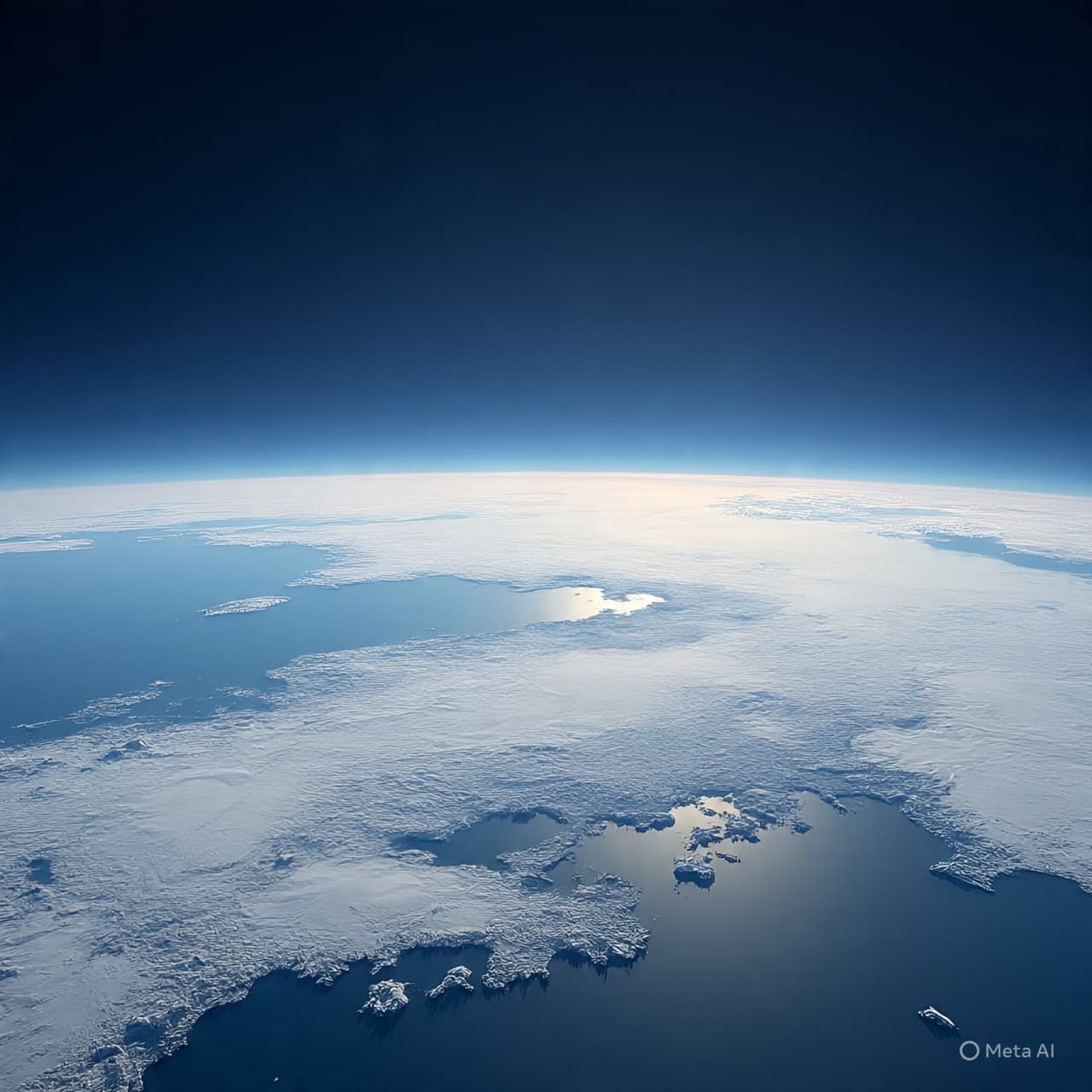
There are moments in Earth’s history that feel almost unimaginable, like half-remembered dreams buried beneath layers of stone. Among them is the vision of a planet wrapped in white — oceans stilled, continents sealed beneath ice, sunlight reflecting endlessly off a frozen skin. Scientists call it “Snowball Earth,” but the phrase carries a kind of childlike softness that belies the severity of what may have occurred.
Once, long before cities and forests and even complex life, our world may have resembled a drifting sphere of frost. And yet, beneath that frozen silence, something remarkable endured.
The Snowball Earth hypothesis suggests that during the Cryogenian period, roughly 700 million years ago, global temperatures plunged so dramatically that ice sheets extended from the poles toward the equator. Geological clues — glacial deposits found in regions that were once tropical — have encouraged researchers to consider a world where oceans were capped by thick ice.
But recent studies published in journals such as Nature and Science indicate something even more startling: liquid seawater beneath that ice may have dipped well below the typical freezing point. Under immense pressure and with high salinity, parts of Earth’s oceans could have remained liquid at temperatures far colder than zero degrees Celsius.
It is a quiet reminder that water, so familiar in a glass or a rainstorm, behaves differently in the deep. Salt lowers the freezing point, and pressure reshapes the rules further still. In laboratory simulations and chemical modeling, researchers have suggested that these briny pockets might have persisted in extreme cold — frigid yet fluid, dark yet alive with potential chemistry.
This possibility changes the emotional landscape of Snowball Earth. Rather than a planet entirely locked in icy stillness, we begin to picture hidden currents flowing beneath frozen crusts. Life, if present, would have sought refuge in these sheltered environments. Microbial communities may have endured in the deep sea or near hydrothermal vents, protected from the harsh surface climate.
The survival of early life through such episodes is more than a biological curiosity. It hints at resilience — not only of organisms, but of planetary systems themselves. Earth’s carbon cycle, volcanic outgassing, and gradual accumulation of greenhouse gases likely played roles in eventually thawing the planet. When the ice retreated, the world did not return unchanged. It emerged transformed, possibly setting the stage for the later explosion of complex life.
Snowball Earth also resonates beyond our own planet. As scientists study icy moons such as Europa and Enceladus, the idea of ultra-cold yet liquid oceans becomes especially relevant. If Earth once maintained briny seas beneath global ice, might similar processes sustain hidden oceans elsewhere in the solar system? The past, in this way, becomes a guidebook for the search for life beyond Earth.
There is a certain humility in realizing that our planet has endured states so extreme that they defy everyday intuition. The gentle blue world we know today has worn a very different face. Oceans have simmered and frozen; continents have drifted like slow thoughts across deep time.
In recent years, researchers have refined models of ocean chemistry and temperature during Snowball Earth episodes, suggesting that subzero liquid conditions were chemically plausible. Field studies continue to examine ancient rock formations for further clues about how cold those oceans truly became. While debate remains about the exact extent of global freezing, evidence increasingly supports the idea that at least some marine environments stayed liquid — albeit at temperatures far below what we once assumed possible.
The story is not one of catastrophe alone, but of endurance. Earth may have once shimmered like a frozen pearl in the darkness of space, yet beneath its icy shell, life and liquid water persisted. In that hidden resilience, we glimpse a deeper truth about our planet: even in its coldest chapters, it was never entirely still.
AI Image Disclaimer
Graphics are AI-generated and intended for representation, not reality.
---
Sources
Nature Science Magazine BBC News National Geographic Smithsonian Magazine
Published by Banx Network. This article is part of the Banx decentralized media programme, powered by the BXE token on the XRP Ledger.