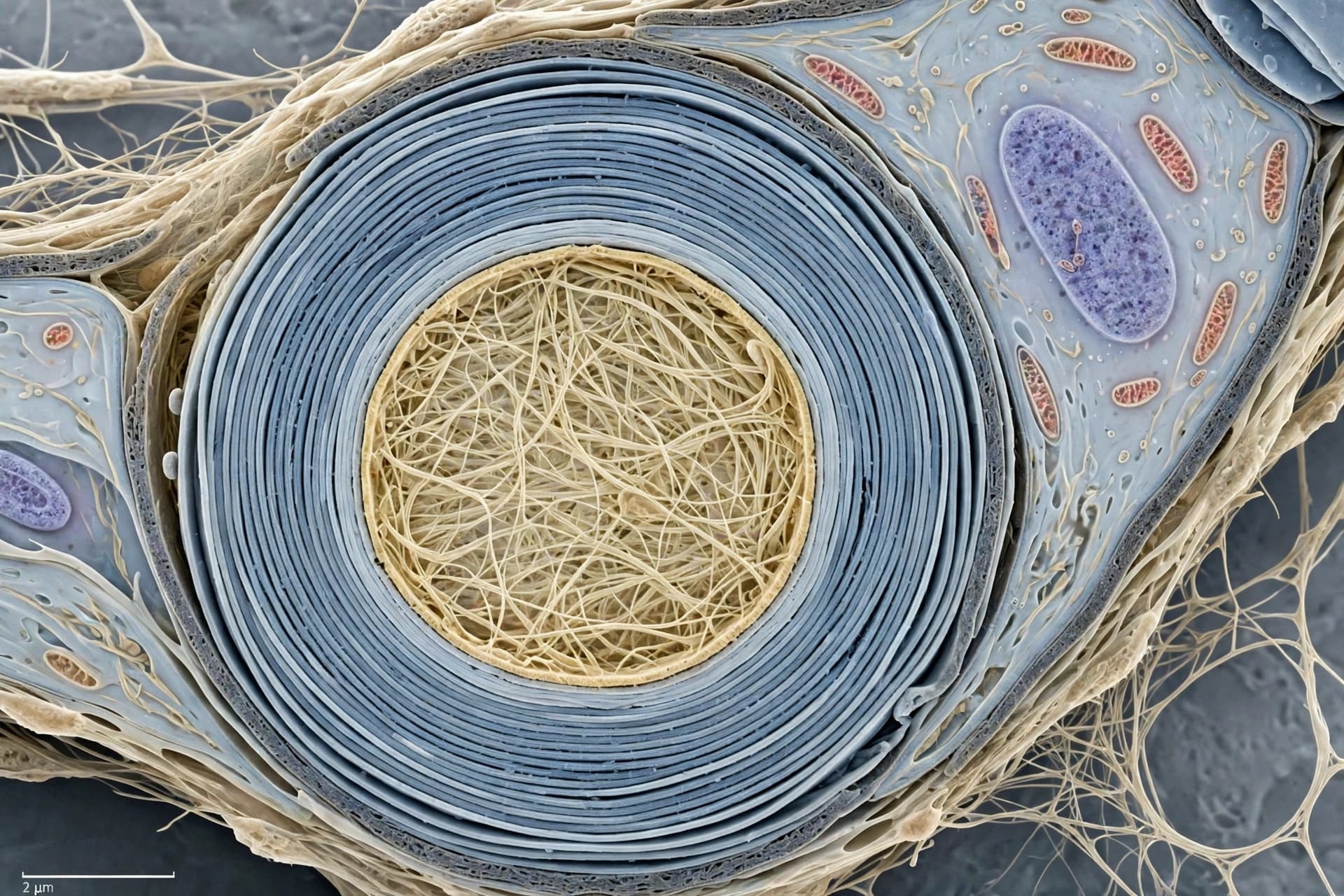
There are moments in science when time seems to fold in on itself, when a fragment small enough to rest on a fingertip carries within it an age that humbles mountains. Long before Earth cooled, before oceans formed or continents shifted, before even the Sun gathered itself into flame, there were grains — minute crystals drifting through interstellar space, born in the outflows of dying stars.
These crystals, known as presolar grains, are older than the solar system itself. They formed more than 4.6 billion years ago in the stellar winds and explosive ends of ancient stars. When those stars shed their outer layers or erupted as supernovae, atoms fused in their cores were cast outward into the galaxy. In that expanding cloud of dust and gas, tiny mineral fragments condensed — microscopic crystals of silicon carbide and other compounds — each carrying a chemical signature unique to its stellar birthplace.
Eventually, some of that dust found its way into the vast molecular cloud that would collapse to form our Sun and planets. Most material was melted, reworked, and erased in the intense heat of the newborn solar system. But a fraction of these ancient grains survived, embedded within primitive meteorites that later fell to Earth. In laboratories today, scientists isolate them grain by grain, studying isotopic ratios that differ sharply from those formed within our own solar neighborhood.
Their compositions reveal stories that cannot be read any other way. Variations in isotopes of carbon, nitrogen, and noble gases act like fingerprints of long-vanished stars. Some grains point to red giants; others to supernovae. Together, they suggest that the solar system was assembled not from a single stellar ancestor, but from a mingled inheritance — debris from multiple stellar generations.
In recent years, increasingly precise measurements have allowed researchers to estimate the ages of some of these grains more accurately. Certain silicon carbide crystals have been dated to more than 7 billion years old, meaning they existed billions of years before the Sun ignited. This finding reshapes the narrative of our origins, suggesting that parts of the material that built Earth had already endured immense spans of cosmic history.
These grains also offer insight into the environment in which the solar system formed. Their abundance and age distribution imply a period of intensified star formation in our region of the Milky Way before the Sun’s birth. In other words, the solar system may have emerged in a neighborhood already alive with stellar activity — a place where older stars were ending as new ones began.
There is something quietly profound in this continuity. The iron in blood, the calcium in bone, the silicon in sand — all trace back to stellar furnaces. The presolar crystals make that lineage tangible. They are not abstractions of astrophysics, but physical relics, older than our star, older than any planet, bearing witness to cycles of death and renewal that predate our sky.
Scientists continue to analyze these grains using advanced mass spectrometry, refining models of galactic chemical evolution and solar system formation. The evidence confirms that the earliest building blocks of our planetary system included material forged in ancient stars, preserved within meteorites that survived billions of years of cosmic change.
In studying crystals older than the Sun, researchers are not merely looking backward. They are tracing the continuity between distant stellar explosions and the quiet existence of a planet where questions can be asked at all. The beginning of the solar system, it turns out, is not a solitary event, but part of a much longer and wider unfolding.
AI Image Disclaimer
Visuals are AI-generated and serve as conceptual representations.
Sources (Media Names Only)
Nature Science NASA Live Science The New York Times
Published by Banx Network. This article is part of the Banx decentralized media programme, powered by the BXE token on the XRP Ledger.