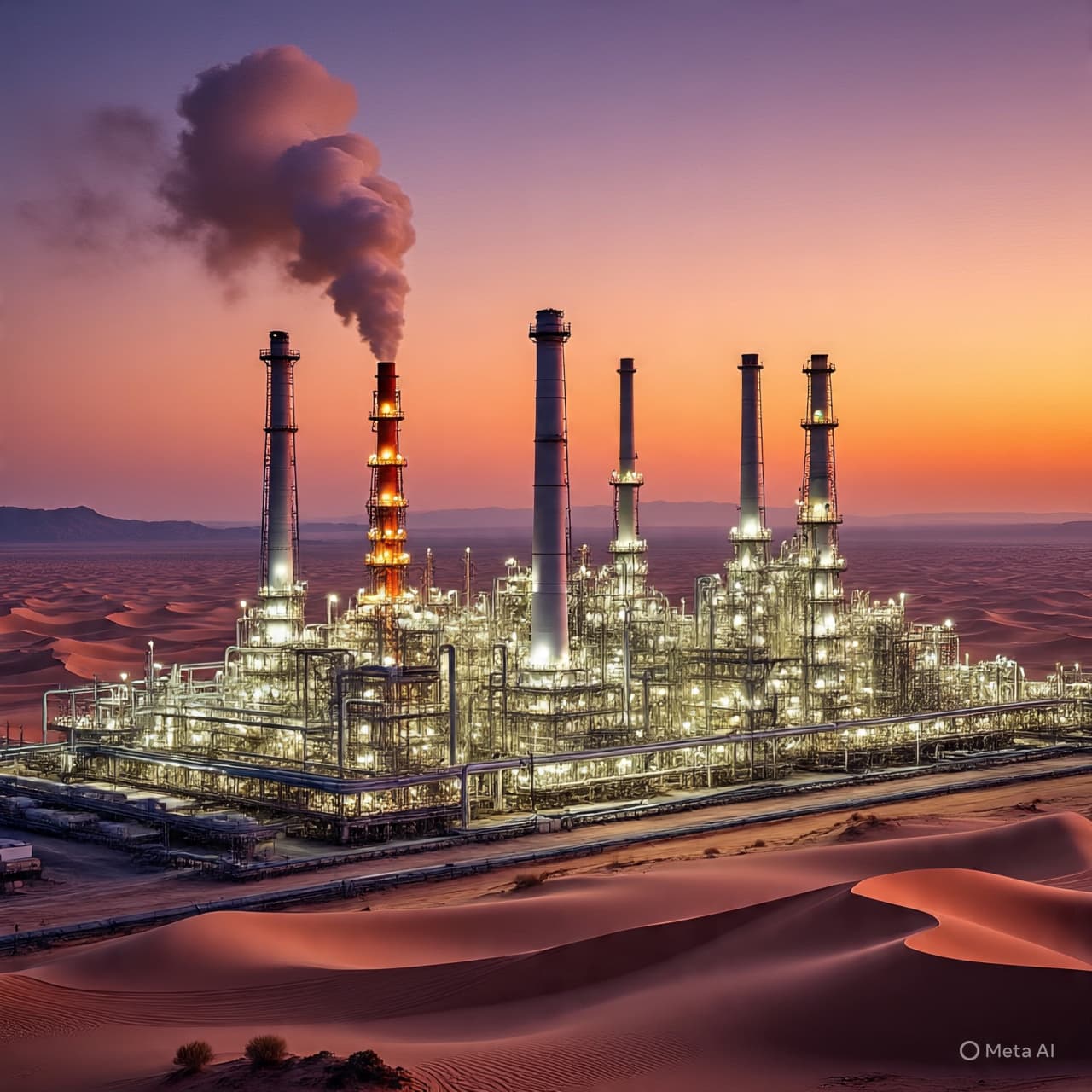
The desert does not rush its decisions. It holds the sun a little longer in the evening, lets the heat linger in the stones, and carries silence across its vast distances as if time itself were something to be negotiated. In that quiet expanse, where pipelines cut thin, deliberate lines across sand and sea, the rhythm of energy—and of consequence—moves with a patience that often outlasts the urgency of men.
In recent days, that rhythm has shifted, not with an explosion or a sudden turn, but with a pause. Donald Trump, standing at the center of a widening geopolitical tension, has chosen to delay potential strikes on Iran’s energy infrastructure by ten days. The decision arrives like a held breath, suspended between action and restraint, suggesting that even in moments of escalation, there are intervals where calculation overtakes impulse.
The energy sector—refineries, export terminals, and the delicate arteries that carry oil to global markets—has long been both symbol and substance of Iran’s position in the world. To target it is not merely to strike industry, but to disturb a broader ecosystem of supply, pricing, and dependence. Markets listen closely to such moments, reacting not only to what is done, but to what is almost done. In that sense, the delay itself becomes a signal, rippling outward through traders, governments, and households far removed from the desert.
The context surrounding the pause is layered. Tensions between Israel and Iran have intensified in recent weeks, with exchanges that move between shadow and spectacle. Washington, observing and at times shaping the arc of these developments, has weighed options that balance deterrence with the risk of wider conflict. The proposed strikes on energy facilities were seen as a potential escalation—one that could disrupt global oil flows and draw in actors beyond the immediate region.
Yet, the decision to wait suggests a recalibration. Diplomatic channels, often unseen and rarely linear, may still be in motion. Allies and intermediaries, from Gulf states to European capitals, continue to navigate the narrow space where dialogue remains possible. The ten-day window, then, becomes more than a delay; it is a corridor in which outcomes might still be redirected, however slightly.
Meanwhile, the global energy system—already sensitive to disruptions—absorbs the uncertainty. Oil prices, which often rise on anticipation as much as on event, reflect the fragile equilibrium between supply and risk. Shipping routes through the Strait of Hormuz remain under quiet scrutiny, their significance magnified by every headline and hesitation. In distant cities, where fuel costs shape daily life, the consequences of these decisions are felt not as policy, but as price.
Within Iran, the energy sector continues its steady function, even as it exists under the shadow of potential targeting. Facilities operate, workers report, and exports move, all within a landscape where continuity is both necessity and defiance. The machinery of production does not pause easily, even when the world around it seems to hover in uncertainty.
As the ten-day interval unfolds, the question is less about what will happen than about what might yet be avoided. Decisions delayed are not decisions undone, but they carry within them the possibility of alteration. In that space—brief, fragile, and often overlooked—history sometimes finds its quieter turns.
For now, the desert holds its breath a little longer. The pipelines remain intact, the ships continue their passage, and the horizon stays unbroken. What comes next will emerge not only from power, but from the measured distance between intention and action—a distance that, for ten days at least, has been allowed to remain.
AI Image Disclaimer Illustrations were created using AI tools and are not real photographs.
Sources Reuters Associated Press Bloomberg Al Jazeera The New York Times
Published by Banx Network. This article is part of the Banx decentralized media programme, powered by the BXE token on the XRP Ledger.