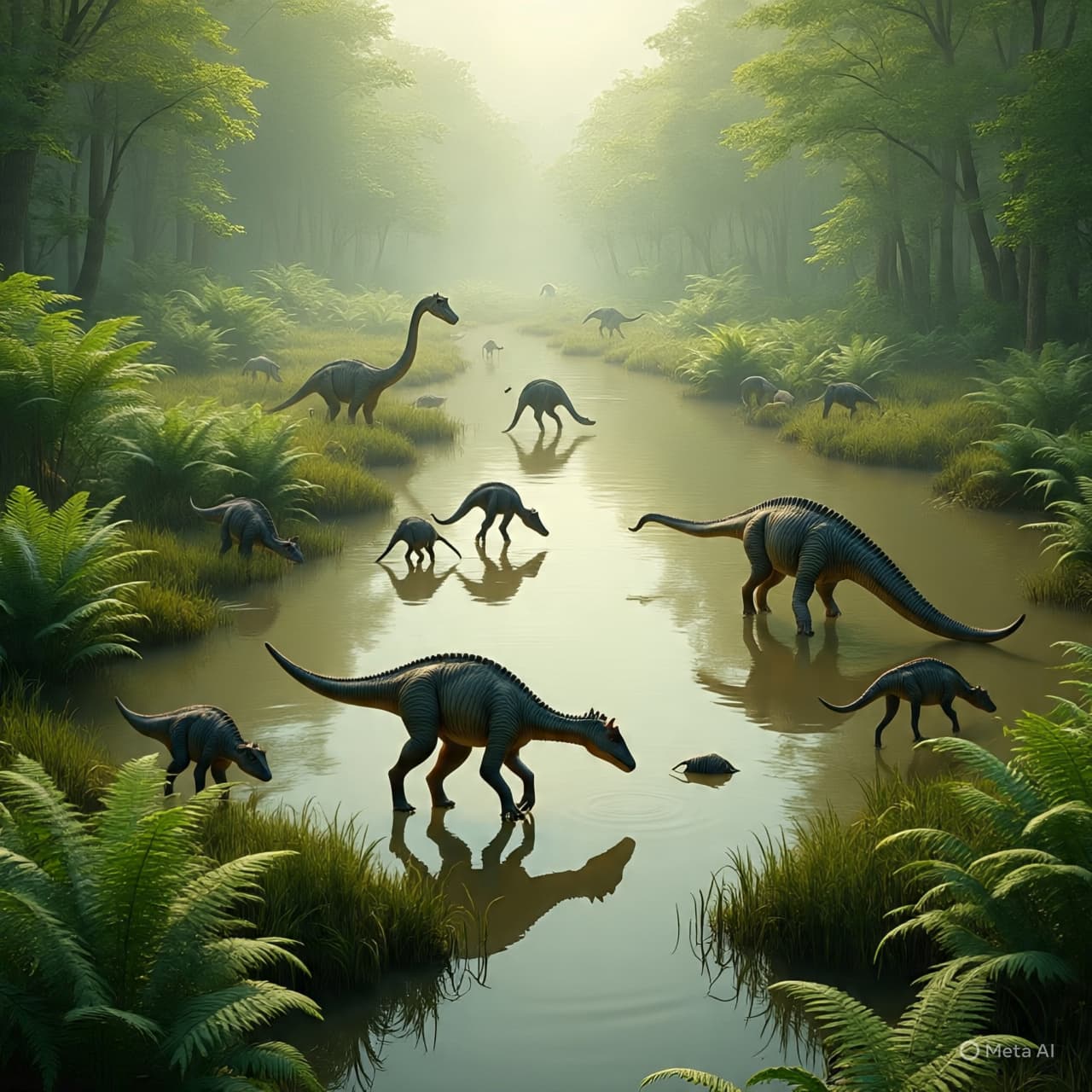
Morning light stretches across an ancient floodplain, long buried beneath layers of stone and time. Beneath the surface, fossils whisper of a world dominated by giants — creatures so immense that their shadows once darkened the plains. Yet, before their enormous necks and tails rose to the sky, these titans began life small, fragile, and surprisingly vulnerable. New research reveals that juvenile sauropods were more than incidental prey; they were a cornerstone of the Late Jurassic food web, a ready source of nourishment for the carnivores that roamed alongside them.
In the fossil record, teeth marks, bone wear, and ecological models tell a story of predation both ordinary and precise. Hatchlings of Diplodocus and Brachiosaurus, no larger than a child, were easy targets for predators like Allosaurus and Torvosaurus. Their abundance provided a reliable food supply, sustaining communities of hunters whose survival depended on this hidden generosity of nature. These young sauropods, delicate yet numerous, formed a vital link in an ecosystem finely balanced between vulnerability and resilience.
Imagine a hatchling stepping from its fragile shell, unaware of the predators watching from the undergrowth, unguarded by parents too immense to brood safely. Life began in constant risk, and yet it persisted, sculpting the evolution of both prey and predator. The patterns of predation reveal not brutality alone, but the subtle logic of ecosystems — a rhythm of abundance, scarcity, and opportunity that echoes across time.
In the quiet of the fossil layers, one sees the delicate interplay of life, where the smallest and weakest become essential to the survival of the largest. It is a reminder that even in the age of giants, life’s tiniest threads can hold the web together.
AI Image Disclaimer: Visuals are AI-generated and serve as conceptual representations.
Sources University College London New Mexico Museum of Natural History and Science ScienceAlert Earth.com India Today
Published by Banx Network. This article is part of the Banx decentralized media programme, powered by the BXE token on the XRP Ledger.