There are stories written not in ink, but in dust—fragments that drift through space, carrying with them the quiet memory of beginnings. Long before oceans formed or life stirred on Earth, these fragments moved through a young solar system, untouched and patient, as if waiting for a moment when their secrets might finally be understood.
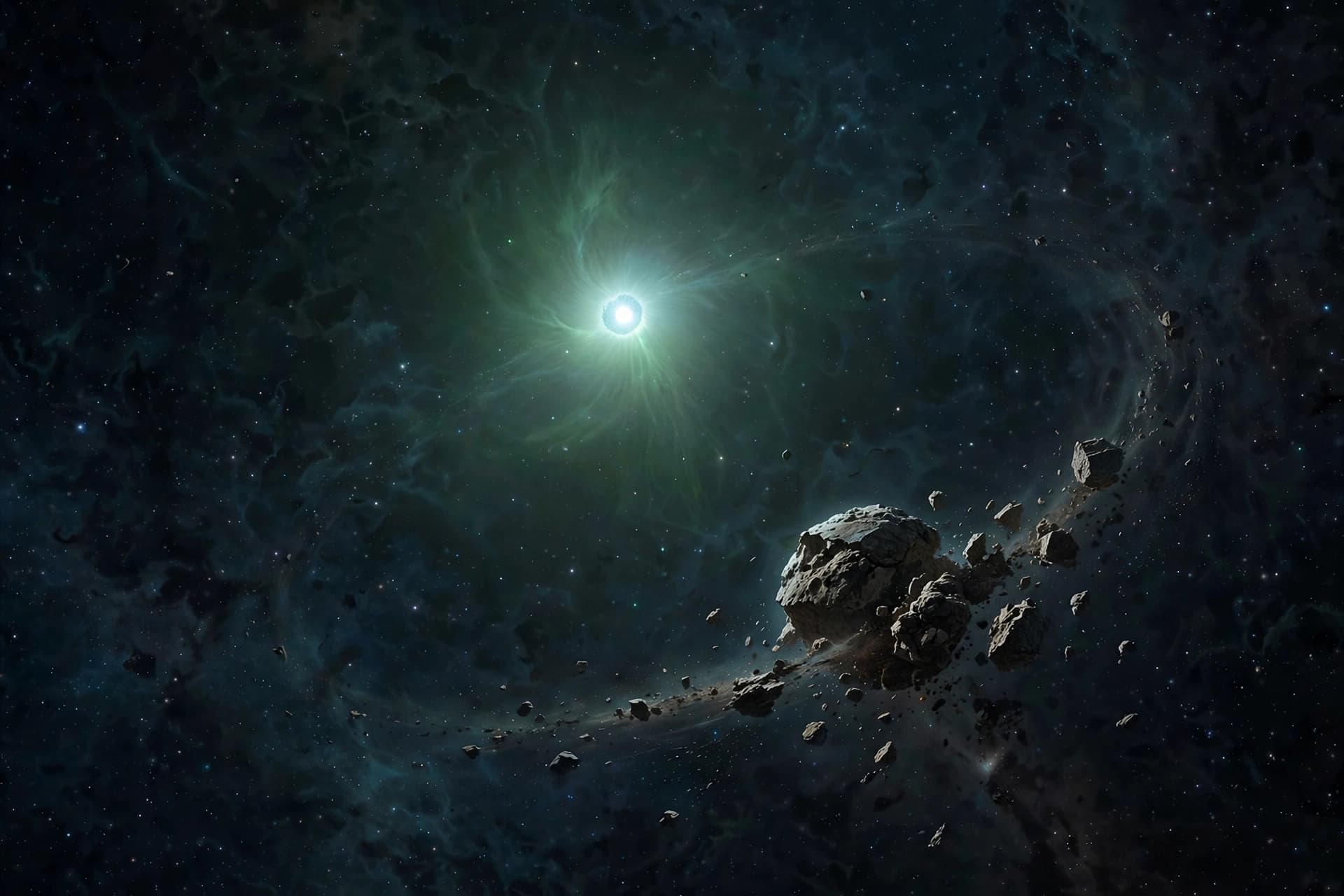
One such fragment is the asteroid , a small, dark body that has become an unlikely messenger from the distant past. Through samples returned by Japan’s , scientists have begun to uncover materials that may illuminate one of humanity’s most enduring questions: how life on Earth began.
The samples, collected by the Hayabusa2 mission, reveal that Ryugu contains a rich array of organic compounds. These are not signs of life themselves, but rather the chemical ingredients that can, under the right conditions, give rise to it. Amino acids, nitrogen-bearing molecules, and other complex carbon-based structures have been identified, suggesting that the building blocks of biology may have been present in space long before they appeared on Earth.
There is something quietly profound in this realization. It suggests that life’s origins may not be confined to a single place or moment, but instead woven into the broader fabric of the solar system. Asteroids like Ryugu, formed from the primordial material of the early solar nebula, act as time capsules, preserving conditions that no longer exist on planets that have since evolved and transformed.
What makes Ryugu particularly valuable is its relative purity. Unlike meteorites that fall to Earth and risk contamination, these samples were carefully collected and returned in a controlled manner, preserving their original composition. This allows scientists to study them with a level of confidence that was once difficult to achieve, offering clearer insights into the chemistry of the early solar system.
The findings also lend support to a long-standing idea known as panspermia, or at least to a gentler variation of it: that essential organic molecules may have been delivered to Earth by asteroids and comets. In this view, the seeds of life were not created entirely in isolation, but arrived gradually, carried across space and deposited onto a young and receptive planet.
Yet the story is not one of simple transfer. The presence of organic compounds does not guarantee the emergence of life. Earth itself provided the unique conditions—liquid water, energy sources, and environmental stability—that allowed these ingredients to assemble into living systems. Ryugu’s contribution, if any, may have been as a supplier, offering raw materials rather than finished forms.
There is also a deeper scientific nuance in the composition of these materials. Some of the compounds found in Ryugu samples show signs of chemical processes that occurred in the presence of water, suggesting that even small bodies like asteroids once hosted environments where complex chemistry could unfold. This blurs the boundary between planet and asteroid, hinting that the pathways toward life’s ingredients may be more widespread than once thought.
In a broader sense, Ryugu invites us to reconsider the scale of life’s origins. Instead of a single origin point, there may have been a network of contributions, a gradual accumulation of complexity across space and time. Each asteroid, each comet, becomes part of a larger narrative—one in which life emerges not from isolation, but from connection.
There is a quiet elegance in this perspective. It transforms the night sky from a distant expanse into a kind of archive, where each object holds a fragment of a shared history. The materials that once drifted through space may now be part of the very systems that allow us to ask these questions.
As research continues, scientists are carefully analyzing the Ryugu samples, comparing them with other extraterrestrial materials and refining their understanding of early solar system chemistry. The work is ongoing, measured, and precise—less a sudden revelation than a gradual unfolding.
In gentle terms, the discoveries from Ryugu do not claim to resolve the mystery of life’s origins entirely. Instead, they offer something more enduring: a deeper context, a broader horizon, and a reminder that the story of life may begin not only on Earth, but in the quiet journeys of objects that traveled long before we knew how to look for them.
AI Image Disclaimer Images in this article are AI-generated illustrations, meant for concept only.
Source Check (Credible Media Identified): Nature Astronomy Science Magazine NASA JAXA (Japan Aerospace Exploration Agency) BBC Science
Published by Banx Network. This article is part of the Banx decentralized media programme, powered by the BXE token on the XRP Ledger.