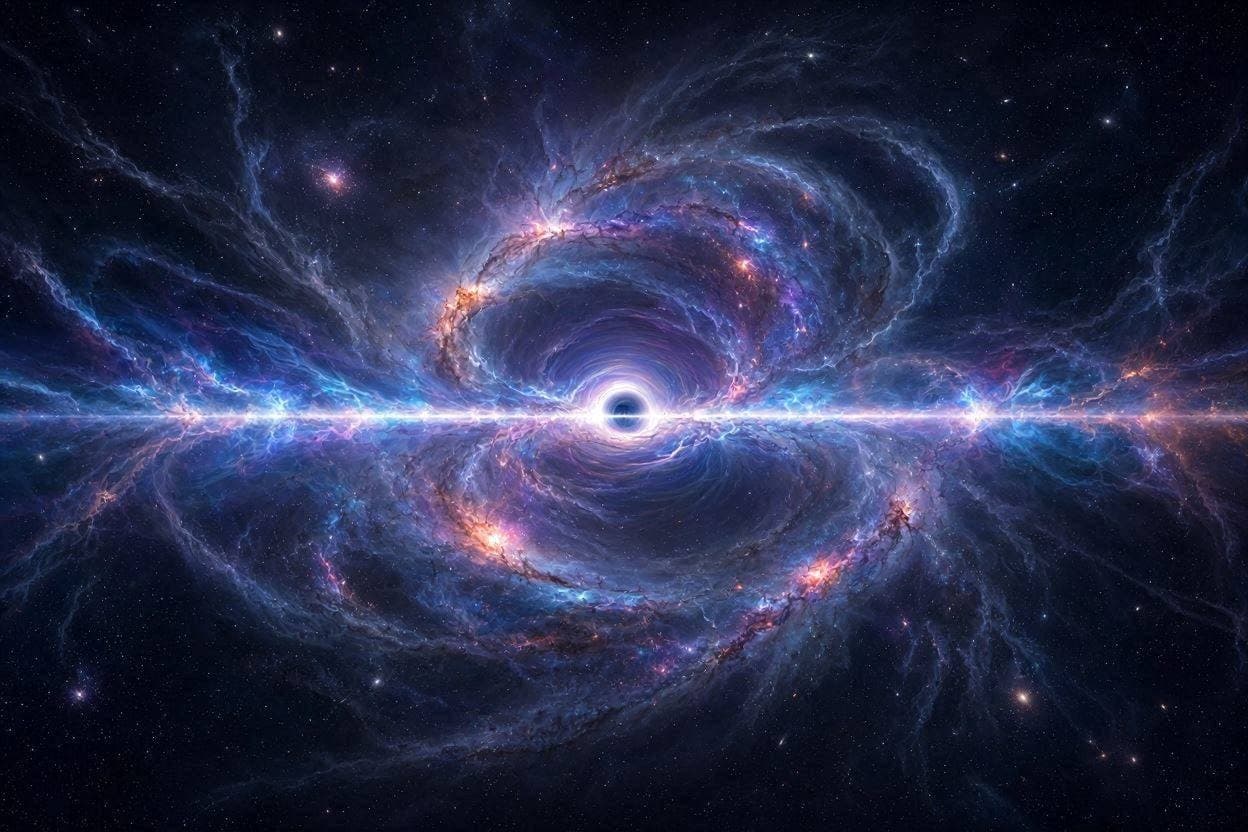
In the deepest recesses of cosmic time, where the universe was still in its infancy, there burn lights so bright they outshine entire galaxies. These are quasars, powered by supermassive black holes that feed on surrounding matter with voracious appetite. Recent discoveries reported by Reuters have identified some of the most distant quasars ever seen, pushing the boundaries of our observational reach and challenging our understanding of how such monstrous structures could form so quickly after the Big Bang.
Body: The newly discovered quasars date back to when the universe was less than a billion years old, a period known as the cosmic dawn. At this time, the first stars and galaxies were just beginning to ignite, yet these quasars suggest that black holes with billions of times the mass of our Sun had already formed. This rapid growth poses a significant puzzle for astrophysicists, as standard models of black hole evolution struggle to explain how they could accumulate so much mass in such a short timeframe.
These ancient beacons are detected through their intense radiation, which travels across billions of light-years to reach our telescopes. By analyzing the spectrum of this light, astronomers can determine the distance of the quasar and the properties of the intergalactic medium it passed through. The light acts as a probe, revealing the distribution of hydrogen and other elements in the early universe, offering a glimpse into the conditions that prevailed before the first galaxies fully assembled.
The discovery of these quasars also sheds light on the process of reionization, a pivotal era when ultraviolet light from the first stars and quasars stripped electrons from neutral hydrogen atoms, making the universe transparent to light. Quasars likely played a crucial role in this process, ionizing vast regions of space and shaping the large-scale structure of the cosmos. Understanding their contribution is essential for constructing a complete picture of cosmic evolution.
However, the existence of such massive black holes so early in history raises questions about their seeds. Did they form from the collapse of massive primordial stars, or did they arise from direct collapse of gas clouds? Or perhaps they grew through frequent mergers of smaller black holes? Each scenario has different implications for the physics of the early universe, and the new observations provide constraints that help theorists narrow down the possibilities.
The technological feat required to detect these faint, distant objects is immense. It involves combining data from multiple observatories, including space telescopes and ground-based infrared instruments, to filter out noise and identify the unique signature of a high-redshift quasar. The collaboration between international teams of astronomers highlights the global nature of modern scientific inquiry, where shared resources and expertise lead to breakthroughs that no single entity could achieve alone.
As we look further back in time, each new quasar discovery adds a piece to the puzzle of cosmic history. They serve as milestones in the timeline of the universe, marking periods of intense activity and transformation. Their study not only informs us about black holes but also about the fundamental laws of physics that govern the growth of structure in the cosmos.
Closing: The identification of these ancient quasars deepens the mystery of the early universe while simultaneously providing valuable data to solve it. As observational capabilities continue to improve, we can expect to find even more distant and surprising objects, forcing us to continually refine our models of how the cosmos came to be as it is today.
AI Image Disclaimer: The images provided are AI-generated visualizations of quasars and the early universe, created for illustrative purposes and not based on direct photographic evidence.
Sources: Reuters, Nature, Space.com, NASA, Scientific American
Published by Banx Network. This article is part of the Banx decentralized media programme, powered by the BXE token on the XRP Ledger.