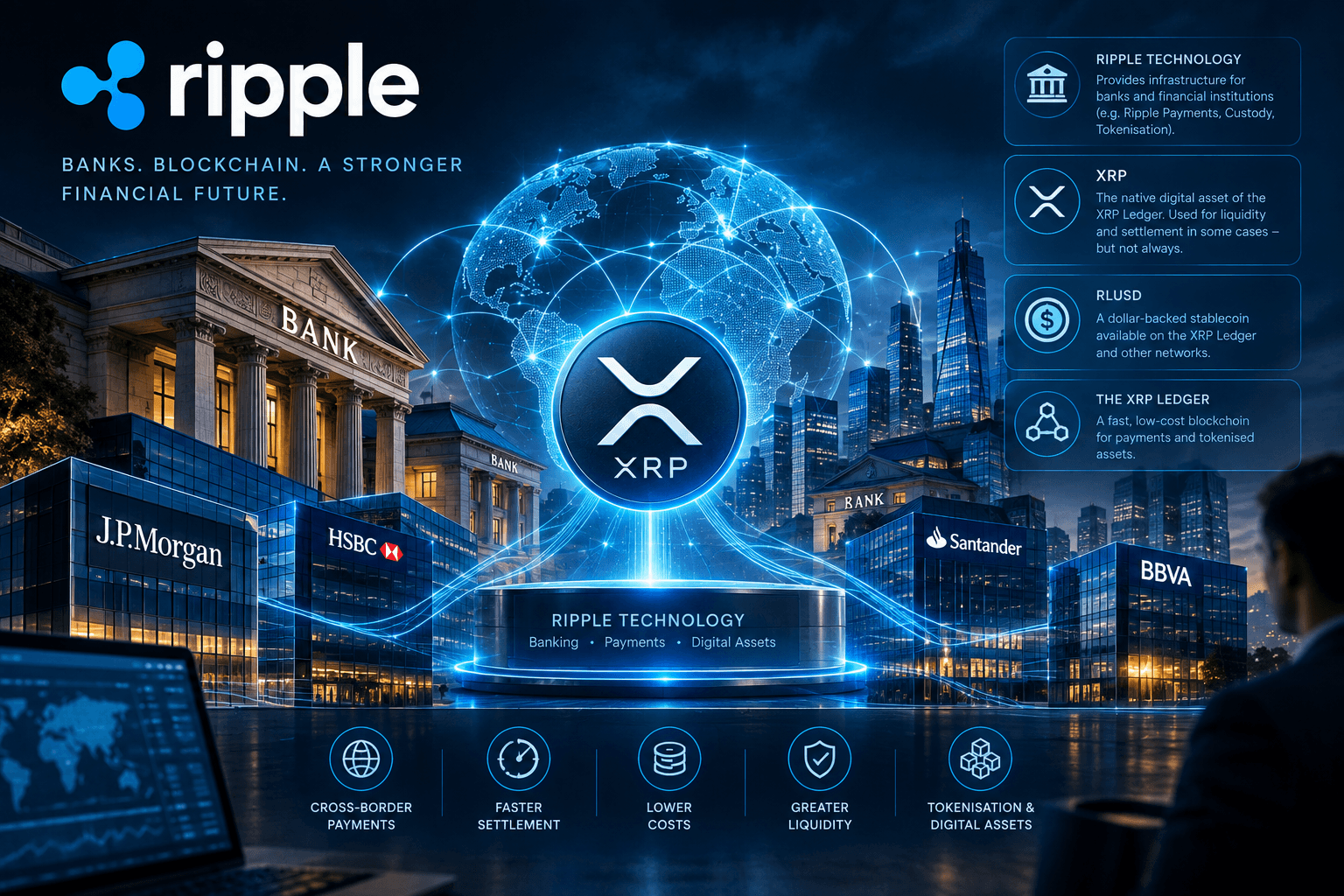
The relationship between traditional banks and cryptocurrency has changed considerably in recent years. Financial institutions are increasingly experimenting with blockchain, tokenised assets and digital payments, while companies such as Ripple are developing infrastructure designed to connect traditional finance with digital assets.
However, one distinction is particularly important: a bank using Ripple technology does not automatically mean that the bank is using XRP.
Ripple and XRP Are Not the Same Thing
Ripple is a financial technology company that develops blockchain-based infrastructure for businesses and financial institutions. XRP, meanwhile, is the native digital asset of the XRP Ledger (XRPL), an independently operated blockchain. [1]
Ripple's products can therefore be used without XRP being involved in every transaction.
This distinction matters when evaluating claims about bank adoption. Ripple offers services covering payments, custody and digital-asset infrastructure, while XRP can function as a digital asset and liquidity mechanism within the broader XRP Ledger ecosystem.
Why Banks Are Interested in Blockchain
Cross-border payments traditionally involve multiple financial institutions, payment systems and intermediaries. These processes can create additional costs, settlement delays and liquidity requirements.
Blockchain networks provide another way of recording and transferring value. The XRP Ledger, for example, supports direct XRP payments that can typically settle in approximately eight seconds or less. [2]
Ripple's current payments infrastructure is designed to connect traditional and digital payment rails. The company says its Ripple Payments platform can provide financial institutions and businesses with cross-border payment capabilities and access to digital assets and stablecoins. [3]
For banks, the attraction is therefore not necessarily cryptocurrency speculation. Instead, blockchain technology can potentially provide new infrastructure for settlement, liquidity management and international payments.
Banks Using Ripple Technology
There are already examples of banks integrating Ripple's technology.
In December 2025, Ripple announced that Switzerland-based AMINA Bank had become the first European bank to use Ripple Payments. The partnership was designed to support near-real-time cross-border payments for AMINA's customers. [4]
In August 2026, Ripple announced another banking partnership with South Korea's Jeonbuk Bank. The bank became the first regional Korean bank to deploy Ripple Payments for cross-border remittances to business customers. Ripple said the service provides settlement in seconds to minutes and operates around the clock. [5]
These examples demonstrate growing institutional interest in Ripple's payment infrastructure. However, neither announcement by itself establishes that the banks are using XRP as the settlement asset for every transaction.
Where Does XRP Fit In?
XRP has a different role within the digital-asset ecosystem.
The XRP Ledger allows XRP to be transferred directly between accounts without intermediaries. XRP can also be used as a bridge asset between different currencies in certain payment structures.
Historically, Ripple has tested XRP with financial institutions as a potential mechanism for improving cross-border liquidity. In 2016, Ripple and R3 announced a trial involving 12 banks, including Barclays, Santander, Royal Bank of Canada, National Australia Bank and Westpac. The trial specifically examined XRP for cross-border payments and liquidity. [6]
However, a historical trial should not automatically be interpreted as evidence that those banks currently use XRP in their live payment operations.
That distinction is particularly important because Ripple's modern payments strategy also includes stablecoins and other digital assets.
RLUSD Adds Another Layer
Ripple's introduction of RLUSD, a dollar-denominated stablecoin, has expanded the range of digital assets available within its ecosystem.
Ripple states that RLUSD is backed by reserves and is available across supported blockchain networks, including the XRP Ledger. [7]
This creates an important distinction between the company's payment infrastructure and any individual digital asset used within it. A financial institution can potentially use Ripple's infrastructure while choosing XRP, RLUSD, fiat currency or another supported settlement mechanism depending on the product and transaction.
A recent example illustrates this distinction. In August 2026, Ripple announced its partnership with Jeonbuk Bank but did not identify XRP as the asset powering the bank's cross-border payment service. [5]
The Institutional Adoption Question
The more relevant question may therefore be less about how many banks have "partnered with Ripple" and more about what each institution is actually using.
There are several different levels of involvement:
-Using Ripple's payment infrastructure -Using Ripple's custody technology -Holding or supporting digital assets -Using the XRP Ledger -Using XRP for liquidity or settlement -Using RLUSD or another stablecoin
These are not interchangeable.
Ripple itself highlights banking relationships involving both payments and digital-asset custody. Its banking solutions include Ripple Payments and Ripple Custody, with examples including BBVA Switzerland and Banco Genial. [3]
As the financial sector becomes more involved with blockchain, these distinctions will become increasingly important.
What This Means for XRP
For XRP, institutional adoption depends on actual use rather than simply the number of companies associated with Ripple.
If financial institutions use XRP for liquidity or settlement, that represents a direct use case for the asset. If institutions use Ripple's infrastructure but settle using fiat or stablecoins, the relationship with XRP is different.
The development of multiple settlement options also reflects a broader trend across financial markets. Banks are exploring stablecoins, tokenised deposits and other blockchain-based forms of digital money alongside traditional payment infrastructure. Recent UK banking experiments involving tokenised deposits show that financial institutions are investigating several competing approaches to blockchain-based settlement. [8]
The future relationship between banks and XRP will therefore depend on how institutions choose to use digital assets as blockchain adoption develops.
Rather than treating every Ripple partnership as proof of XRP adoption, examining the specific technology, asset and use case provides a clearer picture of where XRP fits into the evolving financial system.
References
[1] XRP Ledger, What Is the XRP Ledger? XRPL Documentation
[2] XRP Ledger, Direct XRP Payments. XRPL Documentation – Direct XRP Payments
[3] Ripple, Crypto & Blockchain Solutions for Banks. Ripple – Banking Solutions
[4] Ripple, Ripple Payments Sees First European Bank Adoption With AMINA Bank, December 2025. Ripple announcement
[5] Ripple, Ripple and Jeonbuk Bank Partner to Modernize Cross-border Payments, August 2026. Ripple announcement
[6] Ripple, Ripple and R3 Team Up With 12 Banks to Trial XRP for Cross-Border Payments, October 2016. Ripple – XRP Banking Trial
[7] Ripple, Ripple USD Stablecoin Documentation. Ripple Stablecoin Documentation
[8] Reuters, UK banks make first interbank transactions using tokenised deposits, September 2026.
This article is for informational purposes only and does not constitute financial or investment advice.
Published by Banx Network. This article is part of the Banx decentralized media programme, powered by the BXE token on the XRP Ledger.