Key Highlights
- BIS oversees a $1.9 quadrillion derivatives market.
- XRP Ledger offers near-instant settlements at low costs.
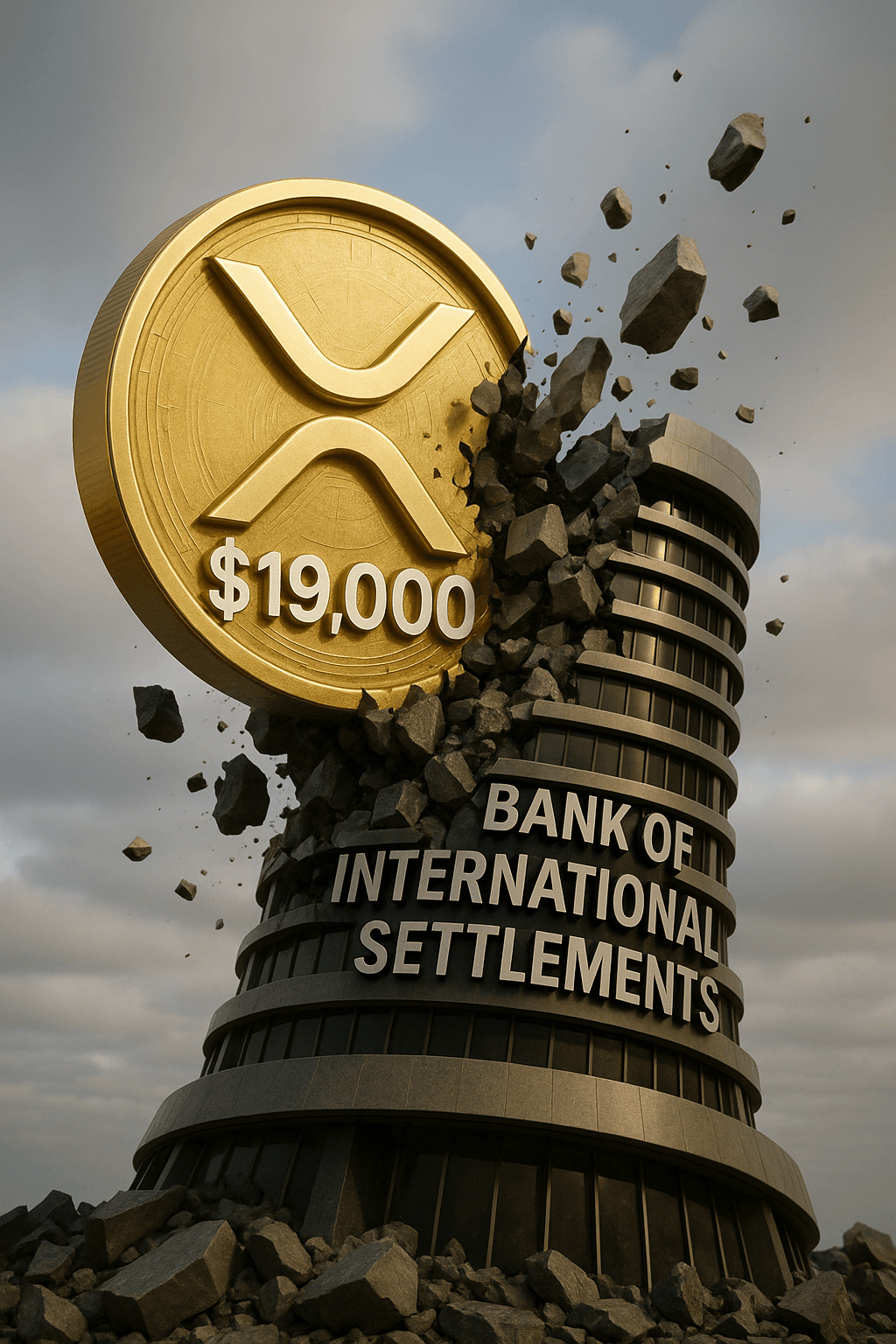
- Analysts speculate XRP could reach $19,000 per token.
The Bank for International Settlements (BIS), often referred to as the 'central bank of central banks,' plays a crucial role in overseeing and facilitating payments, settlements, and regulatory coordination across more than 60 central banks globally. According to BIS reports, the notional value of global derivatives markets is estimated at a staggering $1.9 quadrillion. This immense pool of settlement activity currently relies on traditional banking systems, which are often slow, fragmented, and costly.
The rise of blockchain technology has generated significant interest among central banks and financial institutions looking for faster and more efficient methods of cross-border settlement. The XRP Ledger (XRPL), designed specifically for institutional-scale payments, offers near-instant settlement times of 3 to 5 seconds, with transaction fees as low as $0.0002 per transfer. This positions XRP as a viable solution for managing high-value global settlements effectively.
Institutions are increasingly considering XRP for several reasons. First, the efficiency of XRP transactions is notable; they finalize within seconds, contrasting sharply with the days it can take for traditional correspondent banking networks to settle transactions. Additionally, the low cost of transactions means that even billion-dollar transfers can be settled on the XRPL for a fraction of a cent. The scalability of the XRPL is also impressive, consistently handling over 1,500 transactions per second (TPS) and capable of scaling further as demand increases. Furthermore, Ripple, the company behind XRP, has made strides in regulatory compliance, securing licenses in various jurisdictions and collaborating closely with regulators, central banks, and financial institutions worldwide.
The market potential for XRP is immense. If even a small percentage of the BIS settlement flows were to transition to blockchain solutions like the XRPL, the impact on XRP's valuation could be significant. Analysts and crypto advocates suggest that capturing just 10% of the BIS's $1.9 quadrillion flows could generate trillions in annual settlement demand for XRP. Unlike fiat currencies, XRP has a fixed supply of 100 billion tokens, with a considerable portion already in circulation and some held in escrow. This scarcity, combined with its global utility, supports the argument for potential price appreciation to extreme levels.
Mathematical models indicate that at a fully absorbed $1.9 quadrillion market, XRP's theoretical value could approach $19,000 per token. However, such estimates are speculative and heavily depend on factors like adoption rates, regulatory clarity, and market demand.
Looking ahead, the BIS has begun experimenting with blockchain-based settlement through initiatives like mBridge, a collaborative project with multiple central banks testing cross-border Central Bank Digital Currency (CBDC) settlements. While XRP is not the only technology being evaluated, its proven track record for instant, low-cost settlement gives it a competitive edge.
For XRP to achieve the projected valuations, several critical milestones must align: broad regulatory approval across major economies, institutional adoption by banks and payment processors, integration with CBDCs and cross-border payment frameworks, and sustained liquidity across global exchanges and corridors.
The BIS oversees financial flows that far exceed global GDP, with $1.9 quadrillion in derivatives and related settlements moving through its frameworks. If XRP were to emerge as the primary settlement token in this ecosystem, the theoretical price of $19,000 per token could become a reality. While this figure should be approached with caution, it underscores the vast opportunities XRP could seize as institutions increasingly seek blockchain-powered solutions for the future of finance.
Disclaimer: This article is for informational purposes only and does not constitute financial advice. Cryptocurrency markets are volatile, and any investment decision should be made with independent research and professional consultation.
Published by Banx Network. This article is part of the Banx decentralized media programme, powered by the BXE token on the XRP Ledger.