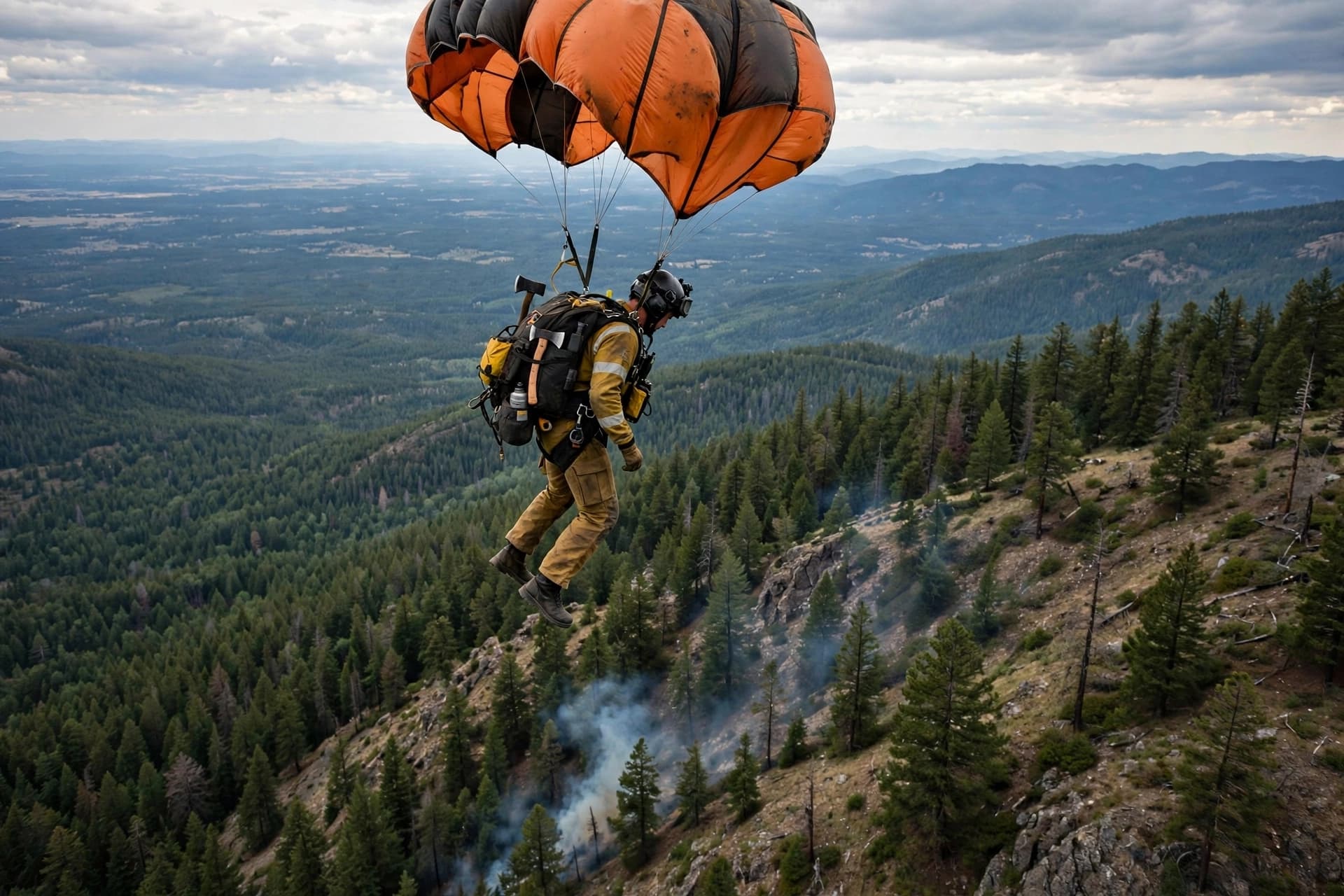
There is a particular logic to fighting a fire before it becomes a fire, to reaching a remote ignition point while it is still a small circle of flame rather than a wall of heat advancing on a town. For decades, Australia has relied on helicopters and rappel crews to reach fires in inaccessible terrain. But as fire seasons lengthen and overlap with the northern hemisphere, a former fire chief and senior military officer is arguing that the country needs a capability it has never used: firefighters who parachute from aircraft into remote fire grounds, the kind North Americans call smoke jumpers.
Major General Peter Dunn, a former ACT Emergency Services Authority commissioner now with Emergency Leaders for Climate Action, told WAtoday that early detection through satellite imagery, drone surveillance, infrared sensing, and artificial intelligence must be paired with teams that can attack fires immediately . "The climate has changed so significantly that we're dealing with these extreme weather events driving fiercer, longer fires," he said. "You're looking at every means of getting qualified firefighters in on the ground when a fire is extremely small, and at times the only way you can get them in is to parachute them in" .
The context for this proposal is a documented decline in capacity. A report titled Prepare or pay: Counting the cost of climate-fuelled bushfires found that in 2023-24 there were 10,336 fewer volunteers with Australian firefighting agencies compared with four years earlier, while paid personnel increased by just 433 full-time equivalent positions . The same report warns that bushfires will cost the economy an average of $6 billion a year over the next 30 years, nearly triple previous estimates. South-east Australia now experiences 14 more days a year of extreme fire weather than before 1998, and fire seasons are 20 percent longer than in 1979 .
Australia has not used parachutes to deploy firefighters. During the Black Summer of 2019-20, a specialist crew rappelled from a helicopter to save a grove of rare Wollemi pines, but that was an exception, not a system . The United States has used smoke jumpers since 1939 and maintains 450 permanent staff trained for the work, according to the US National Interagency Fire Centre. British Columbia in Canada employs about 80 "para-attack wildfire fighters" a year . Victoria's Forest Fire Management agency has hosted Canadian smokejumpers in recent seasons, including Erwin Bocianski, who noted that Australia's limited water access and hardwood forests required a significant shift in tactics from his experience in Canada .
Dunn's argument extends beyond the parachutes themselves. He called for Australia to buy at least 12 aircraft tankers, noting that the country owns just one, in NSW, because fire seasons now overlap with North America and Australia can no longer rely on borrowing air tankers . He also suggested that the adventurous nature of smoke jumping could help with recruitment, attracting fit young people into fire services at a time when volunteer numbers are falling.
For now, the proposal is a recommendation, not a policy. The report from Emergency Leaders for Climate Action is a contribution to a conversation that Australia will have to have as the fires grow fiercer and the seasons stretch longer. The question is not whether the country needs new tools. It is whether it is willing to build them before the next fire arrives.
---
AI Image Disclaimer: The imagery in this article is generated by artificial intelligence and is intended for illustrative purposes only.
Sources: WAtoday, Emergency Leaders for Climate Action, Department of Energy, Environment and Climate Action (Victoria), Forest Fire Management Victoria
Published by Banx Network. This article is part of the Banx decentralized media programme, powered by the BXE token on the XRP Ledger.