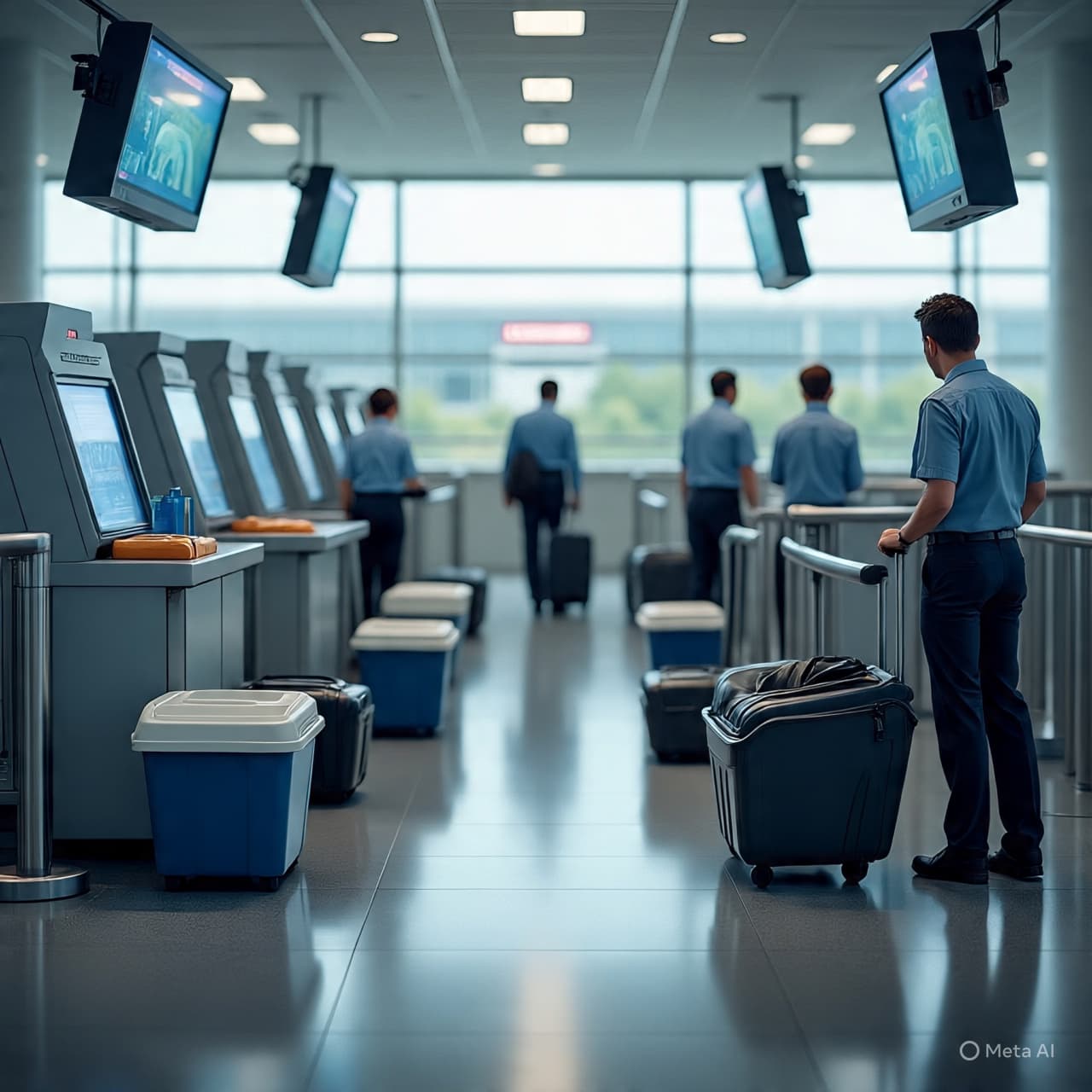
Morning in an airport often begins before the sun fully commits to the sky. Fluorescent lights hum softly over long corridors, and footsteps echo in measured rhythms as travelers move between departure boards and security lines. There is a choreography to it all—an unspoken agreement that motion will continue, that gates will open, that journeys will unfold as expected.
Yet beneath this familiar pattern, there are moments when the system shows its strain.
Across the United States, officials have warned that shortages among Transportation Security Administration staff could lead to the temporary closure of some airports or terminals. The concern centers on the ability to maintain consistent security screening operations, a requirement that stands quietly at the foundation of modern air travel.
The Transportation Security Administration, responsible for screening millions of passengers each day, operates within a delicate balance of personnel and timing. Even small disruptions—absences, staffing gaps, or logistical constraints—can ripple outward, slowing lines, delaying departures, and in more severe cases, forcing reductions in service. In the current situation, officials have suggested that if staffing levels fall below operational thresholds, certain facilities may have to suspend activity altogether.
The causes of the shortage appear layered. Reports point to ongoing recruitment challenges, retention difficulties, and the cumulative weight of a workforce that has been stretched across years of fluctuating demand. Airports, which once grew quiet during the early months of global disruption, have since returned to near-full capacity, bringing with them the renewed pressure of volume without always restoring the full strength of staffing.
For travelers, the implications remain largely unseen until they arrive at the checkpoint. The quiet hum of scanners and the steady cadence of instructions depend on a presence that is often taken for granted. When that presence thins, the rhythm shifts. Lines lengthen, patience is tested, and the invisible architecture of travel becomes momentarily visible.
Airports themselves, from regional hubs to major international gateways, are places where precision matters. A delay in one corner can ripple through schedules far beyond its origin. The possibility of closures, even temporary ones, introduces a different kind of uncertainty—less dramatic than storms or mechanical failures, but equally capable of reshaping plans.
Officials have indicated that contingency measures are being considered, including reallocating staff and adjusting schedules to maintain operations where possible. Still, the acknowledgment of potential closures suggests the limits of flexibility within a system that relies so heavily on human presence.
As the situation develops, the facts remain clear: staffing shortages within the Transportation Security Administration may force the temporary closure of some U.S. airport facilities if security screening cannot be maintained at required levels. In the steady flow of departures and arrivals, where movement is expected and continuity assumed, the moment serves as a reminder that even the most routine journeys depend on a fragile alignment of people, place, and time.
AI Image Disclaimer Illustrations were created using AI tools and are not real photographs.
Sources Reuters Associated Press CNN The Washington Post Bloomberg
Published by Banx Network. This article is part of the Banx decentralized media programme, powered by the BXE token on the XRP Ledger.