There is something unsettling about the idea that the smallest traces of our modern world—fragments too tiny to see, shed from bottles and bags and synthetic fibers—might be circulating inside us. We have known for years that microplastics are everywhere: in oceans, in soil, in rain, and in human blood. What has remained less clear is what they actually do once they find their way into the body. A new study published in Nature offers a molecular answer, and it begins not with toxicity in the traditional sense, but with something more fundamental.
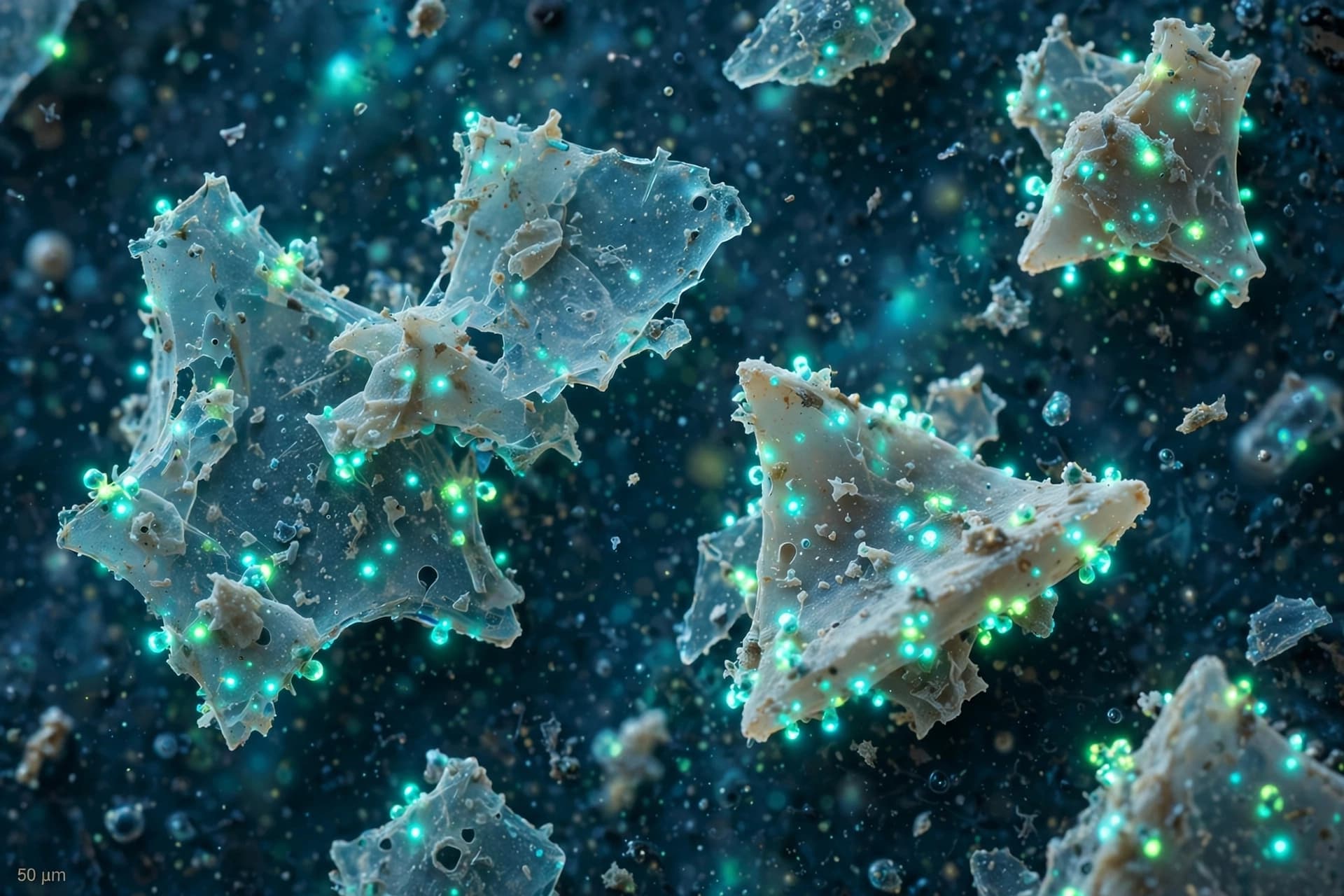
Researchers have identified a novel mechanism by which microplastics interact with biological systems: the surfaces of microplastic particles, when in contact with water, spontaneously generate reactive radicals—unstable molecules that can damage cells and biomolecules . This activity is not unique to one type of plastic. The study found that all six types of microplastics tested exhibited this property, suggesting it is a general feature of aqueous microplastic surfaces .
The mechanism centers on what happens when water meets plastic. The interaction creates an electrostatic field at the microplastic-water interface, and this field is tightly coupled with the generation of radicals. The result is a surface that is not inert, as plastics are often assumed to be, but chemically active in its own right .
This activity has direct consequences for biology. The researchers observed that charged biomolecules—including proteins and DNA—are attracted to and accumulate at the microplastic-water interface. The enrichment depends partly on the plastic's surface charge and hydrophobicity, with more hydrophobic plastics drawing more biomolecules . When proteins are exposed to polystyrene microplastics, they begin to aggregate and form fibrils, a process associated with a range of diseases including neurodegenerative conditions .
The study also found that the microplastic surface can cause structural perturbations in proteins, potentially disrupting their normal function. This adds a new dimension to our understanding of microplastic toxicity, which has largely focused on the chemicals leaching from plastics or the physical damage caused by particles lodging in tissues. The new findings suggest that the plastic surface itself can act as a site of chemical reactivity, generating damaging radicals and altering the molecules it encounters .
These molecular effects may help explain some of the broader health concerns that have been observed in connection with microplastic exposure. Previous research has documented that microplastics can accumulate in tissues, cross biological barriers, and cause oxidative stress and immunotoxicity . The new study provides a mechanistic pathway for how some of these effects might begin—not through a single toxic compound, but through the basic chemistry of a plastic surface in water.
The findings also raise questions about the role of microplastics in other biological processes. The radicals generated at plastic surfaces could potentially damage DNA, and the aggregation of proteins they induce might contribute to conditions where protein misfolding plays a role. The study's authors note that their results suggest microplastic-water interfacial activity is a general phenomenon, meaning the implications extend to virtually all plastic types and all environments where plastics meet water .
For a problem as pervasive as microplastic pollution, understanding the mechanism is the first step toward addressing the harm. The research does not offer a remedy, but it does provide something equally important: a clearer picture of what is happening at the smallest scales, where the boundaries between our materials and our bodies are not as clear as we once believed.
The illustrations in this report are AI-generated and serve only as visual aids.
Sources: Nature, ScienceDirect, Environmental Pollution, PubMed, Journal of Nanobiotechnology
Published by Banx Network. This article is part of the Banx decentralized media programme, powered by the BXE token on the XRP Ledger.