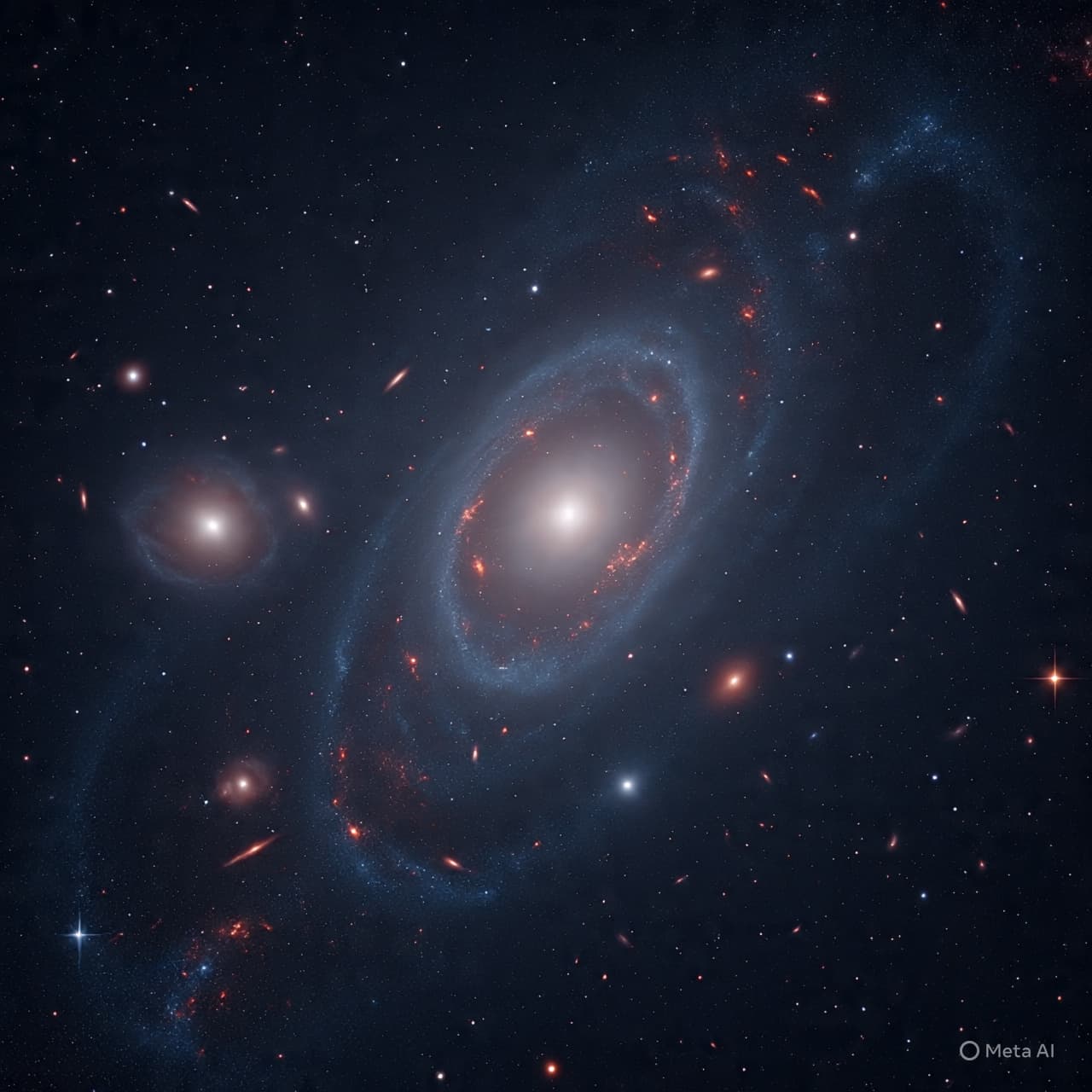
In the vast theater of the cosmos, light travels like a messenger from another era. By the time it reaches us, it carries the hush of ancient beginnings, a whisper from a universe still learning how to shine. At the farthest visible edges of space, astronomers have now identified 70 dusty galaxies whose faint glow has journeyed for more than 13 billion years. They appear not as bright beacons, but as dim embers—yet their quiet presence may alter how we tell the story of cosmic dawn.
These galaxies were observed using the powerful infrared vision of the , a mission designed to peer deeper into time than any of its predecessors. Positioned beyond Earth’s atmosphere, Webb captures stretched, reddened light from the universe’s earliest epochs. What it has found is both surprising and gently disruptive: galaxies rich in dust forming stars far earlier than many theoretical models predicted.
Dust in space is not the household kind, but rather fine particles forged in the aftermath of stellar explosions. It forms when massive stars live brief, luminous lives and then end in supernovae, scattering heavy elements into their surroundings. The prevailing assumption has long been that such dust would require time—perhaps hundreds of millions of years—to accumulate in meaningful quantities. Yet these 70 galaxies, existing when the universe was less than a billion years old, already appear veiled in substantial dust.
Their discovery suggests that star formation in the early universe may have been more intense and more rapid than previously believed. If stars were forming quickly enough to create significant dust so soon after the Big Bang, then early galactic evolution may need recalibration. The findings also hint that many early galaxies could have been obscured from earlier telescopes, hidden behind dusty curtains that masked their true abundance.
Researchers identified these galaxies by analyzing faint infrared signatures, allowing them to detect heat radiated by dust warmed by star formation. Rather than pristine, dust-free systems as once expected, the early universe now appears more textured and complex. In this light, cosmic history resembles not a simple dawn, but a layered sunrise—light emerging through drifting veils.
The implications extend beyond star formation rates. Dust plays a vital role in shaping galaxies: it cools gas clouds, encourages further star birth, and influences how light escapes into space. A dust-rich early universe may have altered the timeline of reionization, the transformative period when the first luminous sources ionized the intergalactic medium and made the cosmos transparent to ultraviolet light.
Scientists remain cautious. These galaxies, though compelling, represent a snapshot—70 points in an immense cosmic tapestry. Further observations will refine distance measurements and confirm their dust content with greater precision. Additional spectroscopic studies are expected to clarify how massive these systems are and how rapidly they formed stars.
Still, the discovery encourages a gentle reconsideration of long-held models. Cosmology evolves not through abrupt revolutions alone, but through incremental revelations—data points that shift assumptions with quiet insistence. If the early universe was dustier and more dynamic than imagined, then its first chapters were richer in complexity than once thought.
For now, astronomers continue to survey the distant sky, using Webb’s instruments to trace the contours of the young cosmos. As more data emerges, theoretical frameworks will be tested and, if necessary, adjusted. The 70 dusty galaxies stand as reminders that even at the universe’s edge, faint light can carry transformative insight.
AI Image Disclaimer Graphics are AI-generated and intended for representation, not reality.
Source Check — Credible Media Coverage Exists:
BBC The New York Times The Guardian Nature News Science Magazine
Published by Banx Network. This article is part of the Banx decentralized media programme, powered by the BXE token on the XRP Ledger.