At the narrow edges of the sea, where vast waters are pressed into slender passages, movement takes on a heightened significance. Ships do not simply pass; they converge, slow, and thread their way through corridors that feel both open and confined. In such places, geography becomes more than landscape—it becomes a quiet force shaping the rhythm of the world beyond it.
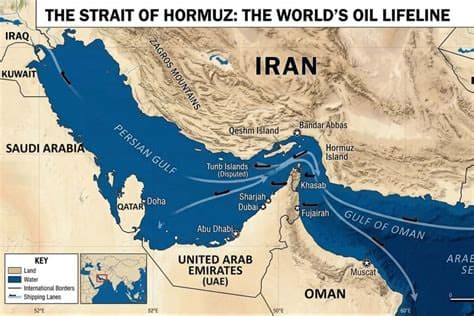
The Strait of Hormuz is one such passage, a maritime artery through which a substantial share of global energy flows. Here, the daily procession of tankers and cargo vessels carries not just goods, but the steady pulse of interconnected economies. It is a route defined by continuity, where disruption, even imagined, can ripple far beyond the horizon.
Against this backdrop, Marco Rubio has warned that any attempt by Iran to impose tolls or otherwise interfere with transit through the strait would be “dangerous to the world.” The remark, delivered with measured clarity, reflects concerns that extend beyond regional tensions into the broader fabric of global trade and energy security. In a place where movement is constant, the idea of restriction carries a weight that is both immediate and far-reaching.
The notion of tolls in such a passage introduces a subtle but significant shift. It reframes the strait not merely as a shared conduit, but as a point of leverage—where access itself becomes part of a wider negotiation. For Iran, whose coastline borders much of the waterway, the strait has long held both strategic and symbolic importance. For others, it represents a route whose openness is essential, not only for commerce but for stability.
Around the world, the implications are considered in quiet calculations. Energy markets, attuned to signals as much as to events, respond to the possibility of disruption with a cautious sensitivity. Governments, in turn, weigh contingencies, considering how shifts in one narrow stretch of water might echo through supply chains, pricing structures, and domestic economies. The distance between the strait and these far-reaching effects is measured not in miles, but in dependency.
Yet the conversation remains, for now, in the realm of projection rather than action. Rubio’s warning does not describe a change already enacted, but a potential path—one that carries with it risks recognized across borders. It is a reminder that in certain places, the balance between openness and restriction is delicate, and that even small adjustments can alter the broader equilibrium.
For those who navigate the waters daily, the strait continues to function as it has, its traffic steady, its patterns familiar. Ships pass, guided by established routes, their journeys part of a larger system that relies on predictability. And yet, beneath this continuity, there exists an awareness—subtle but persistent—that such predictability is not guaranteed.
In the days ahead, attention will remain fixed on the Strait of Hormuz, not only for what happens within its narrow bounds, but for what it represents beyond them. Rubio’s remarks place into focus a simple but consequential idea: that the stability of a single passage can influence the rhythm of the world itself. Whether that rhythm remains uninterrupted will depend, as it often does, on choices made in moments that feel both distant and immediate.
AI Image Disclaimer Illustrations were created using AI tools and are not real photographs.
Sources Reuters Associated Press Bloomberg BBC News Financial Times
Published by Banx Network. This article is part of the Banx decentralized media programme, powered by the BXE token on the XRP Ledger.