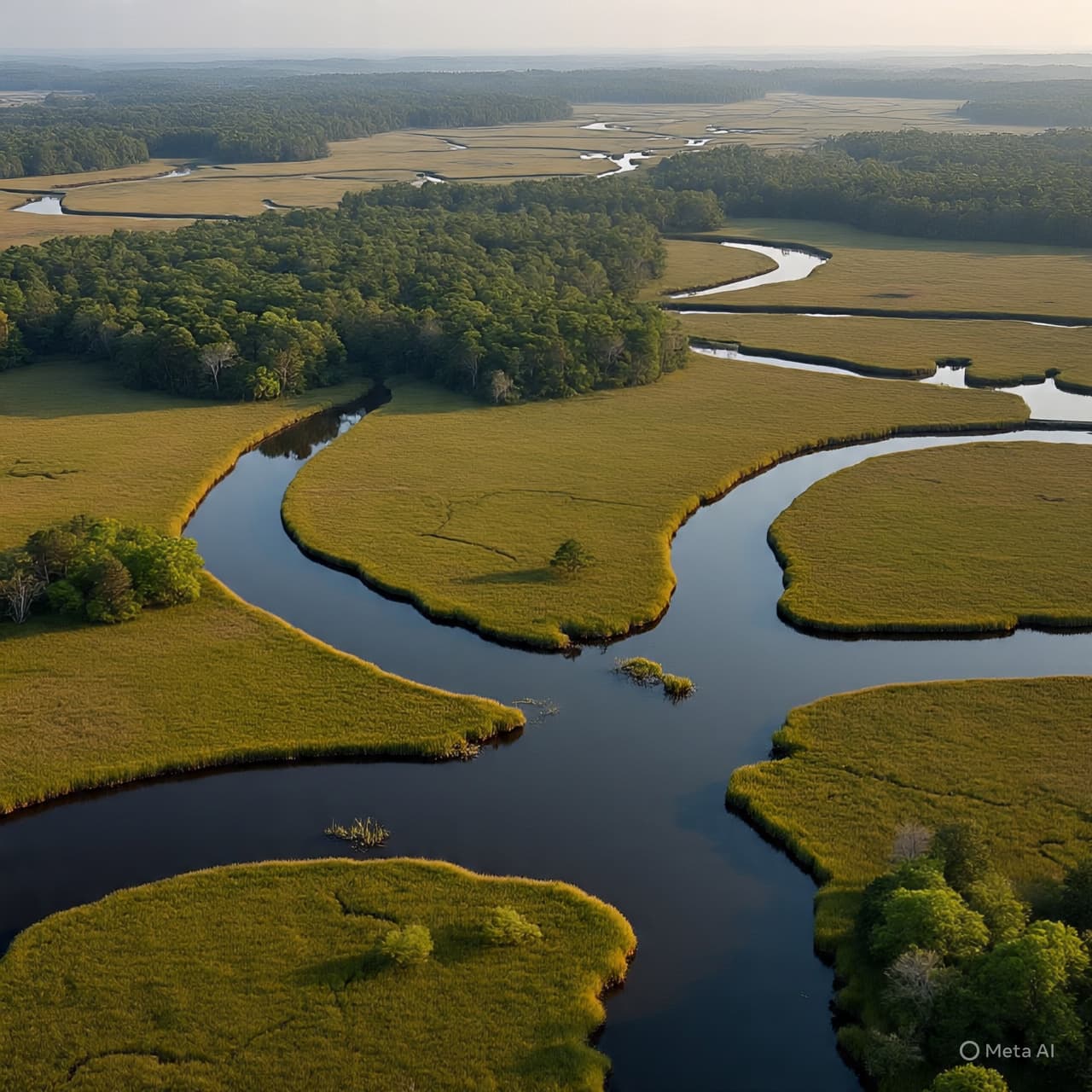
There are landscapes that seem to arrange themselves without instruction, where order appears not imposed but discovered. In marshlands, where water lingers and recedes in a patient rhythm, the ground does not remain still. It shifts, settles, and reorganizes, shaping patterns that are at once fluid and enduring.
In these environments, soil is not simply a foundation. It is an active participant—a medium through which water, organisms, and minerals interact continuously. Over time, these interactions give rise to structures that reflect a kind of self-organization, a process studied within self-organization. Rather than being directed by a single force, the system evolves through countless local exchanges, each one small, yet collectively shaping the whole.
Recent research suggests that this self-organization plays a central role in fostering biodiversity within marsh soils. As water flows through channels and sediments accumulate, distinct zones begin to emerge. Some areas retain moisture longer, supporting microorganisms and plant roots adapted to saturated conditions. Others drain more readily, creating environments with different oxygen levels and nutrient availability. These variations, subtle in isolation, create a mosaic of habitats across the marsh.
Within this mosaic, life finds multiple pathways. Microbial communities diversify according to the chemical and physical properties of the soil. Plant species distribute themselves in response to salinity gradients and water depth. Small invertebrates move through the sediment, contributing to its structure while also responding to it. The result is not uniform richness, but layered diversity—patterns of life that mirror the patterns of the soil itself.
The dynamics of this system are explored through fields such as ecology and soil science, where the focus lies on relationships rather than isolated elements. In marsh soils, these relationships are particularly pronounced. Physical processes, such as sediment deposition and water flow, interact with biological activity, including root growth and microbial metabolism. Each influences the other, creating feedback loops that reinforce certain structures while allowing others to shift.
One of the more striking aspects of this research is the way in which complexity arises from simplicity. The basic components—water, sediment, organisms—are few, yet their interactions produce a system that is both resilient and adaptable. Self-organization allows the marsh to respond to changes, whether gradual shifts in climate or more immediate disturbances, by reorganizing its internal structure rather than collapsing entirely.
There is a quiet persistence in this process. Patterns form, dissolve, and reform, guided not by intention but by balance. The marsh does not seek stability in the rigid sense; instead, it maintains a dynamic equilibrium, where change is constant but not chaotic.
Researchers report that biodiversity in marsh soils is enhanced by self-organizing processes that create spatial variation in moisture, nutrients, and structure. These patterns support diverse communities of organisms and contribute to the resilience of wetland ecosystems. Ongoing studies continue to examine how these systems respond to environmental change and how their natural organization can be preserved.
AI Image Disclaimer
Imagery is AI-generated for visualization purposes and does not represent actual field photography.
Sources
Nature Ecology & Evolution Science Proceedings of the National Academy of Sciences National Geographic Smithsonian Magazine
Published by Banx Network. This article is part of the Banx decentralized media programme, powered by the BXE token on the XRP Ledger.