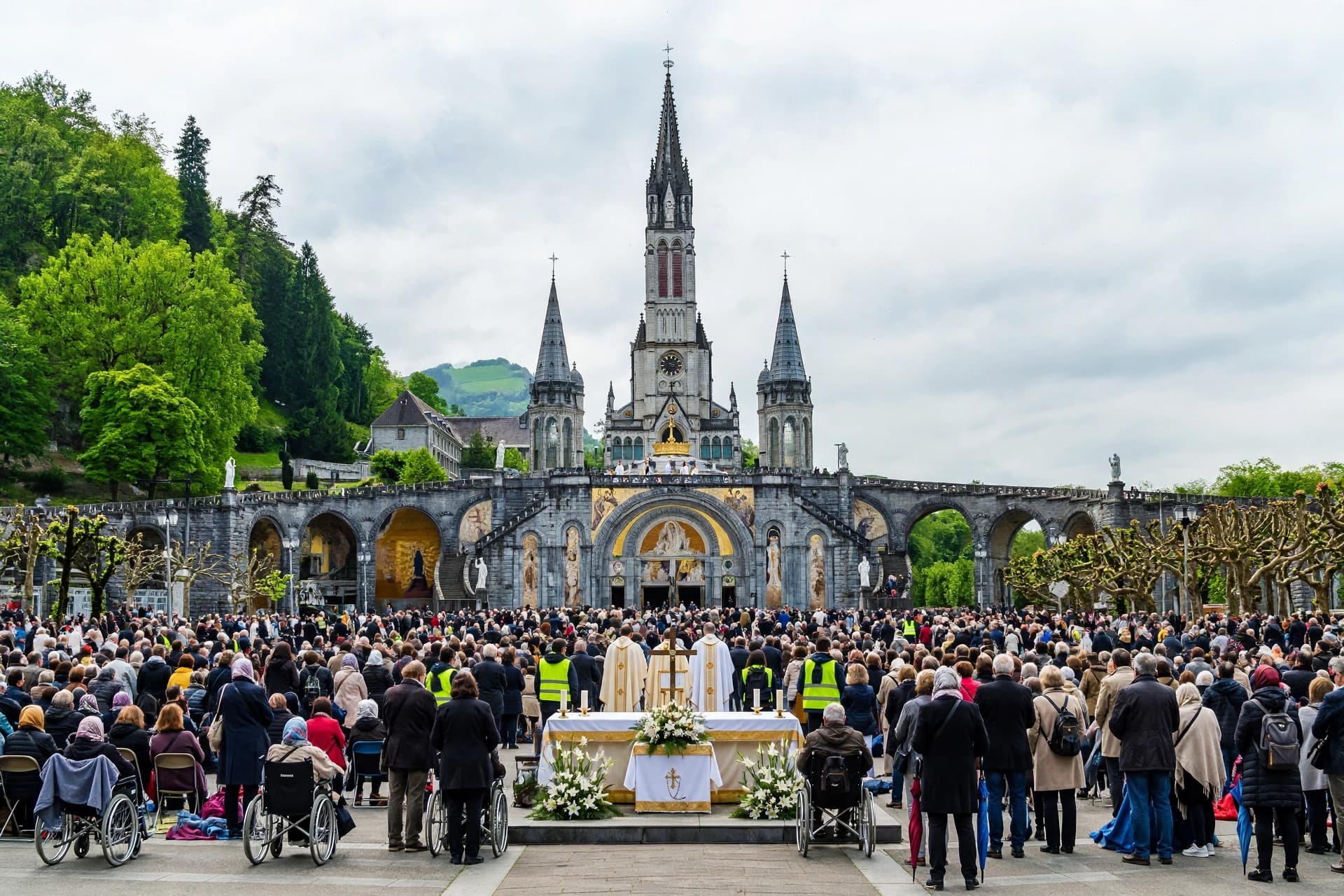
There is a particular weight that settles on a society when it begins to legislate the boundaries of life and death. In France, after years of anguished debate, parliament this summer approved a law allowing adults with incurable illnesses to receive lethal medication. Into that moral landscape stepped Pope Leo XIV on Sunday, standing before the sick and disabled at Lourdes—a shrine long associated with miraculous cures—to offer a different vision of what compassion requires. Sometimes the most powerful arguments are made not in parliaments, but in places where the frail are welcomed rather than measured.
Speaking to believers gathered at the French pilgrimage site, the Pope said assisted dying must not be regarded as “normal.” “We must reject the temptation to cause death under the guise of false compassion,” he told the crowd, many of whom were in wheelchairs. “It is impossible to regard causing death as something normal” .
His words carried particular resonance at Lourdes, where the Catholic Church has recognized 72 cures as miraculous. “No human law should ever make you lose the certainty of your dignity,” he said, addressing those who live with what he called “terrible pain” . The setting itself was a kind of argument: a place where suffering is not hidden away but brought into the open, where crutches and wheelchairs are not obstacles but testimonies.
The Pope’s message was not confined to the shrine. On his third day in France, Leo had already condemned what he called “planned death” upon arriving at the Élysée Palace, and his visit has been marked by repeated calls for a renewed respect for life in keeping with Catholic teaching . France’s law, passed in June, drew strong criticism from the Catholic Church in the country, which denounced the measure as a serious rupture .
Leo framed the issue not merely as a matter of law but of moral truth. “What is legal is not necessarily moral,” he said, a phrase that drew applause from the crowd . He called on medical professionals to see their vocation as caring for the suffering rather than eliminating them, and urged “unremitting” development of medical research and care . The Pope also warned against allowing laboratory algorithms to determine who lives and who dies .
The visit to Lourdes was also marked by a moment of reckoning. In his homily, Leo spoke of “deep wounds, infidelity, and painful failures” committed within the Church, saying that acknowledging these errors was indispensable for spiritual growth . He was scheduled to meet with victims of clerical sex abuse later that day, a reminder that the Church’s moral authority is inseparable from its own accountability .
For the sick and disabled who came to Lourdes, the Pope’s words offered a different kind of dignity than the one written into law. “Your crutches, your wheelchairs and your hidden tears are not obstacles,” he said. “Instead, they are the very place where you are fully respected and welcomed” .
Pope Leo XIV said Sunday that assisted dying must not be considered “normal,” speaking at the Lourdes shrine in France, where parliament recently legalized the practice for certain patients. He called for rejecting “false compassion” and affirmed the dignity of the sick and disabled.
AI Image Disclaimer: The images accompanying this article are generated by artificial intelligence and are intended for illustrative purposes only.
Sources: The Associated Press, The Canadian Press, AFP, Euronews, National Post, The Hindu, NRK
Published by Banx Network. This article is part of the Banx decentralized media programme, powered by the BXE token on the XRP Ledger.