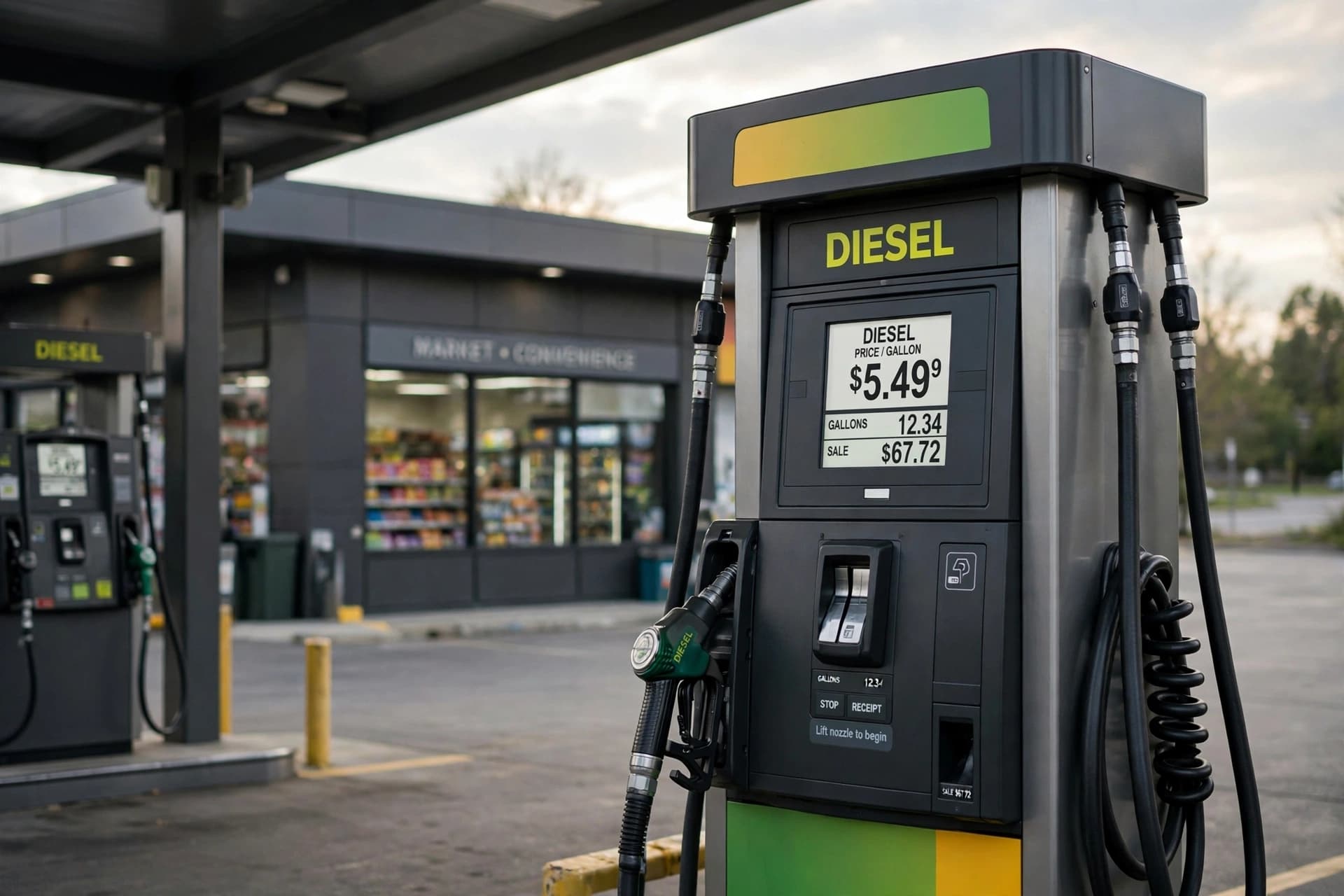
There is a particular frustration that lives at the diesel pump, where the numbers climb higher than they did a year ago and the reasons feel distant from the daily reality of filling a tank. On Sunday, at a suburban Ottawa gas station, Conservative Leader Pierre Poilievre stood before the pumps and pitched a plan he said would bring those numbers down. His proposal: eliminate all federal tax on diesel sales until at least Canada Day, extend the full fuel excise tax cut until July 1 of next year, and remove the GST from fuel purchases . Sometimes the most direct political arguments are made not in Parliament, but beside a nozzle and a receipt.
Poilievre says Canada already produces enough diesel to meet national demand, but transportation bottlenecks leave some regions dependent on imports from the United States . The average price of diesel in Canada stood at $2.672 per litre last Thursday, according to Natural Resources Canada—more than a dollar higher than the same period last year . That gap between production capacity and pump price is the space his proposal seeks to address.
Beyond the sales tax cuts, Poilievre advocates permanently scrapping the federal industrial carbon tax and the Clean Fuel Standard, which he says add costs to diesel production and discourage new investment in refineries . His plan also calls for expanding refining capacity, helping refineries process more Canadian crude, and building the transportation and storage infrastructure needed to supply every region .
The policy proposal is part of a broader pattern. Poilievre has been proposing tax cuts and eliminations on various types of fuel for several years . The framing is consistent: reduce the cost of energy for Canadians by removing federal levies, and pair that with a push for domestic production and infrastructure. Whether the math works—whether the revenue foregone is offset by economic growth, or whether the savings reach consumers rather than being absorbed elsewhere in the supply chain—is a question that will be debated in the weeks and months ahead.
For the Liberal government, the proposal presents a familiar challenge. The carbon tax and Clean Fuel Standard are central to its climate policy, designed to price carbon and incentivize lower-emission alternatives. Removing them, as Poilievre proposes, would represent a significant shift in approach—one that the government has consistently resisted. The debate, then, is not merely about the price of diesel. It is about the trade-offs between affordability and climate action, and about who bears the cost of each.
At the gas station on Sunday, Poilievre's message was direct and unadorned: diesel costs too much, and the federal government should take less. For truckers, farmers, and families who depend on diesel to move goods and heat homes, that message may resonate. For those concerned about the pace of emissions reduction, it may raise different questions. The proposal now enters the arena of public debate, where the answer will be decided not by a single announcement, but by the accumulated choices of voters and policymakers.
Conservative Leader Pierre Poilievre proposes eliminating federal taxes on diesel sales until at least Canada Day, extending the fuel excise tax cut, and removing GST from fuel. He also advocates scrapping the industrial carbon tax and Clean Fuel Standard.
AI Image Disclaimer: The images in this article are generated by artificial intelligence and are intended for illustrative purposes only.
Sources: CBC News, Toronto Star, CityNews Toronto, Radio-Canada, St. Catharines Standard
Published by Banx Network. This article is part of the Banx decentralized media programme, powered by the BXE token on the XRP Ledger.