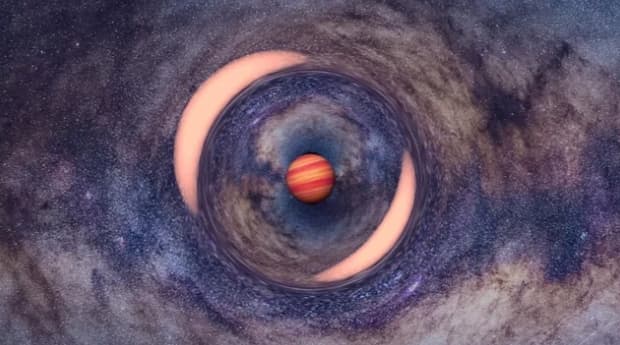
Astronomers have made a remarkable discovery by detecting a 'free floating' exoplanet situated around 10,000 light-years from Earth. Unlike typical exoplanets that orbit stars, this planet appears to drift through space without any stellar companion, offering a unique opportunity to study planetary dynamics.
The newfound exoplanet, designated as SM-158, challenges existing theories of planetary formation and migration. Traditionally, planets are thought to form in protoplanetary discs around stars; however, the existence of free-floating planets suggests that some may be ejected from their original systems or formed in isolation.
Using advanced telescopes and imaging technology, researchers were able to analyze the planet's characteristics, including its estimated mass and temperature. The findings suggest that free-floating exoplanets could be more common in our galaxy than previously believed, prompting scientists to reconsider the ways in which planetary systems evolve.
The study of SM-158 may also provide insights into the atmospheres of these isolated planets, as astronomers explore the chemical compositions and potential habitability of such distant worlds. This discovery not only expands our understanding of the variety of planetary types but also emphasizes the importance of ongoing astronomical surveys.
As the study of exoplanets continues to advance, the implications of discovering free-floating planets like SM-158 could reshape our comprehension of the universe and the processes that govern the formation of cosmic bodies. Further observations and research will be crucial in unraveling the mysteries surrounding these intriguing celestial phenomena.
Published by Banx Network. This article is part of the Banx decentralized media programme, powered by the BXE token on the XRP Ledger.