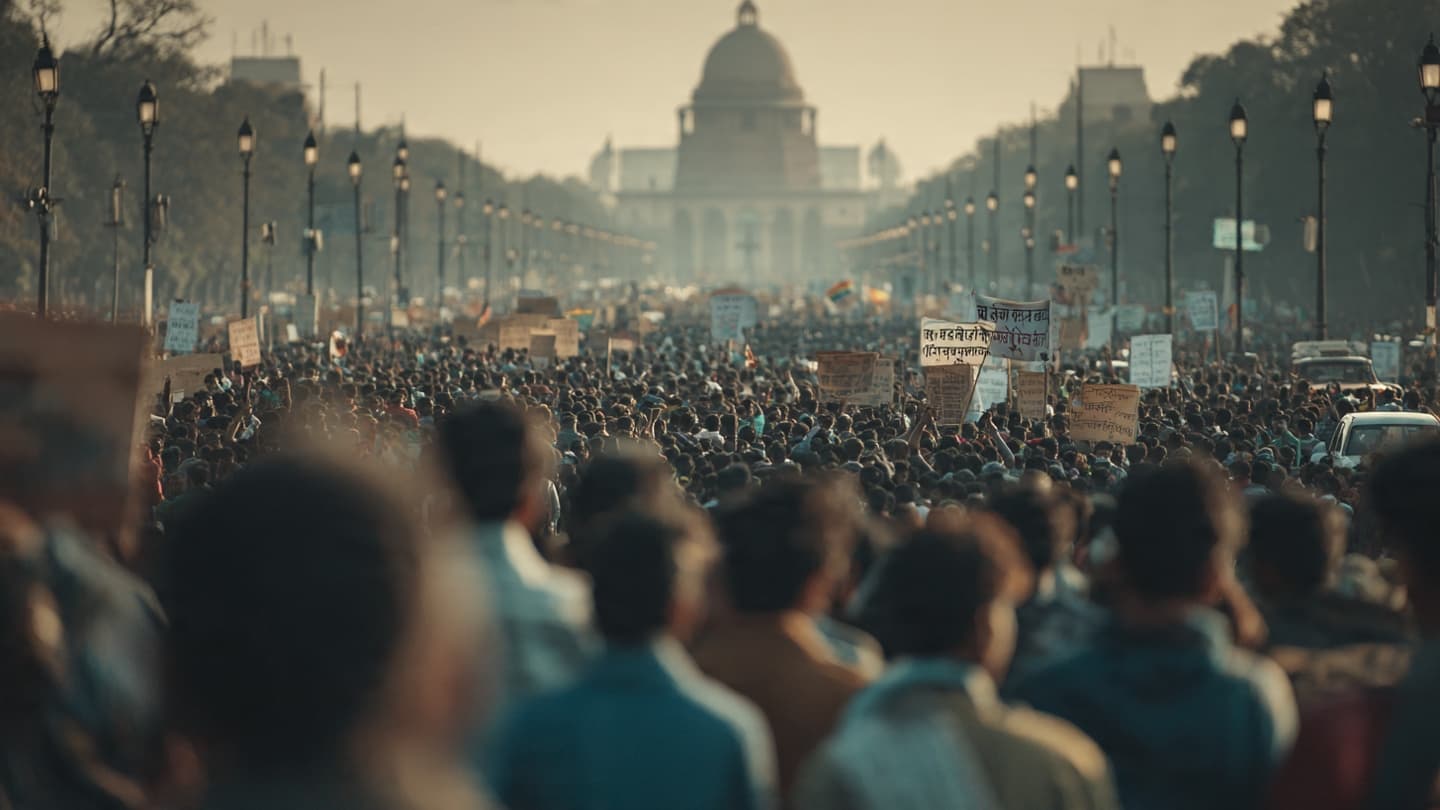
Morning light often settles gently over New Delhi before the city's familiar rhythm gathers pace. Along broad avenues leading toward Parliament, the air carries the ordinary sounds of buses, conversations, and footsteps. Yet there are mornings when those footsteps seem to gather into something larger, becoming a reminder that history is sometimes written not only in government chambers but also in the quiet determination of people walking together.
That atmosphere has accompanied a wave of student-led demonstrations that began with frustration over examination paper leaks and broader concerns about corruption and opportunities for young people. What started as a movement centered on educational accountability has gradually expanded into one of the most closely watched moments of public dissent during Prime Minister Narendra Modi's third term.
The demonstrations drew tens of thousands of participants to New Delhi, where students, families, and supporters called for reforms and the resignation of Education Minister Dharmendra Pradhan. As protesters approached Parliament, police intervened with barricades, batons, and tear gas, leaving many people injured and intensifying national attention on the movement.
Moments of confrontation often reshape the meaning of public gatherings. Images of the police response spread rapidly across social media, carrying the story beyond the streets where it began. For many observers, the discussion expanded from education alone to broader questions about public accountability, peaceful protest, and the relationship between citizens and institutions.
India's opposition parties quickly recognized the significance of the demonstrations. Leaders from several opposition groups expressed solidarity with the students, visited protest sites, and demanded accountability from the government. Their support has provided a rare opportunity to connect with younger voters, many of whom have expressed frustration over unemployment, examination failures, and uncertainty about the future.
Among the most visible moments came when opposition leader Rahul Gandhi joined demonstrations and called for the education minister's resignation before being detained by police. His participation underscored how a movement that initially described itself as independent from traditional politics had become an issue debated both on the streets and inside Parliament.
Even so, many organizers have continued to emphasize that their central demands remain focused on educational reform rather than electoral politics. They argue that restoring confidence in examination systems and creating fair opportunities for students should remain the movement's defining purpose, regardless of which political voices choose to support it.
For the government, the protests present a delicate challenge. India is home to one of the world's youngest populations, making education and employment enduring national concerns. While government officials have stated that steps are being taken to protect students' interests, public expectations remain high as Parliament begins debating issues that extend well beyond the immediate demonstrations.
As evening returns to the capital, the broad roads leading toward Parliament gradually grow quieter again. Yet the conversations carried through classrooms, neighborhoods, and homes continue beyond the day's headlines. Whether these demonstrations ultimately reshape policy, politics, or public trust remains uncertain. What is already clear is that a generation seeking answers has found its voice, and the echoes of that voice are likely to remain part of India's national conversation for some time.
AI Image Disclaimer: Visuals are AI-generated and serve as conceptual representations of the reported events.
Sources: Reuters, Associated Press, Financial Times, The Indian Express, Times of India.
Published by Banx Network. This article is part of the Banx decentralized media programme, powered by the BXE token on the XRP Ledger.