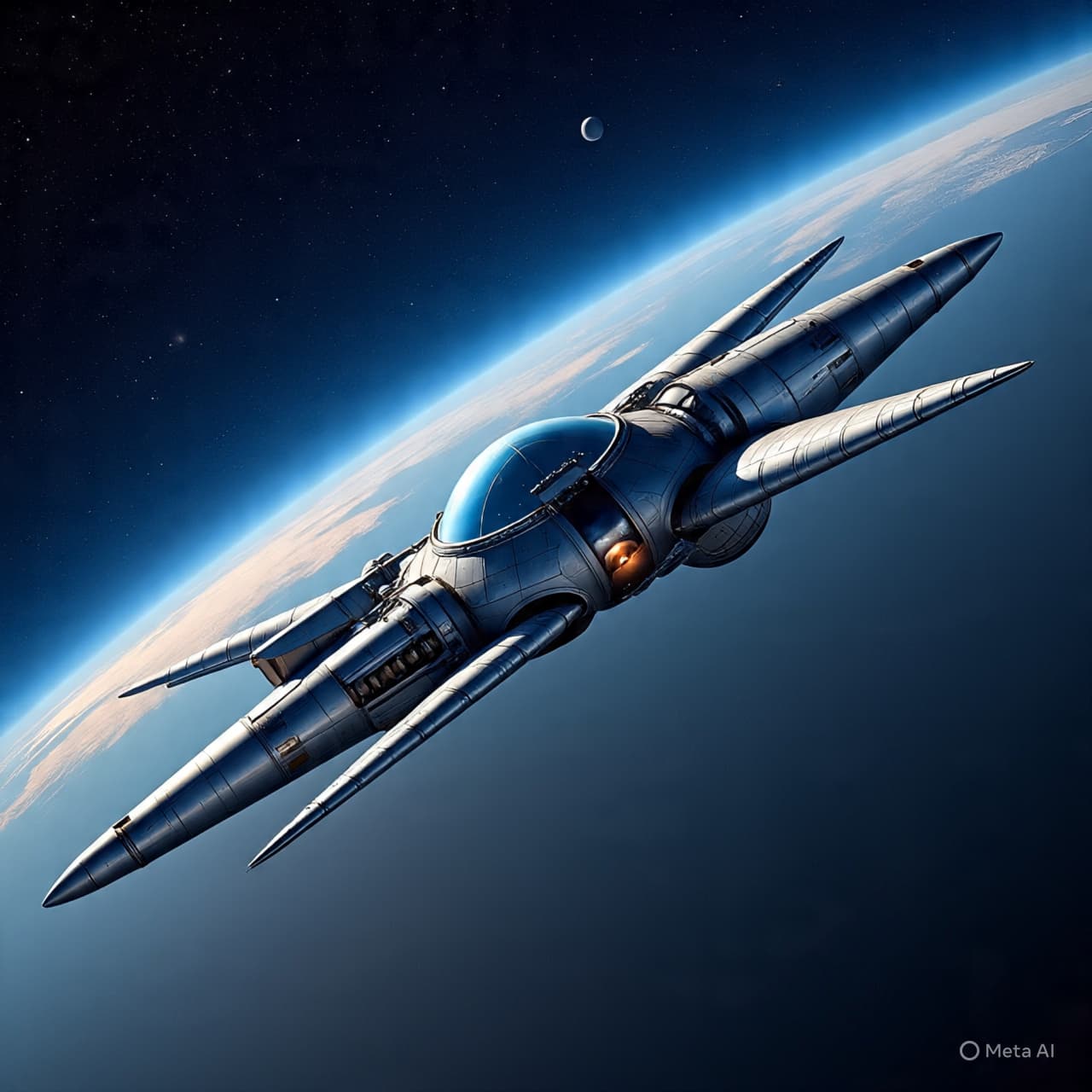
Far beyond the familiar pull of Earth, in the quiet vastness of space, a spacecraft has found its resting place. NASA recently positioned a probe approximately one million miles from our planet, a distance that places it well outside the orbit of the Moon and into a region where Earth’s influence is faint, yet gravitational balance allows stable observation. Despite the technical achievement, this milestone has attracted relatively little public attention, overshadowed by other celestial headlines.
The spacecraft is part of a long-term mission designed to observe the Sun, interplanetary space, and cosmic phenomena with minimal interference from Earth’s atmosphere and magnetic environment. By positioning itself at such a remote vantage point, the probe can gather data in a steady, uninterrupted fashion, offering insights into solar activity, space weather, and the interactions of charged particles across the inner solar system.
Reaching a million miles from Earth requires careful planning and precise orbital mechanics. Engineers must account for solar radiation pressure, gravitational perturbations from the Moon and planets, and the slow accumulation of minor trajectory errors over months of travel. Once in position, the spacecraft maintains its orbit using minimal propulsion, balancing efficiency with long-term mission stability.
From a scientific perspective, the location offers extraordinary advantages. Instruments can capture subtle variations in the solar wind, monitor coronal mass ejections, and study cosmic rays without the distortions or interruptions caused by Earth’s magnetosphere. This quiet environment effectively turns the spacecraft into a sentinel, listening to and recording the whispers of the cosmos.
For the public, the achievement is a reminder of the scale of human exploration: even at a distance where Earth is a pale, tiny globe, our reach extends outward, and each mission builds toward a more complete understanding of the space environment that surrounds our planet.
In practical terms, NASA has successfully positioned a spacecraft roughly one million miles from Earth to conduct long-duration observations of solar and interplanetary phenomena, achieving stable orbit in a remote region where measurements are less affected by Earth’s influence.
AI Image Disclaimer Visuals are AI-generated and serve as conceptual representations.
Sources (names only) NASA Space.com The Verge Science News Reuters
Published by Banx Network. This article is part of the Banx decentralized media programme, powered by the BXE token on the XRP Ledger.