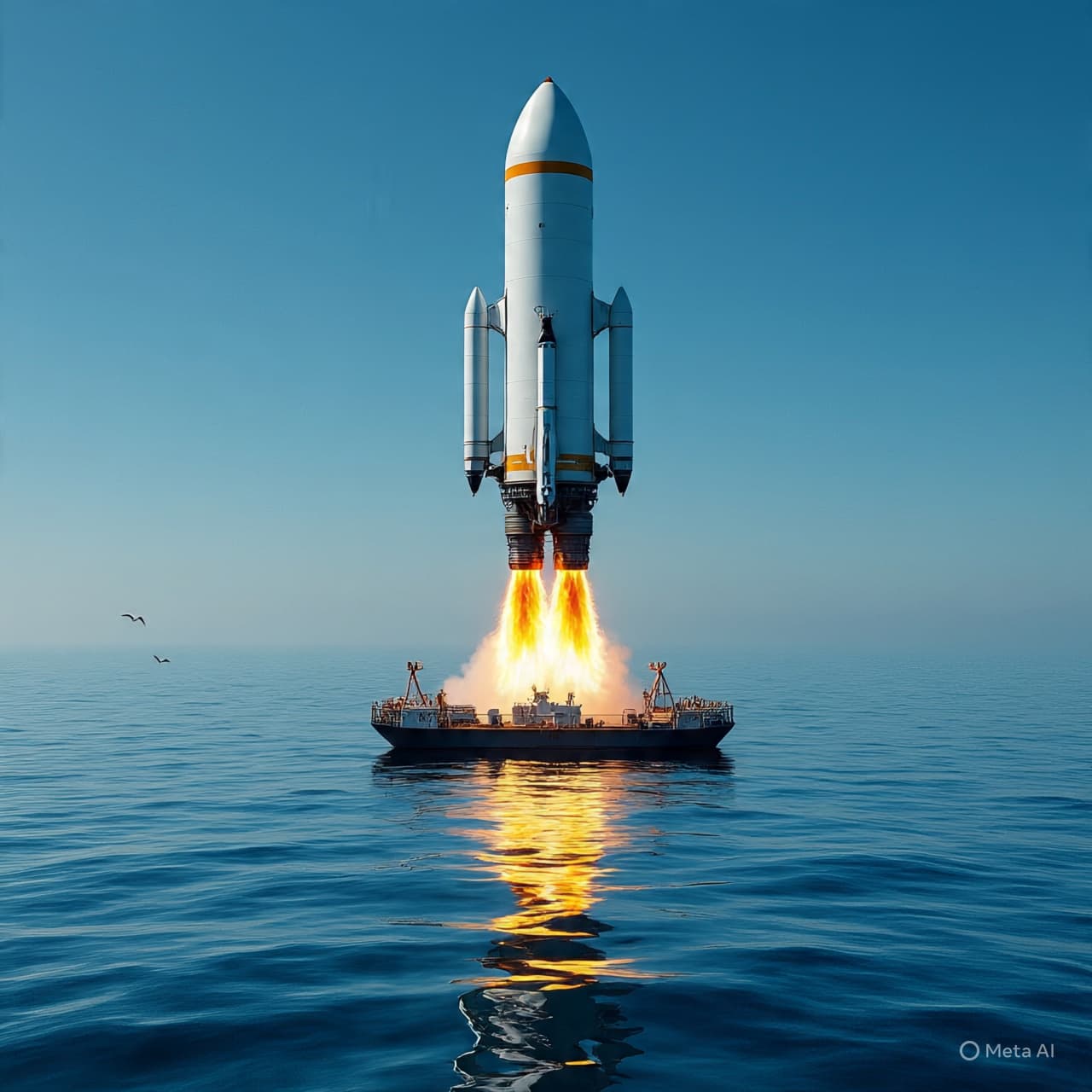
In the late winter light along California’s remote coast, where the ocean’s edge meets a stretch of land carved by wind and centuries of quiet tides, something routinely extraordinary took place: a rocket climbed toward the heightening dusk, its flame a bright signature against a cooling sky. For those who study the motion of metal and fire into the night, each launch carries a whisper of aspiration and persistence. But on this day, the rhythm of ascent resonated with a broader echo — that of six hundred flights by a single class of rocket, a cadence of effort and repetition that has come to define this era of spaceflight.
The rocket in question was a Falcon 9, the workhorse booster winging its way upward from Vandenberg Space Force Base as part of a Starlink mission to place another set of satellites into low Earth orbit. That steady surge of flame and plume carried 24 Starlink satellites outward, each destined for a position in the ever‑growing constellation designed to knit broadband connectivity across the globe. For the handful of observers near the launch pad, and for the broader chorus of engineers and technicians watching from afar, there was little fanfare beyond the familiar hush of anticipation and the surge of motion upward into the night. Yet beneath that familiar ritual lay a quiet milestone: the 600th Falcon 9 launch to date.
This achievement is not merely a count of numbers, but the story of repetition and refinement. The Falcon 9 has become emblematic of reusable spaceflight, its first‑stage boosters returning to Earth time and again on autonomous landing vessels that await them on distant seas. On this flight, the booster seen to its seaward return represented yet another testament to that cycle — the hundreds of successful recoveries and relights that have accompanied this vehicle’s history. To see a Falcon 9 lift off — stout yet elegant, flame and plume trailing as it arcs into the void — is to watch a chapter of aerospace writing itself in fire and motion.
The Starlink satellites aboard this particular mission will join a lattice of machines already numbering in the tens of thousands, relaying data and communication across continents and oceans alike. In some distant horizon, as one of these satellites catches a slant of sunlight minutes after release, it will trace its own quiet arc in orbit — a gentle reminder that even the subtlest objects can carry human ingenuity beyond the firmament. For many, the promise of the Starlink constellation lies in bridging divides of connectivity and bringing digital access to places previously beyond reach; for others, it is a lively emblem of how swiftly human‑made constellations now rise to meet new needs.
Yet the significance of this six‑hundredth Falcon 9 flight is not confined to numbers alone. It is also the count of countless moments: early mornings of preparation, nights of tracking and telemetry, technicians checking valves and seals, and engineers poring over data to ensure that each ascent and each return remains precise and safe. Each mission builds little by little upon what has come before, not in clamorous leaps but in the subtle accretion of learning and adjustment. This is how the cadence of spaceflight becomes a kind of rhythm, shared across teams and time zones, linking ground and sky in a single story of motion.
In straight news terms, SpaceX has successfully launched its 600th Falcon 9 rocket to date, carrying 24 Starlink satellites into low‑Earth orbit from Vandenberg Space Force Base in California. The first‑stage booster completed another landing on a SpaceX droneship, continuing the company’s record of reusable rocket operations. This milestone flight underscores the high tempo of commercial launches and the continued expansion of the Starlink broadband constellation.
All Visuals are AI‑generated and serve as conceptual representations.
Sources (Media Names Only)
Spaceflight Now Meyka
Published by Banx Network. This article is part of the Banx decentralized media programme, powered by the BXE token on the XRP Ledger.