
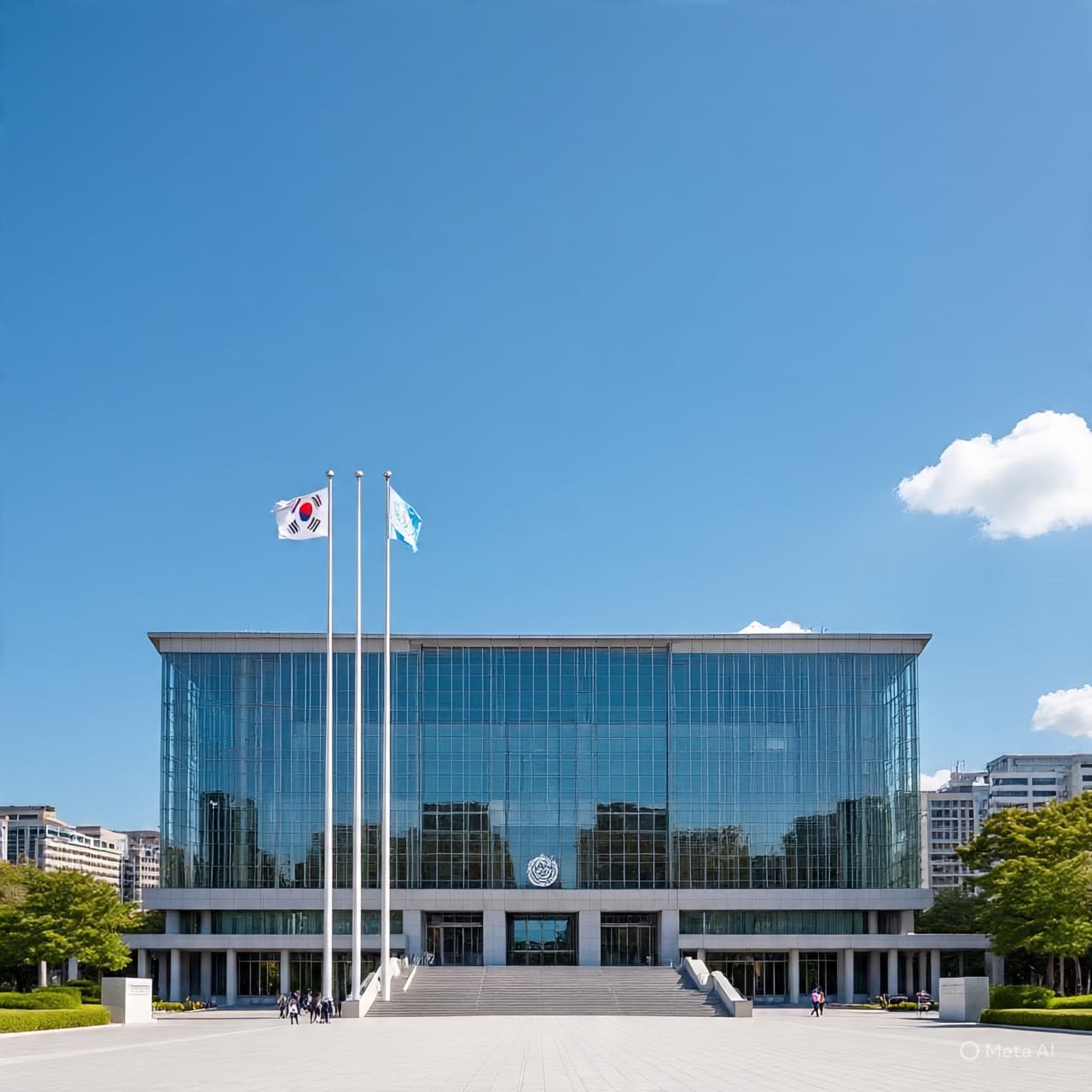
In the cool light of late winter, when the days linger longer and shadows stretch gently across Seoul’s boulevards, the city holds its breath between moments of everyday movement and the broader currents of a world in conflict. The rhythms of trams and footsteps in the Jung District carry an ordinary pulse, punctuated this week by the presence of something larger — a message, printed in bold letters, hung high on the facade of a foreign mission.
On the outer wall of the Russian Embassy in central Seoul, a banner reading “Победа будет за нами” — “Victory will be ours” — draped downward in the colors of the Russian flag. At roughly 15 meters in length, its phrase is one that once echoed through history during the Second World War and has been revived in Russia in recent years in connection with the full‑scale war in Ukraine. To some observers it was a symbol of pride; to others in this city it resonated with a tension that stretches far beyond the fabric of cloth and thread.
The sight of the banner prompted an official response from South Korea’s foreign ministry, which conveyed concerns to the Russian diplomatic mission. Seoul’s government said it sees Russia’s invasion of Ukraine — now entering its fourth anniversary — as a clear violation of the United Nations Charter, and that displaying a message so closely associated with wartime victory on the walls of an embassy in the heart of the South Korean capital could stir unnecessary diplomatic tension. The ministry formally asked for the banner’s removal, even as it reiterated its broader position opposing the war.
In the days that followed, the embassy maintained that the banner’s presence was part of customary decorations commemorating Russian holidays in February, including Defender of the Fatherland Day. Officials there described the slogan as familiar to Russians from historic moments of national pride and insisted it was temporary, planned to be taken down after the related events conclude. They emphasized that displaying such material within embassy grounds is standard practice and not meant to offend — a claim rooted in the diplomatic protections afforded to missions under international conventions.
Yet the juxtaposition of that phrase against Seoul’s broader political landscape was not lost on many here. In a city still mindful of its own history with war and division, and which has watched the conflict in Ukraine with both sympathy and strategic concern, the banner’s message brushed against recollections and debates that extend far beyond the letter of diplomatic language. It also came amid wider unease over military cooperation between Russia and other states, and remarks by diplomats that have touched simmering regional nerves.
Public reactions in Seoul have varied as well. Some residents remarked that such displays feel out of place, given South Korea’s stance on the war and its security concerns in the region. Others suggested patience, noting that embassy practices are often guided by traditions and that official channels of communication exist precisely to navigate such moments. The South Korean government, while firm in its request, acknowledges the constraints of the Vienna Convention on Diplomatic Relations, which grants missions inviolability within their premises.
As winter turns slowly toward spring, the banner remains a quiet reminder of how messages carried by cloth and color can stir uneasy reflection in foreign streets. In this intersection of history and contemporary geopolitics, Seoul’s skyline has momentarily become an unexpected stage for a phrase that carries different echoes for those who read it from within and without.
In straightforward diplomatic language, South Korea’s foreign ministry has urged the Russian embassy in Seoul to remove a large banner reading “Victory will be ours,” saying it could create unnecessary tension with South Korean citizens and other countries. The embassy has said the banner relates to Russian national holidays and was planned to be taken down after commemorative events. South Korea reiterated that Russia’s invasion of Ukraine is illegal under international law while expressing concerns about military cooperation between Russia and North Korea.
AI Image Disclaimer
Illustrations were created using AI tools and serve as conceptual representations.
Sources (Media Names Only)
Reuters The Guardian South China Morning Post Korea JoongAng Daily NK News
Published by Banx Network. This article is part of the Banx decentralized media programme, powered by the BXE token on the XRP Ledger.


.jpg&w=3840&q=75 "Nightclub Shooting, Rio de Janeiro: Drive-by Attack Leaves Two Dead and Three Wounded Outside Venue")