
Key Highlights
- Punch:A young macaque abandoned by his mother shortly after birth.
- Plush Toy:Zoo caretakers provided a toy to help him cope with loss.
- Social Integration:Punch is gradually learning to navigate macaque society.
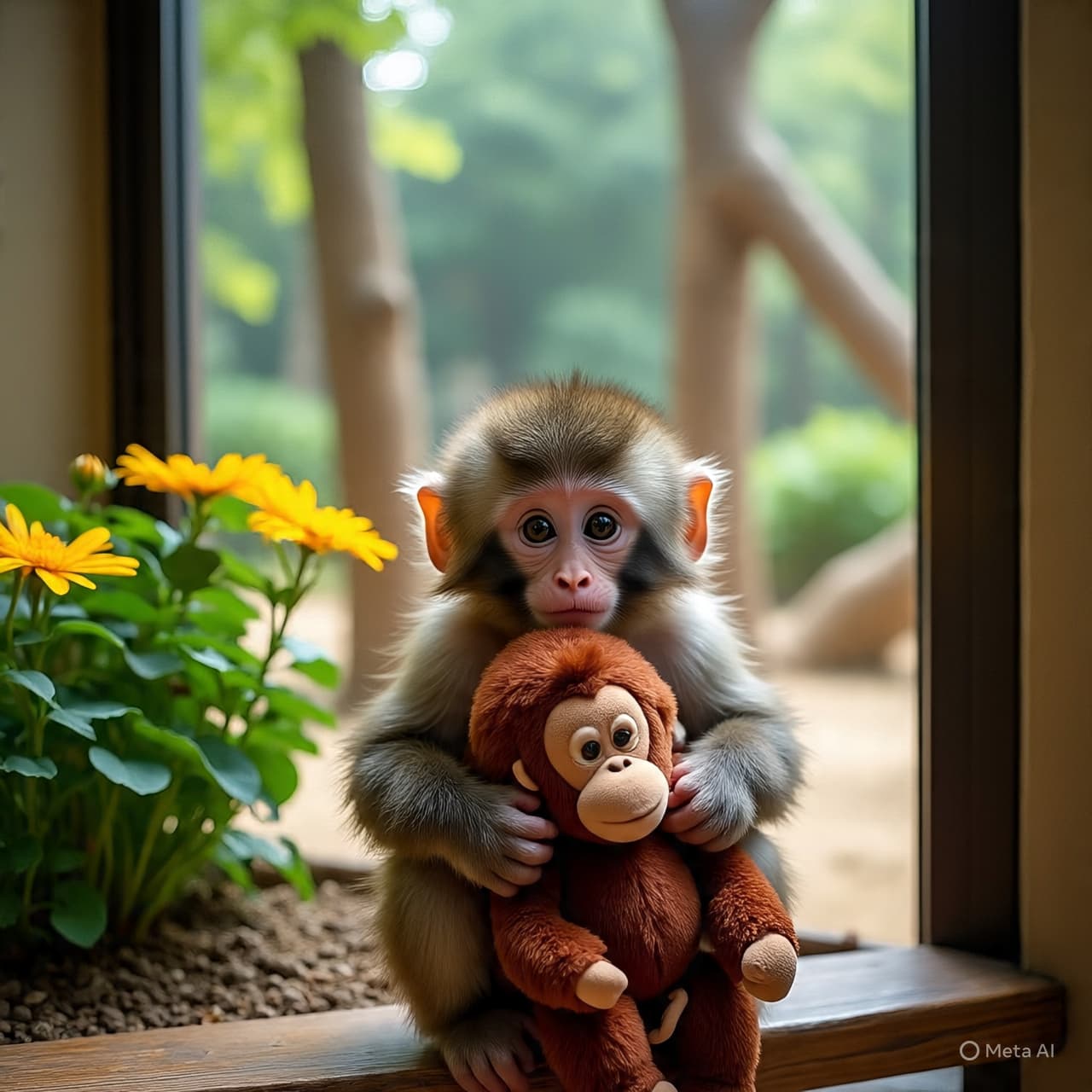
In the stillness of a zoo courtyard north of Tokyo, the early light slides over rock and vine, warming the quiet corners of an enclosure where a young macaque named Punch moves with hesitant steps. Clutched tightly in his arms is a large, plush orangutan toy — frayed at the seams and faded from sun and touch, yet to him, it fills the emptiness left by his mother’s absence.
Punch’s mother, a young and inexperienced macaque, abandoned him soon after birth. Primatologists explain that some first-time mothers fail to bond with their infants, especially under stress or in captivity. Without her care, Punch’s survival fell to his human keepers, who fed and warmed him but could not replicate the rhythm of his mother’s heartbeat or the language of her grooming. To bridge that void, they placed the soft toy beside him. What began as a gesture of care became his anchor — a stand-in for touch, warmth, and belonging.
Primatologists describe such attachments not as curiosities, but as echoes of deep biological need. In studies spanning decades, young primates separated from their mothers often cling to soft objects, finding in them the comfort that skin and scent once offered. For Punch, the toy became more than comfort; it became a social cue, a quiet reassurance that the world, however altered, still held softness.
However, life within the larger troop has been less forgiving. Without a mother to guide him through the intricate etiquette of macaque society, Punch entered a hierarchy already defined. The older monkeys push him aside, assert dominance, and occasionally chase him from favored perches. To human eyes, it looks like cruelty. To primate behaviorists, it is instruction — the unspoken structure of rank that governs their world. In this rough schooling, each gesture and chase teaches him where he stands and how to endure.
Observers have noted that over time, Punch has begun to navigate these rules more deftly. He approaches others more confidently, shares moments of play, and endures the occasional grooming session that signals his slow inclusion. The toy, though still close at hand, now rests more often at the edge of his world rather than at its center. His story, in miniature, charts the passage from isolation toward belonging — the gradual transformation that every living being, in one form or another, must make to survive among others.
Punch’s journey has touched millions who watch from afar, drawn by the simplicity of his gestures and the tenderness of his bond. Yet beneath the viral fascination lies something quieter and more profound: a reflection on nurture, loss, and the primal desire to be held — not only by arms, but by understanding.
In factual terms, Punch is a baby Japanese macaque living in a zoo in Japan who was abandoned shortly after birth by his inexperienced mother. Zoo caretakers provided a plush toy for comfort, and experts explain his attachment and subsequent treatment by other monkeys as part of natural primate behavior. Over time, Punch has begun to integrate into his troop, marking the slow emergence of connection in a structured social world.
Published by Banx Network. This article is part of the Banx decentralized media programme, powered by the BXE token on the XRP Ledger.



