There is a soft transition each evening when daylight folds into the afterglow and the sky becomes a canvas of deepening blues and quickening shadows. In that gentle hour before night fully takes hold, the ageless sphere above us reveals itself not as a static backdrop but as a place of motion — subtle, slow, and endlessly graceful. As February turns toward its close, that motion will be especially poetic: six of the solar system’s planets are set to appear together in the night sky, weaving a rare celestial tapestry that invites both contemplation and quiet wonder.
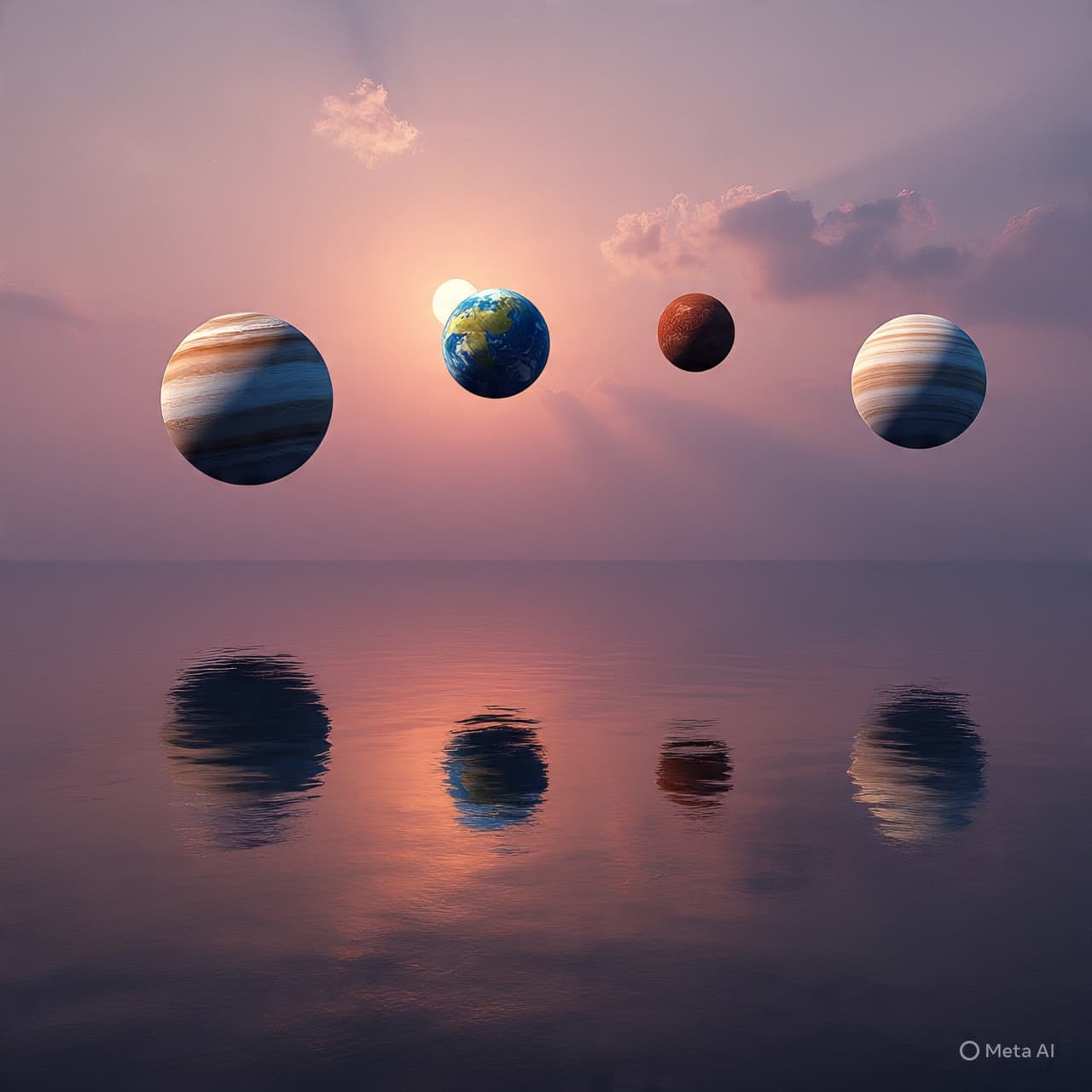
Soon after sunset on Saturday, February 28, 2026, the planets Mercury, Venus, Jupiter, Saturn, Uranus, and Neptune will trace a broad, gentle arc across the heavens. From Earth’s vantage point, this arrangement — often called a planetary parade or alignment — is a consequence of the way their orbits intersect our line of sight, bringing seemingly disparate worlds into the same region of sky. It’s a fleeting phenomenon, visible for a span of evenings around that date, and one that will not repeat in quite the same way for many years.
There is a quiet poetry to the idea of these planets sharing the nighttime firmament together. Under a clear western horizon, shortly after the sun’s last glow fades, Jupiter’s bright presence will soar above, its light an easy guidepost for observers. Nearby, Venus will shine with an intensity that draws the eye, outshining most stars. Lower still, Mercury and Saturn will grace the dimming sky, their positions tied to the horizon’s edge before they slip beneath it. For those with binoculars or small telescopes, the more distant Uranus and Neptune will also join the display, subtle and serene against the deepening night.
This parade is a reminder of the elegant clockwork of our solar system — great bodies in vast motion, each shaped by the invisible pull of gravity, yet occasionally lined up in a course that, from our Earthbound perch, feels almost choreographed. It is not a straight line in space, but from our vantage in the twilight it can appear as a gentle arc, tracing the ecliptic path near the horizon. Such arrangements are not entirely unique, but the opportunity to see six planets at once — especially spanning both those visible to the naked eye and those requiring optical aid — remains relatively uncommon.
For skywatchers, the experience hinges on simple things: a clear view toward the west, a calm evening without cloud cover, and the patience to let eyes adjust to the dark. In that time between sunset and deep night, there is often a quiet sense of connection — a fleeting awareness that these distant worlds, though separated by unimaginable space, can join in a shared sky that all of humanity looks upon. Through the brief window of this spectacle, people around the globe — from wide plains to city rooftops — can look upward together and glimpse a cosmic dance that is both fleeting and timeless.
In straightforward terms, from late February into early March 2026, a rare celestial event will allow skywatchers to see six planets — Mercury, Venus, Jupiter, Saturn, Uranus, and Neptune — aligned across the night sky shortly after sunset. Jupiter and Venus will be easily visible to the naked eye, while the other planets will require optical aids or clear dark skies to be spotted. The alignment is a perspective effect resulting from the orbits of the planets and will be best seen with an unobstructed view of the western horizon in the early evening.
AI Image Disclaimer
Illustrations were created using AI tools and serve as conceptual representations.
Sources (Media Names Only)
The Guardian National Geographic Sky News Earth.com San Diego State University News
Published by Banx Network. This article is part of the Banx decentralized media programme, powered by the BXE token on the XRP Ledger.