From Chamonix, Mont Blanc still rises above the valley with the familiar shape that has drawn climbers and visitors for generations. Yet the landscape around the mountain is changing in ways that can be measured not only from scientific instruments, but also along routes where guides once moved with greater predictability.
The summer of 2026 brought an exceptional combination of heat, glacier retreat, and rockfall activity across the Mont Blanc massif. Euronews, reporting with AP, said researchers expect the number of major collapses in the massif this year to approach around 400, roughly ten times the level seen two decades ago.
The underlying changes are closely connected to permafrost. Frozen ground acts as a stabilizing element within steep Alpine terrain, helping bind sections of rock together. As temperatures rise and ice within the mountain weakens, some slopes can become increasingly unstable.
Ludovic Ravanel, a researcher at Université Savoie Mont Blanc, has studied the effects of climate change on snow, glaciers, and mountain permafrost. He told Euronews that many rock faces remain stable partly because of ice within the mountain, meaning continued warming can alter conditions in places that have appeared solid for centuries.
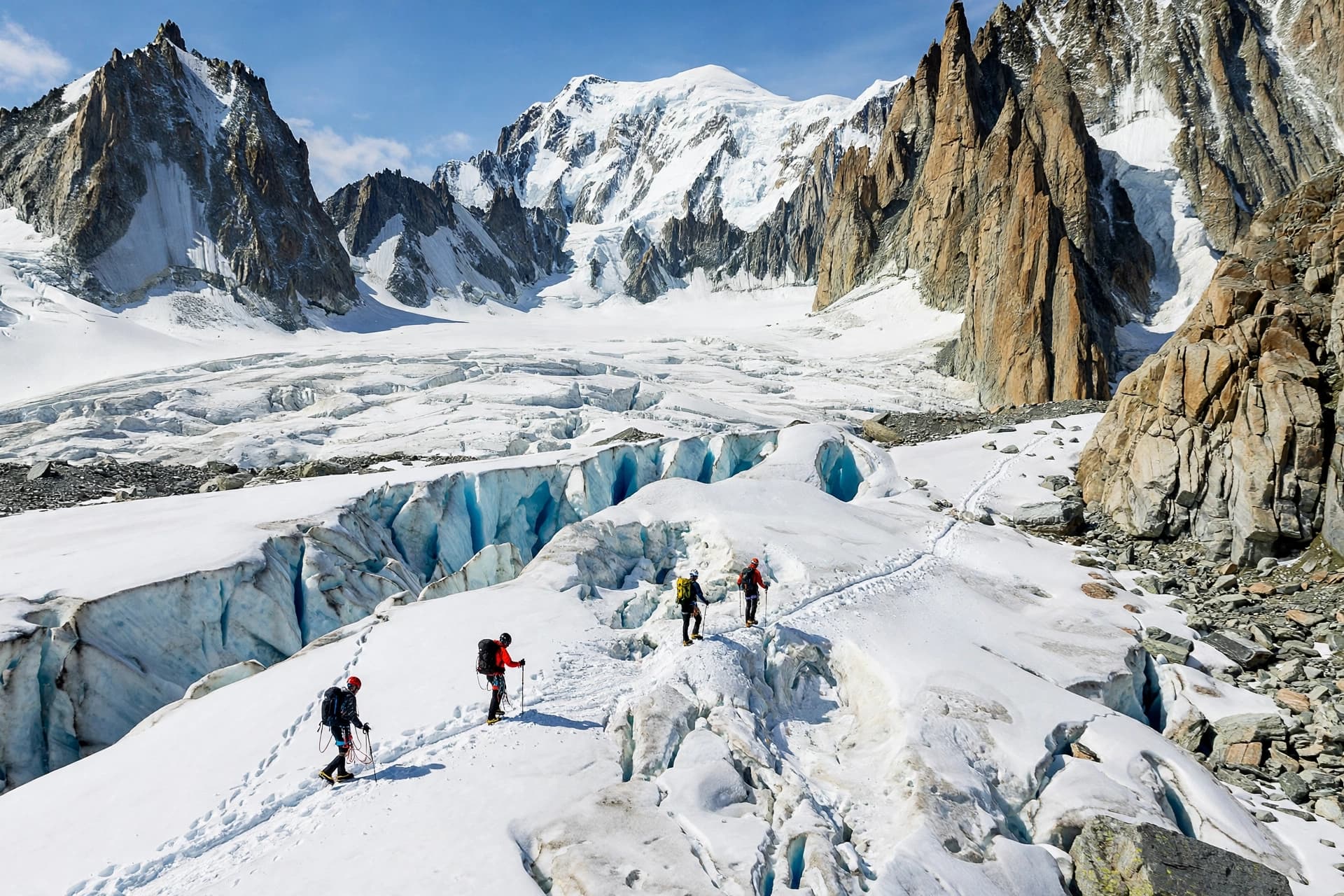
The effects were visible during the summer climbing season. Glacier retreat opened new crevasses, while melting snow and ice changed the routes used by mountaineers. Some areas became difficult to cross, and rockfalls occurred on routes that had previously been used during the same months.
For mountain guides, this means that familiar knowledge must increasingly be combined with constant observation. Stuart MacDonald, a Chamonix-based guide, described seeing glaciers retreat rapidly compared with their positions in previous years. He also had to cancel a planned ascent after conditions along the route became unsuitable.
The changes are not confined to the immediate summit area. Across the French Alps, 2026 has already produced unusually high rockfall activity. Euronews reported in August that around 450 rockfalls had been recorded in the Mont Blanc massif since the beginning of the year, according to research cited by AFP.
For Chamonix and neighboring communities, the mountain is therefore both a landscape and a living environment whose physical conditions are changing. Tourism, mountaineering, rescue planning, and access to high-altitude routes all depend on understanding those changes.
Mont Blanc remains a powerful destination, but the routes toward its summit are no longer defined only by maps drawn years ago. As glaciers retreat and permafrost responds to warmer conditions, researchers and mountain professionals are continuing to document how the Alpine landscape is shifting from one season to the next.
AI Image Disclaimer The accompanying visuals are AI-generated conceptual illustrations and do not depict real photographic events.
Published by Banx Network. This article is part of the Banx decentralized media programme, powered by the BXE token on the XRP Ledger.