⸻
Artificial Intelligence: Transforming Society, Industry, and the Future
Short Description: This comprehensive article explores the rise of artificial intelligence, tracing its history, core technologies, and applications across healthcare, finance, transportation, education, and more. It examines ethical, societal, and economic implications, highlights global case studies, and provides a forward-looking perspective on AI’s role in shaping the world of 2030–2050.
⸻
Artificial Intelligence (AI) has emerged as one of the most transformative technologies of the 21st century. It is reshaping industries, economies, societies, and even the way humans interact with technology. From self-driving cars to medical diagnostics, AI touches nearly every aspect of daily life. Yet, the journey of AI is as complex as the technology itself, blending decades of research, philosophical inquiry, and technological breakthroughs.
What is Artificial Intelligence?
Artificial Intelligence is broadly defined as the ability of machines to perform tasks that typically require human intelligence. These tasks include problem-solving, learning, reasoning, perception, language understanding, and decision-making. Unlike traditional software that follows fixed rules, AI systems can adapt to data, recognize patterns, and even predict outcomes.
AI is generally categorized into two main types: 1. Narrow AI (Weak AI): AI systems designed for specific tasks. Examples include virtual assistants, language translation software, and facial recognition systems. Narrow AI excels in particular areas but cannot generalize knowledge beyond its training. 2. General AI (Strong AI): Hypothetical AI that can perform any intellectual task a human can do. While still largely theoretical, General AI remains the ultimate goal of AI research.
The distinction is important because current AI technologies, even the most sophisticated, remain in the realm of Narrow AI. However, their capabilities are expanding rapidly.
⸻
Historical Evolution of AI
The idea of intelligent machines has fascinated humans for centuries. From ancient myths about mechanical beings to the scientific exploration of computation, AI’s history is a rich tapestry of innovation.
Early Foundations
• 1940s–1950s: The foundation of modern AI began with Alan Turing, who proposed the concept of a machine capable of performing any intellectual task. His famous Turing Test, designed to evaluate a machine’s intelligence, remains influential.
• 1956: The Dartmouth Conference officially coined the term “Artificial Intelligence,” marking the birth of AI as an academic discipline. Pioneers like John McCarthy and Marvin Minsky set the stage for decades of research.
Symbolic AI and Early Optimism
In the 1960s and 1970s, AI research focused on symbolic reasoning and problem-solving. Early programs like ELIZA, a conversational chatbot, demonstrated that computers could simulate human conversation, albeit superficially. These programs inspired optimism but revealed the complexity of true human-like intelligence.
AI Winter and Revival
The 1980s saw the first “AI Winter,” a period of reduced funding due to overhyped expectations and technical limitations. By the 1990s, advances in computational power, algorithms, and data availability revived AI research. IBM’s Deep Blue defeating chess champion Garry Kasparov in 1997 highlighted AI’s growing capabilities.
The Era of Machine Learning
The 2000s and 2010s ushered in machine learning and deep learning as dominant AI paradigms. Massive datasets and powerful GPUs enabled neural networks to process information in ways previously impossible. Landmark achievements, including Google’s AlphaGo defeating world champion Go players, showcased AI’s extraordinary potential.
⸻
Core Technologies Behind AI
Modern AI rests on multiple interrelated technologies:
Machine Learning
Machine Learning (ML) allows computers to learn patterns from data. Key paradigms include:
• Supervised Learning: Models are trained on labeled datasets to predict outcomes. For example, predicting loan defaults based on historical financial data.
• Unsupervised Learning: Models identify patterns in unlabeled data, such as customer segmentation in marketing.
• Reinforcement Learning: AI agents learn by trial and error, receiving rewards for desirable outcomes. Applications include robotics and gaming AI.
Deep Learning
A subset of ML, deep learning uses neural networks with multiple layers to model complex patterns. Convolutional Neural Networks (CNNs) are used in image recognition, while Recurrent Neural Networks (RNNs) excel in sequential data like speech and text.
Natural Language Processing (NLP)
NLP allows machines to understand and generate human language. Applications include language translation, sentiment analysis, chatbots, and AI writing assistants. Recent models, like OpenAI’s GPT series, demonstrate advanced language generation capabilities, enabling AI to engage in coherent conversations and content creation.
Computer Vision
Computer vision enables machines to process and interpret visual information. Applications include facial recognition, autonomous vehicles, medical imaging, and surveillance.
Robotics and Autonomous Systems
AI-powered robots perform tasks autonomously, from manufacturing to exploration. Autonomous vehicles combine computer vision, sensor data, and AI algorithms to navigate complex environments safely.
Knowledge Representation and Reasoning
AI systems use rules, logic, and probabilistic models to represent knowledge and reason about it. This enables problem-solving, decision-making, and planning in dynamic environments.
⸻
Applications of AI Across Industries
The impact of AI is far-reaching, transforming sectors such as healthcare, finance, transportation, education, and beyond.
Healthcare
AI enhances diagnosis, treatment planning, and patient care. Machine learning algorithms analyze medical images to detect cancer, neurological disorders, and cardiovascular diseases. Predictive models anticipate patient outcomes and optimize resource allocation. Virtual assistants streamline administrative tasks, improving efficiency.
Finance
AI drives fraud detection, algorithmic trading, and credit scoring. Robo-advisors provide personalized investment advice, while predictive analytics help institutions anticipate market trends. AI also supports regulatory compliance and risk management.
Transportation
Autonomous vehicles rely on AI to navigate roads safely. Smart traffic systems optimize flow and reduce congestion. Logistics companies use AI to improve delivery efficiency, route planning, and warehouse management.
Education
AI-powered learning platforms provide personalized education. Adaptive systems adjust content based on student performance, while analytics help educators identify learning gaps and enhance teaching methods.
Retail and E-Commerce
AI personalizes shopping experiences, predicts demand, and optimizes inventory. Visual search, chatbots, and recommendation engines enhance customer engagement and satisfaction.
Manufacturing
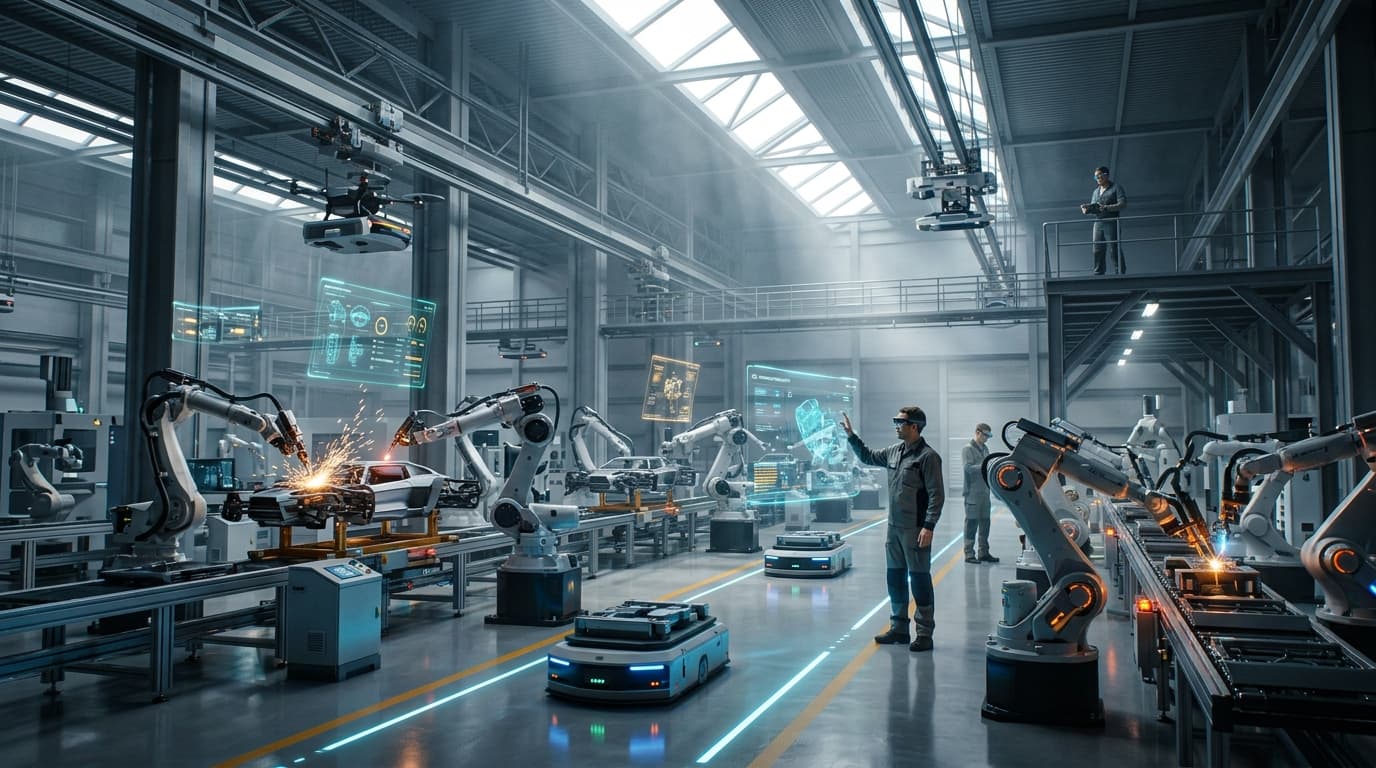
Industry 4.0 leverages AI for predictive maintenance, quality control, and process optimization. Intelligent robotics and automation reduce errors and increase productivity.
Agriculture
AI improves crop yields through precision agriculture. Drones, sensors, and machine learning optimize irrigation, fertilization, and pest management.
Entertainment
AI transforms content creation and distribution. Streaming platforms use AI for personalized recommendations, while AI-generated music, writing, and art expand creative possibilities.
Government and Security
AI aids in cybersecurity, law enforcement, and public administration. Predictive analytics detect threats, while AI-driven decision support improves policy and planning.
⸻
Ethical and Societal Implications of AI
As AI becomes increasingly integrated into society, it raises profound ethical, social, and economic challenges. While AI offers tremendous benefits, it also presents risks that must be addressed to ensure it serves humanity responsibly.
Bias and Fairness
AI systems are only as unbiased as the data they are trained on. Historical, social, and cultural biases can be unintentionally embedded into datasets, leading to discriminatory outcomes. Ensuring fairness requires diverse training data, continuous auditing of AI models, and transparent methodologies.
Privacy Concerns
AI relies on large datasets, often containing sensitive personal information. Legal frameworks like the European Union’s GDPR attempt to regulate data privacy, but AI’s rapid development challenges existing protections. Responsible AI requires robust data governance, encryption, anonymization, and informed consent.
Job Displacement and Economic Impact
Automation driven by AI is reshaping the labor market. Routine, repetitive tasks are increasingly performed by machines. While AI also creates new roles, workforce reskilling and lifelong learning are essential to mitigate economic disruption.
Accountability and Transparency
Deep learning models are often opaque, making it difficult to understand how decisions are reached. Explainable AI (XAI) seeks to make models interpretable, providing users with understandable reasoning behind AI decisions.
Safety and Security
AI systems can be vulnerable to adversarial attacks, and malicious use of AI—such as deepfakes or automated cyber-attacks—poses societal risks. Ensuring AI safety requires robust testing, security protocols, and regulatory oversight.
⸻
AI and Global Governance
The global nature of AI raises challenges in regulation, cooperation, and ethical standards. Countries are racing to lead in AI innovation, prompting concerns about geopolitical power dynamics. International cooperation and ethical guidelines are crucial to ensure that AI benefits are equitably distributed worldwide.
⸻
AI in Science and Research
AI accelerates scientific discovery by processing enormous datasets and simulating complex phenomena. Examples include healthcare research, climate modeling, and astronomical data analysis. AI’s ability to identify subtle patterns enables breakthroughs that were previously unattainable.
⸻
The Future of Artificial Intelligence
Looking forward, AI promises to reshape society in ways that are both exciting and challenging.
• Artificial General Intelligence (AGI): Hypothetical AI capable of human-level understanding across all domains.
• Human Augmentation: AI enhances human creativity, decision-making, and productivity.
• Integration with Emerging Technologies: Quantum computing, IoT, and biotechnology combined with AI will unlock unprecedented capabilities.
• Societal Adaptation: Lifelong learning, digital literacy, and ethical awareness will become essential skills.
⸻
Real-World Global Case Studies of AI
• India: AI-powered mobile health apps improve diagnostics and healthcare access.
• United States: AI-driven finance enhances fraud detection, credit scoring, and investment advice.
• Kenya: AI in agriculture optimizes planting, pest control, and logistics.
• Europe: AI smart traffic systems and autonomous public transport reduce congestion and emissions.
• Japan: AI supports creative industries, generating art, music, and animation.
⸻
Societal Transformation Through AI
AI affects education, employment, governance, and human interactions. Personalized learning, workforce reskilling, and AI-driven public services are reshaping society. Human-AI collaboration emphasizes creativity, empathy, and critical thinking as complementary to automation.
⸻
Ethical Reflections on Human-AI Coexistence
• Autonomy vs. Control: Maintaining human oversight is critical.
• Value Alignment: AI must reflect human values and rights.
• Equity and Access: Broad access ensures benefits are shared globally.
• Transparency and Trust: Understanding AI decision-making fosters confidence and accountability.
⸻
Future Outlook: AI as a Force for Global Good
AI can tackle global challenges like healthcare access, climate change, education gaps, and economic inequality. Responsible governance, ethical foresight, and international cooperation are essential to maximize benefits while minimizing harm.
⸻
Conclusion
Artificial Intelligence represents one of the most transformative forces of the modern era. Its applications span healthcare, finance, agriculture, transportation, and creative industries, fundamentally altering how humans live and work. While the benefits are immense, challenges of ethics, privacy, fairness, and accountability demand careful attention.
Looking ahead, AI promises to augment human capabilities, solve complex global problems, and transform society. With responsible deployment, human-centered design, and equitable access, AI can serve as a powerful tool for progress, empowerment, and shared prosperity. The choices made today will determine whether AI fulfills its potential as a force for global good.
Published by Banx Network. This article is part of the Banx decentralized media programme, powered by the BXE token on the XRP Ledger.