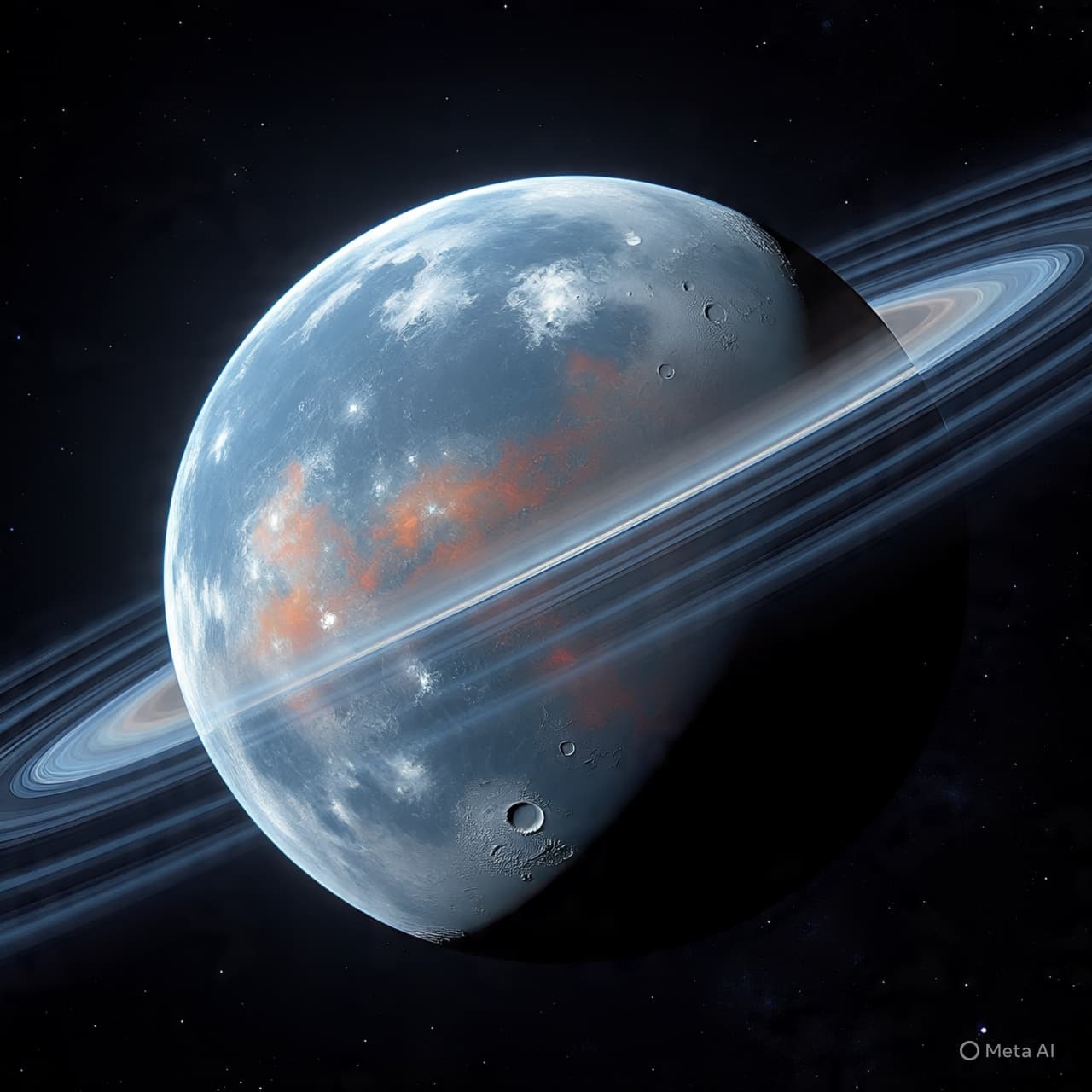
Far from the warmth of the Sun, beyond the orbits we casually trace in textbooks, there are worlds so small and so cold that they seem almost like afterthoughts in the grand design of the solar system. They drift in darkness, wrapped in ice, distant and quiet. Yet sometimes, in that silence, something unexpected hums — not visible to the eye, but alive in invisible frequencies.
Scientists have reported the discovery of a vast web of hidden electromagnetic waves surrounding a small icy moon, a finding that reshapes how researchers understand the interaction between frozen worlds and the space environments they inhabit. The discovery, supported by observations and modeling work associated with missions from NASA and the European Space Agency, suggests that even tiny celestial bodies can generate or influence complex electromagnetic activity.
Published in journals such as Nature Astronomy, the research describes how charged particles from a nearby planet’s magnetosphere interact with the icy moon’s surface and tenuous atmosphere. These interactions produce electromagnetic waves that ripple outward, forming a network that extends far beyond the moon itself. Though invisible, the waves can be detected by sensitive instruments aboard spacecraft, appearing as subtle variations in magnetic and plasma readings.
The moon at the center of the discovery is small in size but dynamic in effect. Its icy crust reflects sunlight faintly, yet beneath or around that surface, plasma interactions may be far more active than once assumed. Scientists believe that the electromagnetic web forms as energetic particles become trapped and guided along magnetic field lines, creating oscillations that propagate through surrounding space.
Such findings matter not simply for curiosity, but for context. Many icy worlds in the outer solar system — including moons orbiting gas giants — exist within powerful magnetic environments. Understanding how electromagnetic waves behave around them helps researchers refine models of subsurface oceans, surface chemistry, and even potential habitability. Waves can act as messengers, carrying clues about what lies beneath the ice.
Spacecraft instruments designed to study magnetospheres have become increasingly sophisticated. By measuring fluctuations in electric and magnetic fields, scientists can reconstruct the architecture of these invisible webs. What once appeared as noise in data is now recognized as structure — patterns shaped by physics, motion, and environment.
The discovery also underscores how even the smallest worlds are not isolated. In space, boundaries are porous. A moon’s surface, a planet’s magnetic field, and streams of solar particles all intersect, weaving together a system that is dynamic and interconnected. The icy world does not merely orbit; it participates.
Researchers caution that further study is needed to fully understand the scale and implications of the electromagnetic network. Future missions, equipped with advanced magnetometers and plasma detectors, may clarify how common such phenomena are across other small icy bodies.
For now, the findings add a new layer to our understanding of the outer solar system. A tiny ice world, once thought quiet and inert, is revealed to be surrounded by a complex and energetic structure. The discovery invites continued exploration, guided by instruments that can hear what human senses cannot.
AI Image Disclaimer Images in this article are AI-generated illustrations, meant for concept only.
Source Check
Credible mainstream and scientific sources covering this topic include:
NASA European Space Agency Nature Astronomy Science Space.com
Published by Banx Network. This article is part of the Banx decentralized media programme, powered by the BXE token on the XRP Ledger.