The Question That Has Followed Humanity
Are we alone?
It is one of the oldest questions humans have asked.
For most of history, there was no practical way to investigate it. The stars were distant points of light, and planets orbiting other stars had not even been confirmed.
That has changed dramatically.
Scientists have now confirmed more than 6,000 exoplanets — planets orbiting stars beyond our Sun — with thousands of additional candidates still awaiting confirmation. Some are roughly Earth-sized, while others orbit within regions where temperatures could potentially allow liquid water to exist.
The search for life has therefore moved from philosophy into observational science.
The question is no longer simply could life exist elsewhere?
It is increasingly becoming:
Where should we look, what should we look for, and how would we know if we found it?
Why Scientists Take the Possibility Seriously
There is an important distinction between saying that extraterrestrial life exists and saying that the universe contains environments where life might be possible.
Scientists have only one confirmed example of life: Earth.
That makes Earth our reference point.
Life as we know it requires complex chemistry and, for the organisms familiar to us, liquid water. But scientists increasingly recognise that environments very different from Earth's surface could potentially support biology.
This has dramatically expanded the number of places worth investigating.
Mars once had rivers, lakes and environments that were considerably wetter than the planet is today.
Europa appears to contain a huge ocean beneath its frozen surface.
Enceladus has an underground ocean and releases material into space through plumes.
Titan contains an extraordinarily rich organic chemistry.
And beyond the Solar System, thousands of planets provide an enormous laboratory for investigating how common potentially habitable worlds might be.
The universe may therefore contain vastly more opportunities for life than scientists once imagined.
The Exoplanet Revolution
Perhaps the biggest development in the search for extraterrestrial life has happened relatively quietly.
We discovered that planets are everywhere.
The first confirmed exoplanets were discovered in the 1990s. Just a few decades later, NASA's confirmed catalogue passed 6,000 planets.
That changes the mathematics of the question.
If planets were extremely rare, Earth could potentially be an extraordinary exception.
If planets are common, however, the question becomes much more interesting.
How many of those planets have conditions suitable for life?
How many actually developed life?
How many developed complex life?
And how many produced intelligent civilisations capable of communicating across interstellar distances?
We currently don't know.
But we now have enough worlds to start investigating the question scientifically.
What Makes a Planet Habitable?
The phrase habitable zone is often misunderstood.
It does not mean that a planet definitely contains life.
It generally refers to a region around a star where conditions could allow liquid water to exist on a planet's surface, assuming suitable atmospheric and planetary conditions.
But habitability is much more complicated than simply being the correct distance from a star.
Scientists also need to consider:
atmospheric composition planetary temperature pressure radiation geological activity chemical availability the presence of water the stability of the host star potential energy sources
A planet can sit inside the habitable zone and still be completely hostile to life.
Conversely, some environments outside traditional habitable zones could potentially support life beneath their surfaces.
That is why scientists are increasingly looking beyond simple Earth-like conditions.
Mars: Was There Ever Life on the Red Planet?
Mars remains one of humanity's most important targets.
Billions of years ago, Mars was significantly different from the cold, dry world we see today.
Ancient river valleys and lake environments provide evidence that liquid water once existed on the Martian surface.
NASA's Perseverance rover has been investigating Jezero Crater, an ancient environment where water once flowed.
And the search became considerably more interesting in 2025.
A rock sample collected by Perseverance from a formation known as Cheyava Falls — subsequently named Sapphire Canyon — was reported to contain potential biosignatures.
The discovery does not prove that life existed on Mars.
NASA emphasised that the minerals involved can potentially be produced through non-biological processes, meaning further evidence is required before scientists could conclude that the material has a biological origin.
That distinction is critical.
A potential biosignature is not the same thing as discovering life.
But it demonstrates exactly why scientists continue looking.
Mars may preserve evidence of an ancient biological world inside rocks that are billions of years old.
Europa: An Ocean Hidden Beneath Ice
Mars is not necessarily the most exciting place in our Solar System.
That title could belong to Europa.
Jupiter's moon Europa is covered by an icy shell, but strong evidence suggests that a vast liquid-water ocean exists beneath it.
NASA considers Europa one of the most promising environments in our Solar System for potentially supporting life.
The important point is that life does not necessarily need sunlight.
On Earth, ecosystems exist around deep-sea hydrothermal vents where organisms survive using chemical energy rather than direct sunlight.
If Europa possesses water, chemical ingredients and an accessible energy source, it could theoretically provide an environment in which microbial life survives beneath kilometres of ice.
That makes Europa one of the most important targets in planetary science.
Europa Clipper Is Coming
NASA's Europa Clipper mission launched in October 2024 and is travelling toward Jupiter.
The spacecraft is scheduled to arrive in 2030 and conduct dozens of close flybys of Europa. NASA currently plans approximately 49 dedicated flybys during the mission.
But there is an important misconception to avoid.
Europa Clipper is not directly designed to detect alien organisms.
Its primary objective is to determine whether Europa possesses environments beneath its surface that could support life.
That means the mission is effectively investigating the question:
Does Europa have the ingredients necessary for biology?
If the answer is yes, it could justify even more ambitious future missions designed specifically to search for life.
Enceladus: The Ocean That Comes to Us
Saturn's moon Enceladus presents another extraordinary opportunity.
Unlike Europa, where the ocean is hidden beneath a thick ice shell, Enceladus ejects material from its interior into space through enormous plumes.
That creates an extraordinary scientific advantage.
A future spacecraft may potentially be able to sample material originating from an underground ocean without having to drill through kilometres of ice.
If those plumes contain complex organic molecules, chemical energy sources or other potential biosignatures, scientists could investigate them directly.
In planetary exploration, that is an incredibly valuable situation.
The ocean is hidden.
But the ocean may be sending samples into space.
Titan: A Different Kind of Alien World
Then there is Titan.
Saturn's largest moon looks almost like an alien version of Earth.
It has a thick atmosphere, weather systems, rivers and lakes — although its surface liquids are primarily methane and ethane rather than water.
Titan is also rich in organic chemistry.
NASA's Dragonfly mission is being designed to explore the surface using a nuclear-powered rotorcraft capable of flying between different locations. The mission is currently scheduled to launch no earlier than 2028 and arrive at Titan in 2034.
Dragonfly is not simply an alien-life detector.
Instead, it will investigate Titan's chemistry and explore how far prebiotic chemistry — the chemistry that could precede biology — has developed.
That distinction makes Titan scientifically fascinating.
Scientists are not only asking:
Where does life exist?
They are also asking:
How does chemistry become biology in the first place?
The James Webb Space Telescope Changes the Game
The search does not require spacecraft to physically visit distant planets.
Sometimes scientists can study them from Earth.
The James Webb Space Telescope can analyse light passing through an exoplanet's atmosphere.
Different gases absorb different wavelengths of light.
By analysing that spectrum, scientists can determine which chemicals may be present in an atmosphere.
This creates a potential method for searching for biosignatures from worlds that are hundreds of light-years away.
NASA cautions that interpreting atmospheric chemistry is extremely difficult. A single molecule should not automatically be interpreted as evidence of life because non-biological processes can produce similar chemical signatures. Scientists need to understand the planet's environment, atmosphere and geological processes before making such a conclusion.
This is one of the biggest challenges in modern astrobiology.
Finding a strange chemical signature is relatively easy.
Proving that life produced it is much harder.
What Would Count as Evidence of Alien Life?
Scientists would need to be extremely careful.
Imagine a telescope detects methane, oxygen and another potentially interesting molecule in an exoplanet's atmosphere.
That would be exciting.
But it would not immediately mean:
Alien life discovered.
Scientists would need to investigate alternative explanations.
Could volcanic activity produce the chemicals?
Could radiation create them?
Could atmospheric reactions explain the observation?
Could geological processes mimic a biological signal?
The strongest discovery would therefore probably involve multiple independent lines of evidence.
For example:
Atmospheric chemistry + geological context + biological-style chemical processes + repeated observations
would be much more convincing than a single unexplained molecule.
Science has to resist the temptation to announce the extraordinary before the evidence is strong enough.
The Search for Intelligent Life
Microbial life is one possibility.
Intelligent civilisations are another.
This is where the search becomes even more ambitious.
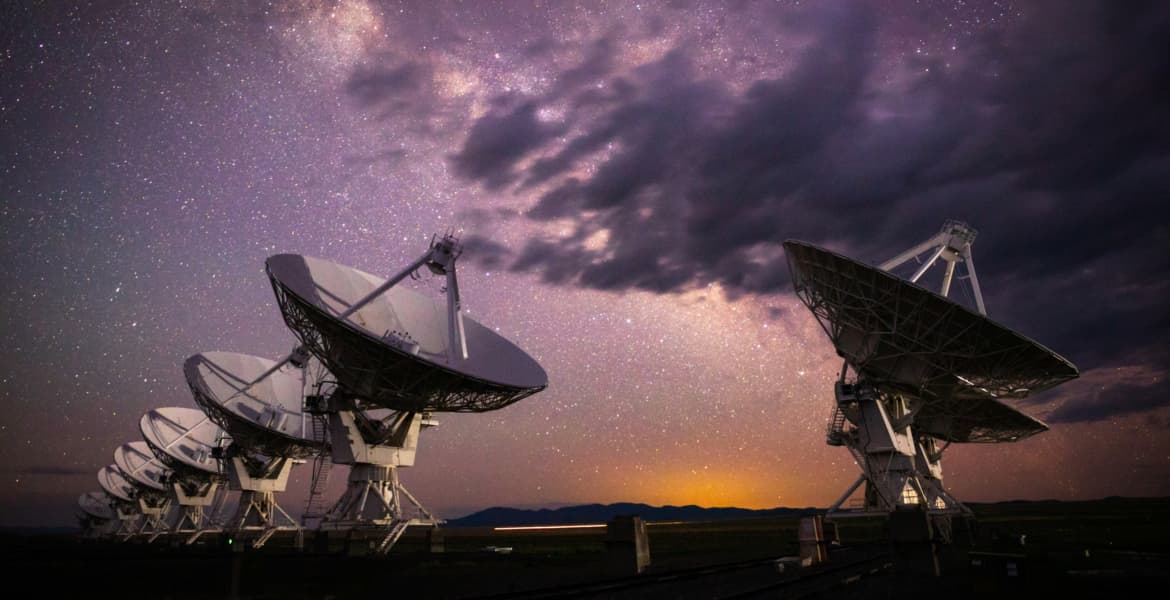
Projects such as Breakthrough Listen search for potential technological signatures — signals or phenomena that could indicate the presence of advanced civilisations.
Breakthrough Listen describes itself as one of the most comprehensive scientific searches for evidence of technological civilisations, surveying targets including nearby stars, the galactic plane and hundreds of nearby galaxies across radio and optical frequencies.
The search is based on a simple idea.
A technological civilisation might produce detectable evidence.
That evidence could potentially include:
radio transmissions unusual optical signals artificial atmospheric chemicals enormous energy structures other unexplained technological signatures
These are known broadly as technosignatures.
So far, no confirmed extraterrestrial technological signal has been detected.
But the search continues.
The Biggest Problem: Distance
Even if intelligent life exists elsewhere, the universe presents an enormous communication problem.
The Milky Way is roughly 100,000 light-years across.
That means a radio signal travelling at the speed of light would need approximately 100,000 years to cross the galaxy.
If another civilisation existed 1,000 light-years away and sent us a message today, we would not receive it for another millennium.
And if we replied immediately, another 1,000 years would pass before the response arrived.
The universe could therefore contain intelligent civilisations that are effectively invisible to one another because of the enormous distances involved.
The question isn't necessarily whether alien civilisations exist.
It could be whether their technological timelines overlap with ours.
What If We Find Microbial Life First?
This could actually be one of the most important discoveries imaginable.
Finding bacteria-like organisms on Mars or another world would prove something extraordinary:
Life is not unique to Earth.
That would immediately change our understanding of biology.
Scientists could compare alien organisms with terrestrial life.
If they shared fundamental biological characteristics, it could suggest that life follows similar chemical pathways throughout the universe.
But if alien organisms used completely different biological chemistry, the implications could be even greater.
It might suggest that life can emerge independently through multiple pathways.
That would dramatically increase the estimated number of potentially inhabited worlds.
What If Alien Life Looks Nothing Like Us?
This is one of the most fascinating possibilities.
Scientists naturally search for life based on what we understand from Earth.
But alien biology might not resemble plants, animals or bacteria.
It could potentially operate under radically different environmental conditions.
This creates a major scientific challenge.
How do you search for something when you don't know exactly what you're looking for?
Astrobiology therefore increasingly focuses on fundamental processes rather than appearances.
Scientists look for:
chemical complexity energy utilisation disequilibrium self-organising systems organic molecules atmospheric signatures patterns difficult to explain through geology alone
The search is gradually becoming less about finding an alien version of Earth and more about identifying the fundamental fingerprints of biology.
The Economic Impact Could Be Enormous
The discovery of extraterrestrial life would not simply be a scientific story.
It could become an economic event.
A confirmed detection could dramatically increase investment in:
space exploration planetary science biotechnology robotics artificial intelligence advanced telescopes communications infrastructure commercial launch systems deep-space missions
Entire industries could emerge around the desire to study another living world.
The commercial space industry could receive another major catalyst.
Governments might increase spending on space science.
Universities could see enormous demand for astrobiology, planetary science and related fields.
And private companies could begin developing technologies specifically designed for biological detection beyond Earth.
The discovery of life could therefore create an entirely new economic category:
the extraterrestrial science economy.
The 2035–2050 Window
The next few decades could be particularly important.
During the 2030s, NASA's Europa Clipper and ESA's JUICE mission will dramatically expand our understanding of Jupiter's ocean-bearing moons. ESA's JUICE spacecraft is scheduled to reach Jupiter in 2031 and investigate Ganymede, Europa and Callisto.
NASA's Dragonfly mission is expected to reach Titan in 2034 if its current schedule holds.
At the same time, increasingly powerful observatories will study exoplanet atmospheres.
Mars exploration will continue investigating ancient environments and potential biosignatures.
And the search for technological signals will become increasingly sophisticated.
This creates an extraordinary possibility.
Between roughly 2035 and 2050, humanity could move from asking whether extraterrestrial life is possible to having much stronger evidence about whether biology exists elsewhere.
That does not guarantee a discovery.
But the tools are becoming substantially better.
Three Possible Futures
There are several realistic outcomes.
1. We Find Nothing
This would not necessarily mean Earth is unique.
It could simply mean life is rare, difficult to detect or separated from us by enormous distances.
2. We Find Microbial Life
This may be the most scientifically plausible first discovery.
Finding independent microbial life on Mars, Europa, Enceladus or another world would fundamentally change biology.
3. We Detect Intelligent Life
This would be the most dramatic possibility.
A confirmed technological signal from another civilisation would immediately become one of the most important discoveries in human history.
It would demonstrate that intelligence capable of producing technology has emerged somewhere else in the universe.
The consequences would extend far beyond science.
Religion, philosophy, politics, economics and humanity's understanding of itself would all be forced to confront the same fact:
We are not alone.
What Happens After Discovery?
The first response would probably be scientific verification.
Researchers around the world would attempt to independently reproduce the observation.
Governments would become involved.
International organisations could establish protocols for communication and information sharing.
The public response would be enormous.
Financial markets could react.
Space companies could attract new investment.
Governments could increase space budgets.
Universities could redirect research programmes.
And humanity would face an entirely new philosophical question.
If another civilisation exists, what does that make us?
For thousands of years, humans have viewed Earth as the centre of our known existence.
A confirmed extraterrestrial civilisation would permanently change that perspective.
The Most Important Discovery May Not Be Aliens
There is an even deeper possibility.
The search for extraterrestrial life could teach us more about Earth.
By studying Mars, Europa, Titan and distant exoplanets, scientists are also learning about the conditions that allowed life to emerge here.
Every failed search eliminates possibilities.
Every unusual chemical signature creates a new question.
Every new planet gives scientists another comparison.
Every spacecraft expands our understanding of how worlds evolve.
In that sense, the search for alien life is also a search for our own origins.
Are We Alone?
Right now, the scientifically honest answer is:
We don't know.
There is no confirmed evidence of extraterrestrial life.
But the question is becoming increasingly testable.
We now know that planets are common.
We know that potentially habitable environments exist beyond Earth.
We have spacecraft travelling toward ocean worlds.
We have rovers investigating ancient Martian environments.
We have telescopes capable of studying distant atmospheres.
And we have dedicated scientific programmes searching for signs of technological civilisations.
Humanity has entered a remarkable period.
For the first time in history, we possess the technology to seriously investigate whether life exists beyond Earth.
The answer could arrive tomorrow.
It could take decades.
Or we could spend centuries searching without finding anything.
But every generation of telescopes and spacecraft brings us closer to answering one of humanity's oldest questions.
Are we alone?
The universe is enormous.
And for the first time, humanity is beginning to look back.
References
[1] NASA Science — 30 Years of Exoplanets — confirmation of more than 6,000 exoplanets.
[2] NASA Science — Are We Alone? Searching for Life Beyond Earth.
[3] NASA Science — Can We Find Life? — biosignatures, technosignatures and methods for detecting life.
[4] NASA — NASA's Search for Life: Astrobiology in the Solar System and Beyond.
[5] NASA Science — Europa Clipper — mission objectives and Europa's potential habitability.
[6] NASA — NASA Says Mars Rover Discovered Potential Biosignature Last Year.
[7] NASA Science — Mars 2020: Perseverance Rover.
[8] NASA Science — Dragonfly.
[9] NASA — NASA Dragonfly Mission Begins Rotorcraft Integration, Testing Stage.
[10] ESA — JUICE Factsheet.
[11] NASA Science — How NASA's Webb Telescope Supports Our Search for Life Beyond Earth.
[12] Breakthrough Initiatives — Breakthrough Listen.
Published by Banx Network. This article is part of the Banx decentralized media programme, powered by the BXE token on the XRP Ledger.