

Key Highlights
- New simulations indicate early galaxies may have formed in colder environments.
- Dust plays a crucial role in cooling gas clouds for star formation.
- Findings challenge previous assumptions about the nature of early galaxies.
[Understanding the New Findings] The universe has long been imagined as a place born in fire—brilliant, violent, and impossibly hot. In that early narrative, galaxies ignited like cosmic furnaces, blazing into existence amid turbulent energy. Yet new simulations now suggest a quieter beginning, one that feels less like an explosion and more like a slow breath in the cold.
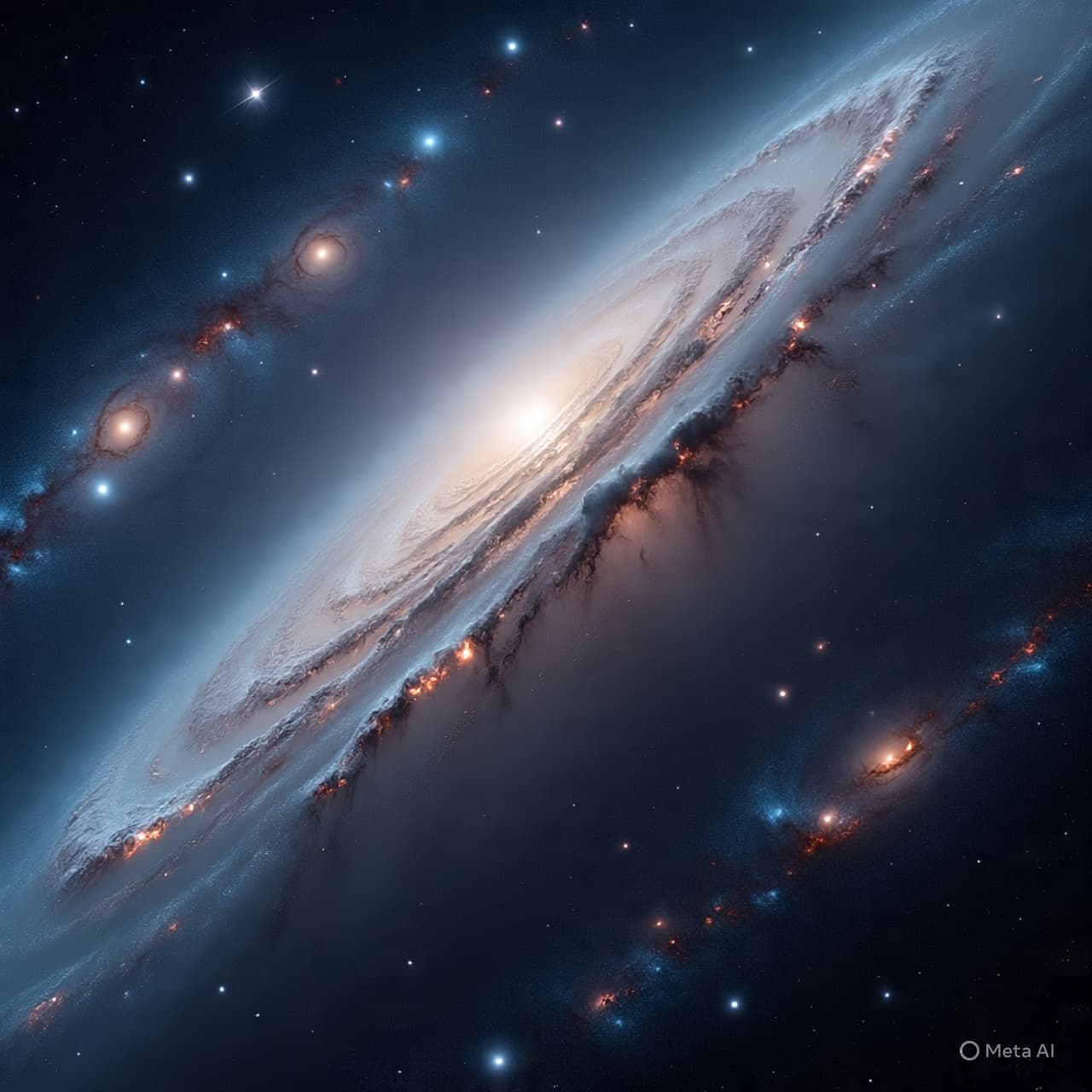
Recent computational models developed by astrophysicists are reshaping how scientists understand the earliest galaxies. Instead of forming in intensely hot, chaotic environments, these simulations indicate that some galaxies may have emerged in colder, dust-rich regions. These environments, though less dramatic, may have provided the right conditions for stars to form more gradually.
Dust, often treated as a secondary element in cosmic evolution, now appears to play a more central role. In these simulations, dust particles help cool surrounding gas clouds, allowing them to collapse under gravity without being disrupted by extreme heat. This cooling effect creates pockets where star formation can proceed in a more stable and sustained way.
[Challenging Previous Assumptions] The findings challenge earlier assumptions rooted in observations of bright, energetic galaxies. Those luminous systems, while easier to detect, may not represent the full diversity of early galactic life. Instead, colder and dimmer galaxies could have been far more common, quietly shaping the structure of the universe in ways only now becoming visible through advanced modeling.
These simulations rely on increasingly sophisticated computing techniques, capable of recreating conditions from billions of years ago. By integrating physics, chemistry, and gravitational dynamics, researchers can test scenarios that are otherwise impossible to observe directly. In this case, the results suggest that the early universe may have been more varied—and more subtle—than once believed.
[Observational Astronomy and Future Implications] Observational astronomy is beginning to catch up with these theoretical insights. Instruments like the James Webb Space Telescope have already detected galaxies that appear surprisingly mature and dusty for their age. These discoveries align with the idea that dust-rich environments were present earlier than previously assumed.
If confirmed, this shift in understanding could reshape timelines of cosmic evolution. It suggests that star formation and galaxy development may have begun under a wider range of conditions, not limited to extreme heat. The universe, in its infancy, may have contained both blazing and quiet regions—each contributing differently to its growth.
For scientists, the implications extend beyond astronomy. Understanding how galaxies form influences theories about dark matter, chemical evolution, and even the distribution of planets. A colder origin story introduces new variables into these interconnected systems.
As research continues, astronomers will look for observational evidence to support these simulations. Future missions and deeper surveys may reveal more of these faint, dusty galaxies, helping to confirm whether this quieter cosmic narrative holds true.
In the end, the universe may not rewrite its story entirely, but it seems to be adding new chapters—ones where creation happens not only in fire, but also in the gentle hush of cold and dust.
Published by Banx Network. This article is part of the Banx decentralized media programme, powered by the BXE token on the XRP Ledger.




